
TDS on Property Purchase From Non-Resident Seller: New Schedule E in Form 141 From 1 October 2026
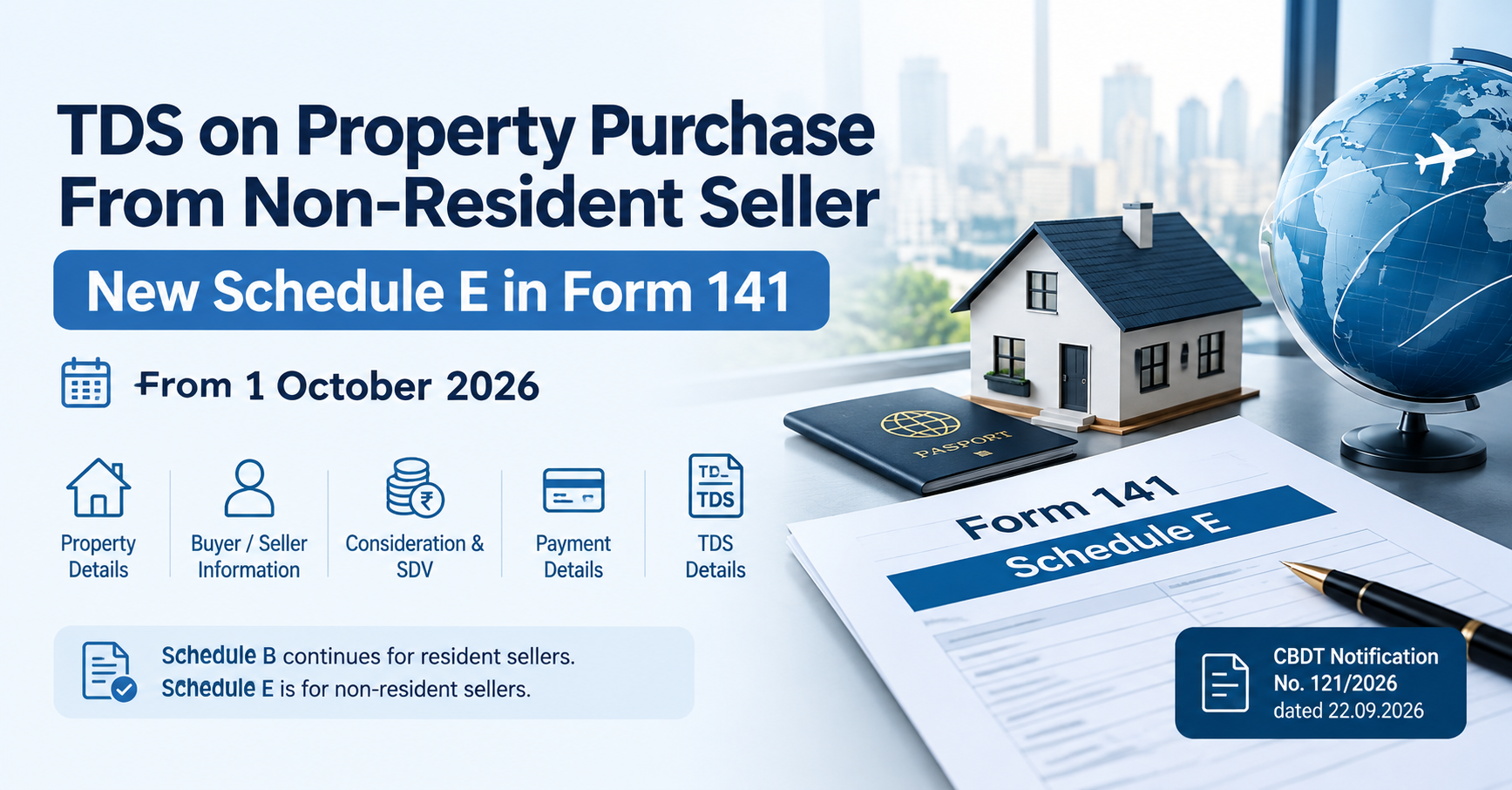
Tax deducted at source (TDS) compliance for immovable property transactions is changing from 1 October 2026. Resident Individuals and Hindu Undivided Families (HUFs) purchasing immovable property from non-resident sellers will have to report the applicable TDS details through the newly introduced Schedule E of Form 141.
If you are searching in Ghaziabad, Noida, Delhi NCR and nearby areas for an Income tax consultant near me or tax consultant near me for assistance with a property purchase involving a non-resident seller, understanding the new reporting requirement is important before completing the transaction.
The new requirement does not replace the existing reporting mechanism for transactions involving resident sellers. Schedule B will continue to apply to the applicable transfer of immovable property involving resident sellers, while Schedule E has been introduced specifically for the covered non-resident property transactions.
Latest Update: Schedule E Introduced From 1 October 2026
CBDT issued Notification No. 121/2026 dated 22 September 2026, introducing amendments to the Income-tax Rules, 2026. The notification states that the amendments will come into force from 1 October 2026.
The amendment specifically adds reporting for a transfer of immovable property by a non-resident to a resident Individual or HUF. Form 141 has also been expanded to include Schedule E, covering TDS on consideration for transfer of immovable property covered under section 393(2), Table Serial No. 17.
The Income Tax Department has also announced that Notification No. 121/2026 extends TDS reporting requirements for non-resident property transactions and updates Forms 132 and 141.
Legal Reference
Section: Section 393(2) of the Income-tax Act, 2025, read with the applicable Table Serial No. 17.
Rules: Income-tax Rules, 2026, including amendments to Rules 215, 218 and 219 and the relevant provisions of Appendix III.
Notification: CBDT Notification No. 121/2026 dated 22 September 2026 — Income-tax (Fifth Amendment) Rules, 2026.
Official Source: CBDT Notification No. 121/2026 — Official PDF
Income Tax Department latest update: Income Tax Department — Latest News
Legal Position
From 1 October 2026, resident Individuals/HUFs purchasing immovable property from non-resident sellers must report TDS details through the new Schedule E of Form 141.
Schedule B will continue for resident sellers. Schedule E requires property, buyer/seller, consideration, Stamp Duty Value (SDV), payment and TDS details, including prescribed overseas identification details of non-resident sellers.
The amendment applies to a transaction where a resident Individual or HUF is required to deduct tax at source on consideration for the transfer of immovable property covered under section 393(2), Table Serial No. 17.
Schedule E requires details relating to the property, including its address and type. The prescribed property categories include land other than agricultural land, a building or part of a building, or both.
Details of all buyers are required, including PAN, name and the proportion of the total sale consideration to be paid or credited by each buyer.
Details of all sellers/deductees are also required. For a non-resident seller, the prescribed information includes PAN, where available, name, status, contact number, email ID, address in the country or specified territory outside India where the seller is resident, Tax Residency Certificate number and Tax Identification Number. The proportion of total sale consideration to be received or credited by each seller is also required.
Where PAN of the non-resident is not available, the prescribed overseas identification details are required in accordance with the applicable rules for ensuring that tax is not deducted at the higher rate.
Schedule E also captures the date of agreement, date of registration where available, total Stamp Duty Value, total sale consideration and whether payment is being made in lump sum or instalments.
For instalment-based payments, the form requires identification of whether the payment is the first, subsequent or last instalment. In applicable cases, the previous acknowledgement number and total consideration paid or credited up to the last instalment are also required.
The transaction details include the seller's PAN and name, applicable taxation-regime information, type of capital gains, proportionate Stamp Duty Value, amounts paid or credited in previous instalments, current payment, date of credit or payment, amount on which tax is liable to be deducted, applicable TDS rate, relevant certificate numbers where applicable, amount of TDS and date of deduction.
Where more than one deductor is involved, each deductor has to file a separate form. Some information may be pre-filled to the extent possible, and amounts are generally required to be reported in rupees unless otherwise provided.
What Does the New Requirement Mean in Practice?
The key change is not merely a change in the name of a form. The new Schedule E creates a more detailed reporting framework for property transactions involving a non-resident seller and a resident Individual/HUF buyer.
For example, suppose a resident HUF purchases a residential property from a seller who is resident outside India. From 1 October 2026, the buyer should consider the Schedule E requirements while arranging the TDS compliance for the transaction.
The buyer may need information from the seller that was not previously part of a straightforward resident-seller property transaction, particularly overseas identification and residency-related information.
Schedule B vs Schedule E
|
Particular |
Schedule B |
Schedule E |
|
Property transaction |
Applicable covered property transaction |
Covered property transfer involving non-resident seller |
|
Buyer category |
As prescribed for the relevant transaction |
Resident Individual/HUF |
|
Seller |
Resident seller |
Non-resident seller |
|
Property details |
Reported as prescribed |
Detailed property information required |
|
Seller overseas details |
Generally not applicable |
Prescribed overseas identification details required |
|
Payment details |
Reported as applicable |
Lump-sum/instalment details specifically captured |
|
TDS details |
Reported as applicable |
Detailed TDS transaction information required |
The important practical distinction is therefore the residential status of the seller and the corresponding reporting schedule.
Information Buyers Should Keep Ready
Before filing the relevant TDS statement, a buyer should coordinate the required information and documents. Depending on the transaction, this can include:
- Property address and type.
- PAN and names of all buyers.
- Share of consideration attributable to each buyer.
- PAN and identity details of the seller, where available.
- Seller's overseas residential address.
- Seller's contact number and email ID.
- Tax Residency Certificate details, where applicable.
- Tax Identification Number of the seller in the relevant foreign jurisdiction.
- Agreement date and registration date, where available.
- Total Stamp Duty Value.
- Total sale consideration.
- Details of previous and current instalments.
- Date and amount of each payment or credit.
- Amount on which TDS is applicable.
- Applicable TDS rate and TDS amount.
- Relevant certificates, where obtained.
This information should ideally be collected before the payment or credit event so that the TDS reporting process does not become a last-minute exercise.
Step-by-Step Compliance Process
Step 1: Identify the seller's residential status.
First determine whether the seller is a resident or non-resident for the relevant tax purpose.
Step 2: Identify the buyer category.
The new Schedule E requirement is relevant to covered transactions where the buyer is a resident Individual or HUF.
Step 3: Collect property details.
Keep the property address, property type, agreement information, registration information and Stamp Duty Value available.
Step 4: Collect seller information.
For a non-resident seller, obtain the required overseas address, Tax Residency Certificate information and Tax Identification Number, along with other prescribed details.
Step 5: Calculate and deduct applicable TDS.
Determine the amount on which tax is required to be deducted and the applicable rate under the relevant provisions.
Step 6: Report through the appropriate schedule.
For the covered non-resident property transaction, use Schedule E of Form 141 from 1 October 2026. Resident-seller transactions continue under the applicable existing schedule.
Step 7: Maintain supporting records.
Keep the agreement, payment records, seller information, TDS workings and acknowledgement details safely for future reference.
Frequently Asked Questions
1. When does Schedule E of Form 141 become applicable?
Schedule E becomes applicable from 1 October 2026 for the covered TDS reporting requirements relating to transfer of immovable property by a non-resident to a resident Individual or HUF.
2. Does Schedule E apply to property purchased from every seller?
No. The new reporting requirement specifically addresses covered transactions involving a non-resident seller and a resident Individual or HUF buyer. Schedule B continues for the applicable transactions involving resident sellers.
3. What information is required about a non-resident seller?
The prescribed information can include PAN, if available, name, status, contact number, email ID, overseas residential address, Tax Residency Certificate number and Tax Identification Number.
4. What if the non-resident seller does not have PAN?
The notification provides for specified overseas identification details to be furnished where PAN is unavailable, in accordance with the applicable rules. These details are relevant for ensuring that tax is not deducted at the higher rate where the prescribed conditions are met.
5. Does Schedule E require Stamp Duty Value?
Yes. Schedule E requires the total Stamp Duty Value of the property and also captures the proportionate Stamp Duty Value in the transaction details for the relevant seller.
6. Does Schedule E apply where the property payment is made in instalments?
Yes. Schedule E specifically captures whether payment is made in lump sum or instalments and provides fields for first, subsequent and last instalments.
7. What if there is more than one deductor?
The notification provides that where there is more than one deductor, each deductor has to file a separate form.
8. Should buyers wait until the payment date to collect seller information?
It is better to collect the prescribed seller and transaction information in advance. This can reduce errors and help ensure that the TDS reporting form is completed correctly.
Local Compliance Support
If you are purchasing property in Ghaziabad, Noida, Delhi NCR or nearby areas from a non-resident seller, the documentation involved in the transaction may require coordination between the buyer, seller, property professionals and tax adviser.
For taxpayers searching for Income tax services near me, Tax consultant near me, or Income tax consultant near me, professional assistance can be useful where the transaction involves multiple buyers, multiple sellers, instalment payments or overseas seller documentation.
Businesses and individuals may also separately search for GST consultant near me, GST services near me, Company registration consultant near me, Company registration services near me, Trade Mark consultant near me, Trade Mark services near me, logo registration consultant near me, or logo registration services near me when seeking broader tax and compliance assistance.
Conclusion
The introduction of Schedule E represents an important reporting change for resident Individuals and HUFs purchasing immovable property from non-resident sellers. From 1 October 2026, buyers should pay particular attention to the seller's residential status, overseas identification details, property information, consideration, Stamp Duty Value, payment schedule and TDS particulars.
The safest approach is to identify the applicable reporting schedule before the transaction and collect the required information from all parties in advance. This becomes especially important where the seller does not have PAN, the consideration is paid in instalments, or multiple buyers or sellers are involved.
For expert guidance on this topic, contact your tax professional today.
Disclaimer: This content is for educational and knowledge purposes only. For verification and applicability to your case, please consult your tax professional.
Have Questions? We're Here to Help
Get expert advice from AMIT SIDDHI AND ASSOCIATES. Reach out to discuss your requirements.