
CBDT Removes Arrest and Detention from Rule 225: What Taxpayers Need to Know
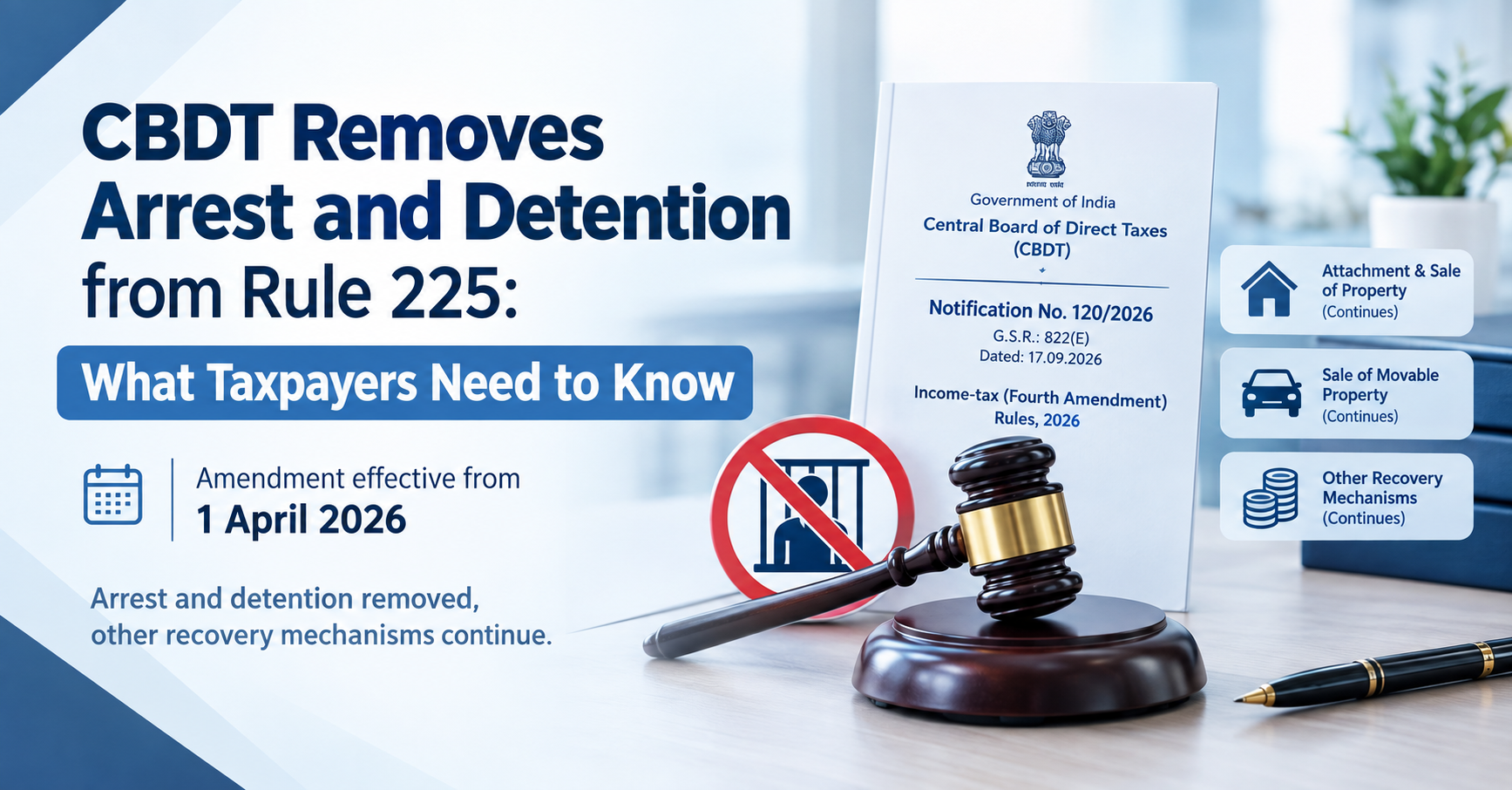
Tax recovery is an important part of the income-tax administration system, particularly when outstanding tax demands remain unpaid. The Income-tax Rules, 2026 have now been amended to remove specified provisions relating to arrest and detention in prison as a mode of recovery of tax arrears.
If you are searching in Ghaziabad, Noida, Delhi NCR, or nearby areas for a tax consultant near me or an Income tax consultant near me, it is important to understand that removal of arrest and detention does not mean that outstanding tax demands are automatically cancelled. Other statutory recovery mechanisms, including attachment and sale of movable or immovable property, continue to apply.
Latest Update: CBDT Notification No. 120/2026
The Central Board of Direct Taxes (CBDT) issued Notification No. 120/2026 dated 17 September 2026, bearing G.S.R. 822(E), introducing the Income-tax (Fourth Amendment) Rules, 2026.
The amendment specifically modifies Rule 225 of the Income-tax Rules, 2026. Under the notification, specified amendments relating to Rule 225 are deemed to have come into force from 1 April 2026. The notification also makes other amendments to the Income-tax Rules, including changes to Rules 160 and 176.
The important point for taxpayers is that the provisions relating to arrest and detention as a recovery mechanism have been removed from Rule 225. However, other recovery measures continue to operate.
Legal Reference
Section: Section 533 of the Income-tax Act, 2025, read with Sections 262, 273, 413, 514 and 515.
Rule: Rule 225 of the Income-tax Rules, 2026.
Notification: CBDT Notification No. 120/2026 dated 17 September 2026.
Gazette Reference: G.S.R. 822(E).
Amendment Rules: Income-tax (Fourth Amendment) Rules, 2026.
Effective date: The amendments covered by rules 2 to 4 of the notification are deemed to have come into force from 1 April 2026.
Official notification reference: The notification was issued by the Central Board of Direct Taxes, Department of Revenue, Ministry of Finance, Government of India. The published notification identifies it as G.S.R. 822(E), dated 17 September 2026.
Legal Position
The CBDT has amended Rule 225 of the Income-tax Rules, 2026 through the Income-tax (Fourth Amendment) Rules, 2026.
Under the amendment, in Rule 225, sub-rule (4), clause (c) has been omitted. In sub-rule (19), the words relating to “or to arrest” have been modified. Further, sub-rules (75), (76), (77), (78), (79), (80), (81), (82), (83) and (91) have been omitted.
The amendment also removes the words “except arrest and detention” from sub-rule (87). These changes collectively remove the provisions dealing with arrest and detention as a mode of recovery under Rule 225.
The notification states that rules 2 to 4 of the Income-tax (Fourth Amendment) Rules, 2026 shall be deemed to have come into force on 1 April 2026. Rule 225 is covered by rule 4 of the amendment notification.
The amendment does not eliminate tax recovery proceedings altogether. Other available recovery mechanisms continue to apply, including recovery through attachment and sale of movable or immovable property.
Therefore, taxpayers should distinguish between removal of a particular recovery mechanism and removal of the underlying tax liability. The amendment concerns the recovery procedure; it does not by itself cancel outstanding tax arrears.
What Has Changed Under Rule 225?
The key change can be understood as follows:
|
Particular |
Position after amendment |
|
Tax arrears |
Outstanding tax liability can continue to remain payable |
|
Arrest as a recovery mechanism under the removed provisions |
Removed |
|
Detention in prison under the removed provisions |
Removed |
|
Attachment of property |
Continues to apply |
|
Sale of movable or immovable property |
Continues to apply |
|
Other applicable recovery mechanisms |
Continue subject to the law |
The practical significance is that taxpayers should not interpret the amendment as a general exemption from tax recovery. Instead, the specified arrest and detention provisions have been removed from the recovery framework.
Practical Explanation for Taxpayers
Suppose a taxpayer has an outstanding income-tax demand and does not pay it within the applicable period. The tax authority may still take steps available under the applicable recovery provisions.
For example, removal of arrest and detention does not mean that a taxpayer can simply ignore a tax demand. Depending on the circumstances and applicable provisions, recovery can continue through mechanisms involving property.
Example 1: Outstanding tax demand
A business receives a final tax demand and the amount remains unpaid. The taxpayer should first examine whether the demand is correct, whether any rectification or appeal is available, and whether payment or other statutory action is required.
The removal of arrest and detention provisions does not automatically extinguish the demand.
Example 2: Property-based recovery
If an outstanding demand remains recoverable, the applicable recovery mechanism may involve attachment and sale of movable or immovable property.
This makes it important for taxpayers to respond to tax notices and outstanding demands within the prescribed framework rather than assuming that the Rule 225 amendment removes all consequences of non-payment.
Example 3: Business compliance
Businesses should also maintain proper records of tax payments, demands, notices, appeals and recovery-related communications. A structured tax compliance process can help identify disputed demands and prevent avoidable complications.
Does the Amendment Cancel Existing Tax Arrears?
No. The amendment should not be interpreted as cancellation of tax arrears.
The notification changes specified provisions in Rule 225 concerning recovery by arrest and detention. Other recovery mechanisms continue to apply.
Accordingly, taxpayers with outstanding demands should check the status of the demand and determine whether it is payable, disputed, under appeal, or eligible for another statutory remedy.
Compliance Process for Taxpayers
Taxpayers dealing with an outstanding income-tax demand can follow a practical process:
Step 1: Check the demand
Review the outstanding tax demand and identify the relevant assessment year, order, amount and reason for the demand.
Step 2: Verify the records
Compare the demand with tax returns, tax payments, TDS/TCS information, challans and other relevant records.
Step 3: Identify whether the demand is disputed
If the demand is incorrect, determine whether rectification, appeal or another statutory remedy is available.
Step 4: Do not ignore recovery communications
Any recovery notice or communication should be reviewed promptly. Removal of arrest and detention does not mean that recovery proceedings have disappeared.
Step 5: Obtain professional advice where required
Businesses and individuals with substantial or complicated outstanding demands may need professional assistance to understand their options and comply with applicable procedures.
Step 6: Maintain documentation
Keep copies of notices, replies, orders, payment records and other relevant correspondence. Proper documentation can be particularly important where the demand is disputed.
What This Means for Businesses
For businesses, the amendment provides an important clarification regarding the recovery framework under Rule 225. However, tax compliance remains essential.
Companies, LLPs, firms, professionals and other taxpayers should continue to monitor their income-tax accounts and outstanding demands. A business should not treat the removal of arrest and detention as a reason to postpone tax compliance.
For taxpayers in Ghaziabad, Vaishali, Indirapuram, Vasundhra, Noida and Delhi NCR, professional assistance can be useful where an outstanding demand involves multiple assessment years, disputed additions, tax payments or recovery proceedings.
Businesses looking for Income tax services near me, GST services near me, or Company registration services near me may also benefit from maintaining a coordinated compliance system covering direct and indirect tax obligations.
Frequently Asked Questions
1. Has CBDT removed arrest and detention from Rule 225?
Yes. CBDT Notification No. 120/2026 amends Rule 225 and removes the specified provisions relating to arrest and detention as a mode of recovery.
2. From which date are the Rule 225 amendments effective?
The notification provides that rules 2 to 4 of the Income-tax (Fourth Amendment) Rules, 2026 are deemed to have come into force from 1 April 2026. Rule 225 is amended under rule 4 of the notification.
3. Does the amendment cancel outstanding income-tax dues?
No. Removal of the specified arrest and detention provisions does not by itself cancel outstanding tax liabilities.
4. Can tax authorities still recover tax arrears?
Yes. Other recovery mechanisms continue to apply. These include mechanisms involving attachment and sale of movable or immovable property.
5. Which notification amended Rule 225?
Rule 225 was amended through CBDT Notification No. 120/2026 dated 17 September 2026, G.S.R. 822(E), titled the Income-tax (Fourth Amendment) Rules, 2026.
6. Should taxpayers ignore outstanding tax demands after this amendment?
No. Taxpayers should continue to verify and respond to outstanding demands and recovery communications. The amendment changes specified recovery provisions; it does not provide a general waiver of tax arrears.
7. Can a tax professional help with an outstanding demand?
Yes. A tax professional can help review the demand, supporting records, payment history and available statutory options. Taxpayers searching for a Tax consultant near me or Income tax consultant near me in Ghaziabad, Noida or Delhi NCR can seek professional assistance based on their specific circumstances.
Conclusion
The amendment to Rule 225 through the Income-tax (Fourth Amendment) Rules, 2026 represents a significant change in the specified recovery framework by removing provisions relating to arrest and detention in prison.
At the same time, taxpayers should clearly understand that removal of these provisions does not mean that income-tax arrears disappear. Other recovery mechanisms, including attachment and sale of movable or immovable property, continue to apply.
The practical approach for taxpayers is therefore to monitor outstanding demands, verify tax records, respond to notices and seek professional guidance where the demand is disputed or recovery proceedings have commenced.
Whether you need Income tax services near me, GST consultant near me, Company registration consultant near me, Trade Mark consultant near me, or logo registration consultant near me, professional advice should be based on the specific nature of your compliance requirement.
For taxpayers and businesses in Ghaziabad (201010), Noida, Delhi NCR and nearby areas, timely professional review can help ensure that outstanding tax matters are addressed through the appropriate statutory process.
For expert guidance on this topic, contact your tax professional today.
This content is for educational and knowledge purposes only. For verification and applicability to your case, please consult your tax professional.
Have Questions? We're Here to Help
Get expert advice from AMIT SIDDHI AND ASSOCIATES. Reach out to discuss your requirements.