
RBI Clarifies NBFC Principal Business Rules: What Companies and CICs Need to Know
The Reserve Bank of India’s clarification on the principal-business test for NBFCs has renewed attention on companies involved in lending, investments, group financing and holding-company activities.
If you are looking for a Tax consultant near me, Income tax consultant near me, or professional compliance guidance in Ghaziabad, Noida, Delhi NCR and nearby areas, understanding the RBI framework can help companies assess whether their activities may fall within the NBFC or CIC regulatory framework.
Legal Reference
The relevant regulatory framework includes the RBI’s principal-business test for NBFCs, the Core Investment Company framework, applicable NBFC regulatory provisions and the RBI FAQ explaining the 50:50 test and CIC conditions.
Official RBI source links:
https://www.rbi.org.in/nbfcfaqs
https://www.rbi.org.in/commonperson/english/scripts/FAQs.aspx?Id=1167
Latest Update
The recent RBI clarification has attracted attention in the context of Tata Sons and its reported regulatory status as a Core Investment Company. Reports indicate that RBI rejected Tata Sons’ request to voluntarily surrender its Certificate of Registration as a CIC.
The verified material does not identify a specific date for the clarification itself. The important point is that RBI’s position relates to an existing regulatory framework rather than introducing a completely new 50:50 test.
RBI’s FAQ states that the principal-business test originated through the RBI press release dated April 8, 1999, because “principal business” was not specifically defined in the RBI Act, 1934.
Legal Position
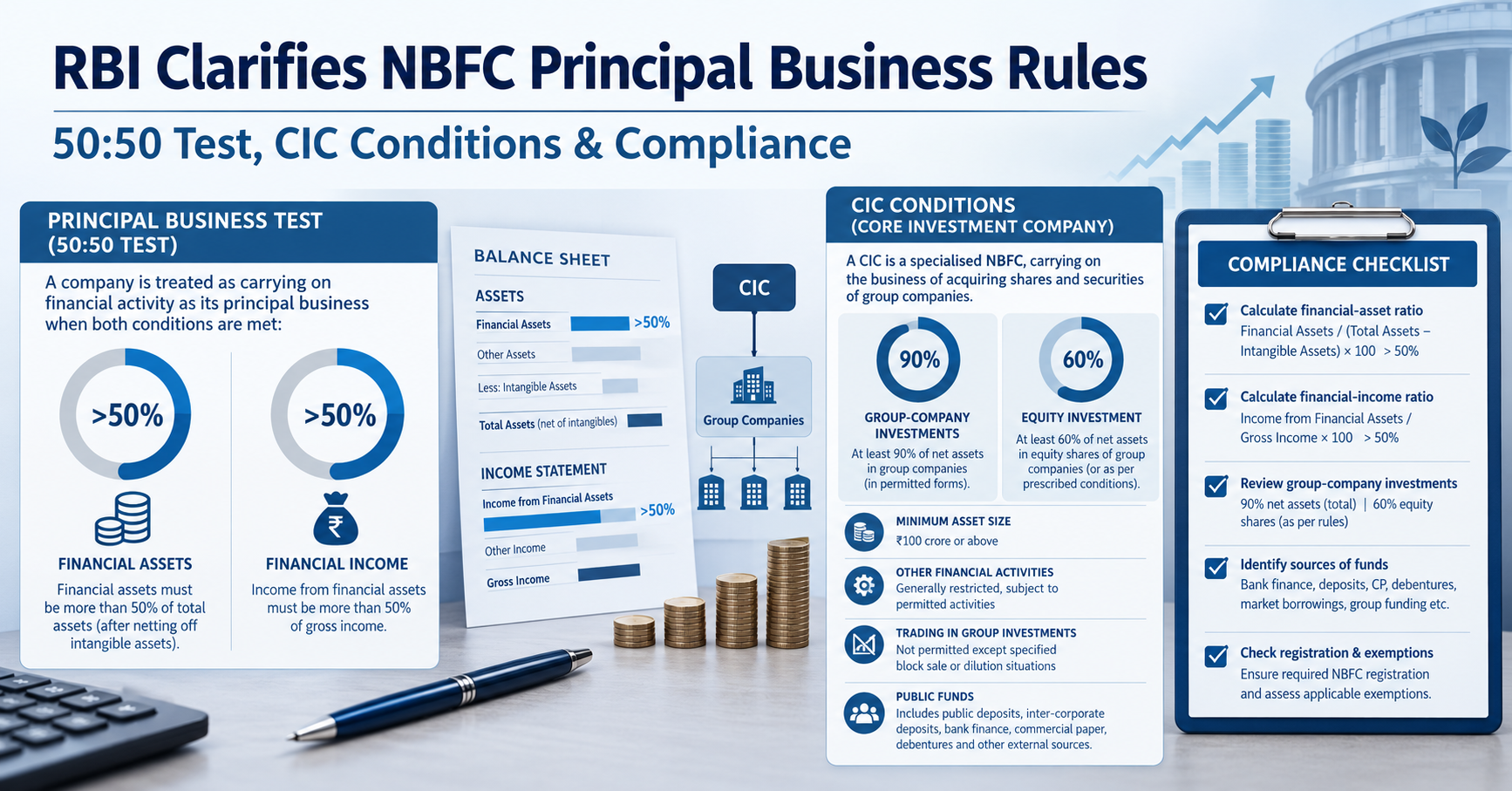
A company is generally treated as carrying on financial activity as its principal business when it satisfies both limbs of RBI’s popularly known 50:50 test. First, financial assets must constitute more than 50% of total assets after netting off intangible assets. Second, income from financial assets must constitute more than 50% of gross income. Both conditions must be satisfied. Meeting only one threshold does not, by itself, establish that financial activity is the company’s principal business.
A company satisfying both criteria is required to obtain registration as an NBFC, subject to applicable exemptions and the wider regulatory framework.
The purpose of the test is to distinguish predominantly financial companies from ordinary commercial or industrial companies that undertake limited financial activities. For example, a manufacturing company may invest surplus funds in securities or provide occasional loans to group entities. Such incidental activities would not ordinarily make financial activity its principal business if its primary business remains manufacturing and it does not satisfy both limbs of the test.
In contrast, a company whose balance sheet is predominantly composed of loans, investments or other financial assets and whose major income arises from those assets may come within the NBFC regulatory framework. The assessment therefore focuses on the company’s actual assets and income rather than simply its name, objects clause or corporate structure.
The financial-asset component generally covers loans and advances, investments in shares and securities, bonds, debentures and similar financial instruments. The comparison is made with total assets after netting off intangible assets.
The income test considers whether more than 50% of gross income arises from financial assets. Depending on the facts, this can include interest income, dividend income, income from loans or advances, investment and securities income and other income attributable to financial assets. Companies should maintain clear working papers supporting the classification of assets and income, particularly where group investments generate dividend, interest, guarantee commission or other investment-related income.
CIC Conditions
A Core Investment Company (CIC) is a specialised category of NBFC carrying on the business of acquiring shares and securities of group companies. A company cannot avoid the CIC framework merely by describing itself as a passive holding company.
Among the principal CIC conditions are:
|
Requirement |
Condition |
|
Investments in group companies |
At least 90% of net assets |
|
Equity investment in group companies |
At least 60% of net assets |
|
Minimum asset size |
₹100 crore or above |
|
Other financial activities |
Generally restricted, subject to permitted activities |
|
Trading in group-company investments |
Not permitted except specified block sale or dilution situations |
|
Public funds |
Relevant public-funds conditions apply |
The 90% requirement covers investments in equity shares, preference shares, debt or loans of group companies. The 60% requirement relates principally to equity shares of group companies, including specified compulsorily convertible instruments and permitted InvIT-related holdings.
Therefore, asset composition, investment patterns, group relationships, financial activities and funding sources should be considered together when assessing CIC status.
Public Funds Are Wider Than Public Deposits
An important distinction under the RBI framework is between public funds and public deposits.
Public funds may include public deposits, inter-corporate deposits, bank finance, commercial paper, debentures and funds received directly or indirectly from external sources.
Therefore, the fact that a company has not accepted public deposits does not automatically mean that it has not accessed public funds. RBI’s FAQ also clarifies that CICs and non-deposit-taking NBFCs are not permitted to accept public deposits.
This distinction can be particularly relevant to holding companies because bank facilities, market borrowings, inter-corporate arrangements and other external financing may affect the regulatory analysis.
Tata Sons Connection
The clarification has received attention because of Tata Sons. Reports indicate that RBI rejected Tata Sons’ request to voluntarily surrender its Certificate of Registration as a CIC. The subsequent clarification has been viewed in the context of the company’s regulatory classification and reported status as an upper-layer NBFC.
The practical assessment is broader than asking whether a company accepts public deposits or conducts conventional lending. Relevant questions include whether the company satisfies the principal-business test, whether its investment structure meets CIC requirements, whether it has access to public funds, whether the applicable Scale-Based Regulatory Framework applies and whether the conditions for surrender of registration have been satisfied.
The development illustrates why regulatory status cannot necessarily be determined only by the absence of public deposits, a debt-free balance sheet or the description of a company as a holding entity.
Is the 50:50 Test a New RBI Rule?
The 50:50 test should not be described as a newly introduced RBI rule.
RBI’s current FAQ states that the principal-business test was defined through its press release dated April 8, 1999, because the expression “principal business” was not specifically defined in the RBI Act, 1934. The test subsequently became part of the NBFC regulatory framework.
Accordingly, the recent development is better understood as a clarification, reiteration or explanation of the existing framework. It does not appear accurate to say that RBI has newly introduced the requirement that financial assets and financial income must each exceed 50%.
Practical Compliance Process
Companies that may fall within the NBFC or CIC framework should conduct a documented review.
Step 1: Calculate the financial-asset ratio.
Financial Asset Ratio = Financial Assets ÷ (Total Assets − Intangible Assets) × 100.
The result must be more than 50% for the first limb of the test.
Step 2: Calculate the financial-income ratio.
Financial Income Ratio = Income from Financial Assets ÷ Gross Income × 100.
This ratio must also be more than 50%.
Step 3: Review group-company investments.
A potential CIC should verify that at least 90% of net assets are invested in group companies in permitted forms and that at least 60% of net assets satisfy the prescribed equity-investment condition. Trading and other financial activities should also be reviewed against permitted limits.
Step 4: Identify funding sources.
Map bank finance, inter-corporate deposits, commercial paper, debentures and other direct or indirect external funding. Non-deposit-taking status alone does not resolve the wider public-funds question.
Step 5: Check registration and exemptions.
A company required to register as an NBFC cannot commence or continue the business of a non-banking financial institution without the required Certificate of Registration, subject to applicable exemptions for entities regulated by other authorities. Carrying on lending, investment or deposit-taking activity as principal business without required registration may result in regulatory and penal consequences.
Practical Example
Suppose a company primarily operates as a manufacturing business but has some investments in securities and occasionally lends surplus funds to a group company. Its financial activity would need to be tested against both 50:50 conditions. If both thresholds are not crossed, the company would not satisfy the principal-business test solely because it has some financial assets.
Now consider a company whose assets mainly consist of loans and investments and whose major income comes from those financial assets. If both ratios exceed 50%, the company should carefully examine whether NBFC registration is required, subject to applicable exemptions.
For a holding company, the review should go further. Its group-company investments, asset size, equity holdings, financial activities and funding sources may need to be examined for CIC requirements.
Businesses seeking professional assistance in Ghaziabad, Vaishali, Indirapuram, Vasundhra, Noida or the wider Delhi NCR region may also search for Income tax services near me, GST services near me, Company registration services near me, Trade Mark services near me or logo registration services near me depending on their broader compliance needs.
FAQ
1. What is RBI’s 50:50 test for NBFCs?
It requires both financial assets to exceed 50% of total assets after netting off intangible assets and income from financial assets to exceed 50% of gross income.
2. Does satisfying only one 50% condition make a company an NBFC?
No. Both limbs of the principal-business test must be satisfied, subject to the applicable regulatory framework and exemptions.
3. Is the 50:50 test a new RBI rule?
No. RBI’s FAQ traces the principal-business test to the RBI press release dated April 8, 1999. The recent development is better described as a clarification or reiteration of the existing framework.
4. What is a Core Investment Company?
A CIC is a specialised NBFC carrying on the business of acquiring shares and securities of group companies and is subject to additional requirements relating to investments, asset size, activities and funding.
5. Is a company outside the CIC framework if it does not accept public deposits?
Not necessarily. Public funds are broader than public deposits and may include bank finance, inter-corporate deposits, commercial paper, debentures and other external sources.
6. Can a holding company automatically avoid NBFC regulation?
No. Regulatory classification depends on the company’s actual assets, income, investment activities, group relationships and funding arrangements, rather than its description as a holding company alone.
Conclusion
The RBI clarification brings renewed focus to the principal-business test and the specialised conditions applicable to CICs. The key points are that both limbs of the 50:50 test must be satisfied, the test is an existing RBI framework rather than a newly introduced rule, CICs have additional investment and regulatory requirements, and public funds extend beyond public deposits.
Companies with substantial group investments, financial income or financing arrangements should review their balance sheet, income profile, investment structure, sources of funds and RBI registration position before concluding that they fall outside the NBFC or CIC framework.
For businesses in Ghaziabad, Noida and Delhi NCR looking for a Tax consultant near me, GST consultant near me, Company registration consultant near me, Trade Mark consultant near me or logo registration consultant near me, professional review can help identify applicable compliance requirements based on the company’s actual facts.
For expert guidance on this topic, contact your tax professional today.
Disclaimer: This content is for educational and knowledge purposes only. For verification and applicability to your case, please consult your tax professional.
Have Questions? We're Here to Help
Get expert advice from AMIT SIDDHI AND ASSOCIATES. Reach out to discuss your requirements.