
ITR Filing Open for AY 2026–27: Complete Guide for Salaried Individuals, Freelancers & Businesses
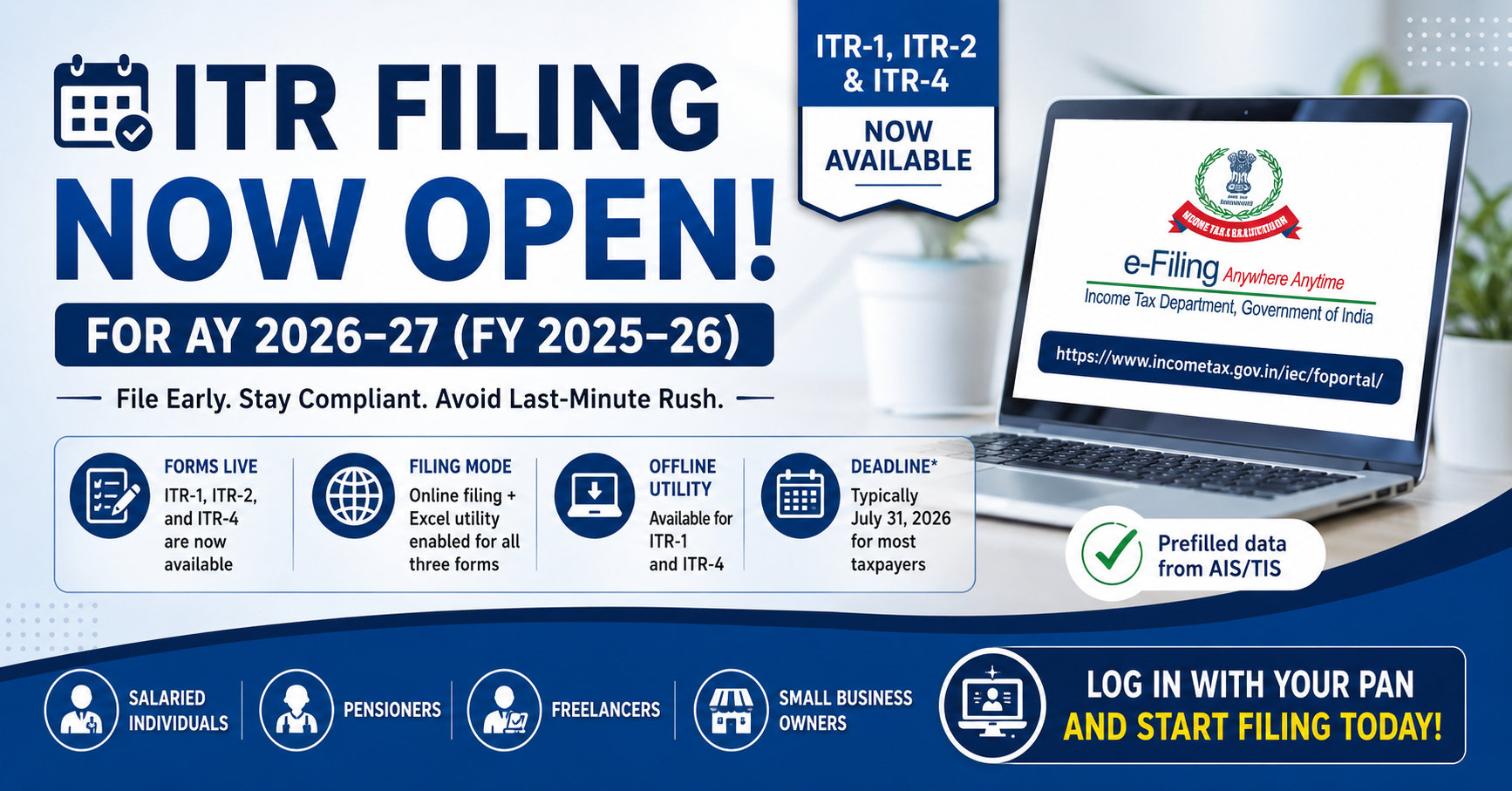
Income Tax Return (ITR) filing for Assessment Year (AY) 2026–27 has officially started on the Income Tax Department e-filing portal. Taxpayers can now access ITR-1, ITR-2, and ITR-4 forms for filing returns related to Financial Year (FY) 2025–26.
If you are searching in Ghaziabad, Noida, Vaishali, Indirapuram, Vasundhara, Delhi NCR, and nearby areas for an income tax consultant near me, tax consultant near me, or income tax services near me, it is important to understand which ITR form applies to your income category and how to complete filing correctly.
Many salaried employees, pensioners, freelancers, professionals, and small business owners are confused about the newly activated ITR filing utilities, applicable forms, and filing deadlines. Understanding the latest official update can help taxpayers avoid penalties, defective returns, and processing delays.
Latest Update
The Income Tax Department has activated online filing and utilities for AY 2026–27 corresponding to FY 2025–26.
As per the latest official update:
· ITR-1, ITR-2, and ITR-4 are now available for filing.
· Online filing and Excel utility options have been enabled.
· Offline utilities are available for ITR-1 and ITR-4.
· Prefilled information from AIS and TIS is also available for taxpayers.
· The usual due date for most non-audit taxpayers is expected to be 31 July 2026 unless extended officially.
No recent official extension notification has been issued as of today.
Practical Explanation
The opening of ITR filing utilities is important because many taxpayers wait until the last month and face portal traffic issues, missing documents, or incorrect reporting.
Filing early provides several practical advantages:
|
Benefit |
Practical Impact |
|
Faster Refund |
Early processing of refund claims |
|
Error Correction |
More time to revise mistakes |
|
Better Tax Planning |
Helps identify pending tax liability |
|
Loan Processing |
Easier availability of ITR acknowledgements |
|
Compliance Safety |
Reduces late filing penalty risk |
Which ITR Form Should You Use?
|
ITR Form |
Applicable For |
|
ITR-1 (Sahaj) |
Salaried individuals, pensioners, one house property, limited income sources |
|
ITR-2 |
Capital gains, multiple house properties, foreign assets or overseas income |
|
ITR-4 (Sugam) |
Presumptive taxation for small businesses and professionals |
For example:
· A salaried employee earning salary income and bank interest may generally use ITR-1.
· A freelancer opting for presumptive taxation under Section 44ADA may use ITR-4.
· A taxpayer who sold shares or property during FY 2025–26 may need ITR-2.
Taxpayers in Ghaziabad (201010), Vaishali (201019), Noida, Indirapuram (201014), and nearby Delhi NCR areas should carefully review AIS and Form 26AS before filing returns. Many notices are generated due to mismatch between reported income and department records.
Importance of AIS and TIS Data
AIS (Annual Information Statement) and TIS (Taxpayer Information Summary) contain transaction-level information such as:
· Salary details
· Interest income
· Share transactions
· Mutual fund transactions
· TDS deductions
· Foreign remittances
· High-value transactions
Since prefilled information is now available, taxpayers should not blindly accept the data. Proper verification is necessary because incorrect reporting can lead to scrutiny notices.
If you are searching for income tax consultant near me or GST consultant near me in Delhi NCR, professional review of AIS data before filing can help avoid future disputes.
Step-by-Step Process to File ITR for AY 2026–27
Step 1: Collect Documents
Keep the following documents ready:
· PAN card
· Aadhaar card
· Form 16
· Bank statements
· Interest certificates
· Capital gain statements
· Investment proofs
· Home loan details
· AIS and Form 26AS
Step 2: Login to E-Filing Portal
Visit the official Income Tax Department portal and log in using:
· PAN
· Password
· OTP authentication
Step 3: Select Correct Assessment Year
Choose:
· Assessment Year: 2026–27
Step 4: Choose Applicable ITR Form
Select the appropriate return form based on your income type.
Step 5: Verify Prefilled Information
Cross-check:
· Salary income
· TDS details
· Interest income
· Capital gains
· Bank account details
Step 6: Declare Deductions and Exemptions
Report eligible deductions under applicable sections such as:
· Section 80C
· Section 80D
· Section 80CCD
· Home loan deductions
Step 7: Pay Additional Tax if Applicable
If any self-assessment tax is payable, deposit it before submission.
Step 8: Submit Return and Verify
Complete e-verification using:
· Aadhaar OTP
· Net banking
· Demat account
· Bank account EVC
Return filing is considered incomplete until verification is successfully completed.
Common Mistakes Taxpayers Should Avoid
Choosing Wrong ITR Form
Using an incorrect ITR form may result in defective return notices.
Ignoring AIS Mismatch
Many taxpayers fail to reconcile income with AIS/TIS records.
Not Reporting Interest Income
Savings account and fixed deposit interest must be disclosed.
Delayed Filing
Late filing may attract:
· Late filing fees
· Interest liability
· Delayed refund processing
Incorrect Bank Details
Wrong bank account information can delay refunds.
Local Compliance Relevance
Businesses, startups, and professionals in Ghaziabad, Vasundhara (201012), Noida, and Delhi NCR often require integrated compliance support including:
· Income tax services near me
· GST services near me
· Company registration services near me
· Trade Mark services near me
· Logo registration services near me
· Company registration consultant near me
· Trade Mark consultant near me
· Logo registration consultant near me
Although ITR filing is a central law-based compliance applicable across India, local professional support can help taxpayers maintain proper documentation, reconcile GST and income records, and manage notices effectively.
Legal Reference
Section: Section 139 of the Income-tax Act, 1961
Rule: Income-tax Return Filing Rules and applicable notified ITR Forms for AY 2026–27
Official Portal:
https://www.incometax.gov.in/iec/foportal/
File ITR Guide:
https://www.incometaxindia.gov.in/tax-services/file-income-tax-return
Download ITR Forms:
https://incometaxindia.gov.in/pages/downloads/income-tax-return.aspx
Legal Position
ITR filing is now open for Assessment Year (AY) 2026–27 corresponding to Financial Year FY 2025–26.
ITR-1, ITR-2, and ITR-4 forms are currently available on the Income Tax Department e-filing portal.
Online filing and Excel utility are enabled for all three forms.
Offline utility is available for ITR-1 and ITR-4.
The portal for filing returns is available through the official Income Tax Department e-filing website.
The typical due date for most taxpayers is 31 July 2026 unless any official extension is notified later.
Salaried individuals, pensioners, freelancers, and small business owners can generally file using ITR-1 or ITR-4 depending on eligibility.
Taxpayers having capital gains, multiple house properties, or overseas income may be required to use ITR-2.
Returns are available with prefilled data from AIS and TIS.
Taxpayers can log in using their PAN credentials and start filing returns immediately.
Frequently Asked Questions (FAQ)
1. Is ITR filing open for AY 2026–27?
Yes, the Income Tax Department has activated ITR-1, ITR-2, and ITR-4 filing utilities for AY 2026–27.
2. What is the due date for filing ITR for AY 2026–27?
The normal due date for most non-audit taxpayers is expected to be 31 July 2026 unless extended officially.
3. Who can file ITR-1?
ITR-1 is generally applicable for salaried individuals and pensioners having limited income sources and subject to eligibility conditions.
4. Who should use ITR-2?
Taxpayers having capital gains, multiple house properties, foreign assets, or overseas income may need to use ITR-2.
5. Can freelancers use ITR-4?
Yes, eligible freelancers and professionals opting for presumptive taxation may file ITR-4.
6. Is offline utility available?
Offline utilities are currently available for ITR-1 and ITR-4.
7. Is AIS verification important before filing?
Yes, AIS and TIS reconciliation is extremely important to avoid mismatch notices and tax disputes.
8. Can I revise my ITR after filing?
Yes, revised return filing is permitted subject to conditions prescribed under the Income-tax Act.
Conclusion
The opening of ITR filing for AY 2026–27 gives taxpayers enough time to organize documents, verify AIS records, and file accurate income tax returns.
Salaried employees, freelancers, professionals, pensioners, and business owners should carefully choose the correct ITR form and verify all prefilled data before submission. Filing early can help taxpayers receive faster refunds and reduce compliance risks.
If you are located in Ghaziabad, Noida, Indirapuram, Vaishali, Vasundhara, Delhi NCR, or nearby areas and searching for a tax consultant near me or income tax consultant near me, professional guidance may help in proper tax planning and return filing.
For expert guidance on this topic, contact your tax professional today.
Final Disclaimer
This content is for educational and knowledge purposes only. For verification and applicability to your case, please consult your tax professional.
Have Questions? We're Here to Help
Get expert advice from AMIT SIDDHI AND ASSOCIATES. Reach out to discuss your requirements.