
Delhi High Court Quashes Section 220 Notice for Non-Service of Demands and Nine-Year Delay: Lessons from APS Hydro Pvt. Ltd. v. Union of India
Section 220 of the Income-tax Act, 1961 is one of the most important provisions governing recovery of tax demands after an assessment is completed. Once a demand notice is served and the taxpayer fails to pay within the prescribed time, the assessee may be treated as an “assessee in default,” enabling the Income-tax Department to initiate recovery proceedings, levy interest, and take coercive action.
However, recovery powers under the Income-tax Act are not unlimited. The Department must first establish that the underlying assessment order, penalty order, rectification order, and demand notice were properly served on the assessee. Without valid service, recovery action becomes legally vulnerable.
If you are searching in Ghaziabad, Noida, Delhi NCR, Vaishali, Indirapuram, Vasundhra, and nearby areas for an income tax consultant near me, GST consultant near me, or tax consultant near me to understand tax recovery notices and legal remedies, the recent Delhi High Court ruling in APS Hydro Pvt. Ltd. v. Union of India provides important guidance.
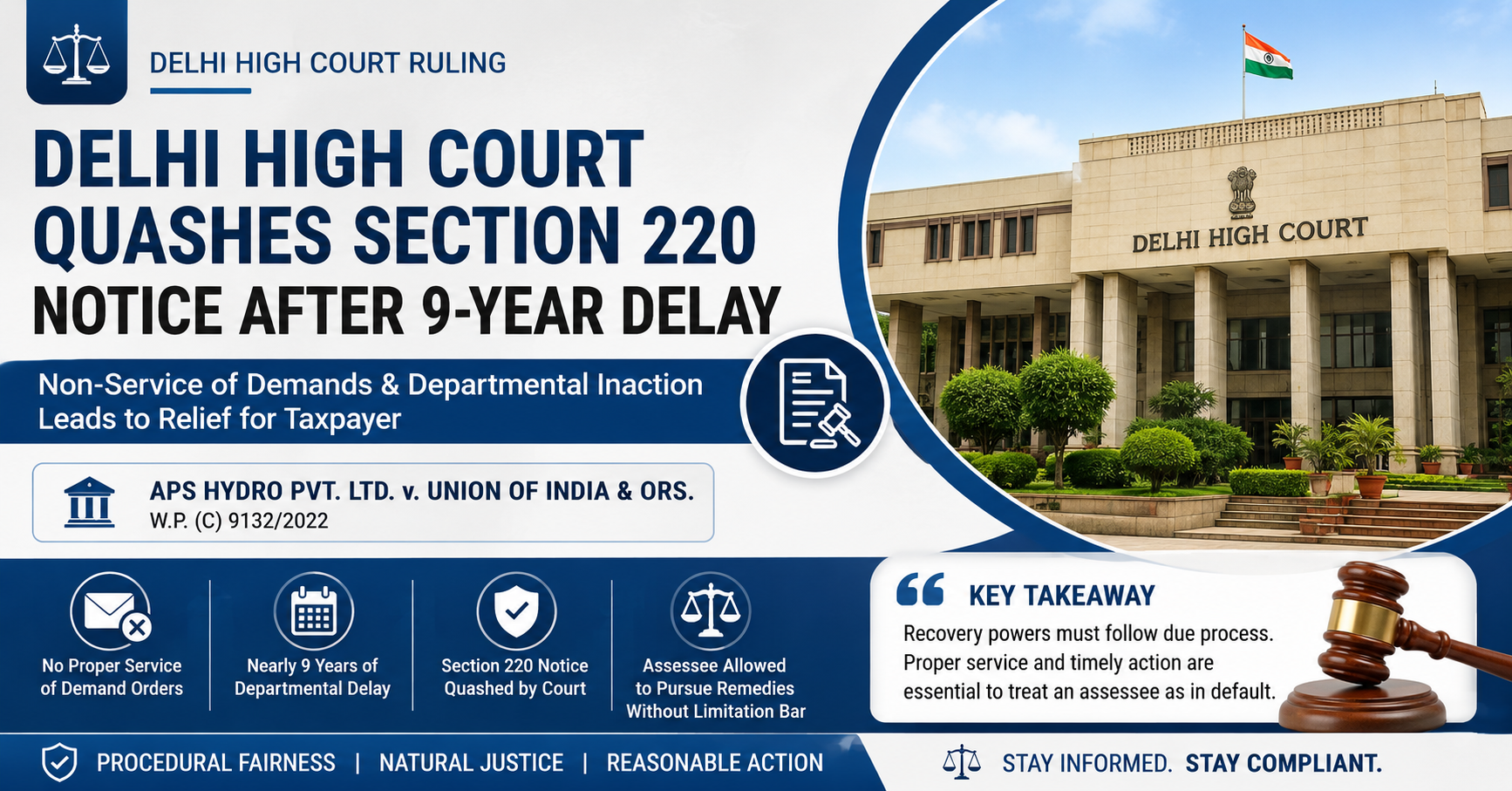
The Delhi High Court recently dealt with this issue in APS Hydro Private Limited v. Union of India & Ors., W.P. (C) 9132/2022, where it quashed a Section 220(1) notice due to non-service of demand orders and unexplained departmental delay of nearly nine years.
Latest Update
The Delhi High Court has reportedly quashed a notice issued under Section 220(1) of the Income-tax Act against APS Hydro Pvt. Ltd. on the grounds that:
· The Income-tax Department failed to establish proper service of the underlying assessment, rectification, and penalty orders.
· The Department remained inactive for nearly nine years before initiating recovery proceedings.
The Court permitted the assessee to pursue statutory remedies without limitation objections and directed the Department to provide copies of the relevant orders.
No further official update or CBDT circular regarding this matter has been reported as of today.
Practical Explanation with Real-Life Examples
Why Proper Service Matters
Suppose a company receives a sudden recovery notice for old tax demands from 2013 or 2014, but it never received the original assessment orders. In such a situation:
· The company loses the opportunity to file appeals.
· Interest under section 220(2) keeps increasing.
· Bank attachment or recovery action may begin unexpectedly.
The APS Hydro ruling confirms that such recovery action may be challenged if service itself is doubtful.
Physical Service vs Electronic Service
|
Earlier System |
Current E-Assessment System |
|
Speed post / physical notices |
Email communication |
|
Postal acknowledgment |
Portal logs and delivery records |
|
Manual dispatch records |
System-generated records |
In today’s digital tax environment, taxpayers must regularly monitor:
· Registered email ID
· E-filing portal
· SMS alerts
· DIN-based communications
Important Learning for Businesses
Many businesses in Delhi NCR, Noida, Ghaziabad, Vaishali (201019), Indirapuram (201014), and Vasundhra (201012) often assume that if no physical notice is received, no proceedings exist. This assumption can be risky under the e-assessment regime.
If you are searching for income tax services near me, GST services near me, or a company registration consultant near me for tax litigation support, it is important to maintain proper compliance systems and digital tracking.
Step-by-Step Compliance Process If You Receive a Section 220 Notice
Step 1 – Obtain Complete Demand Details
Request copies of:
· Assessment order
· Demand notice under section 156
· Penalty order
· Rectification order
· Computation sheet
Step 2 – Verify Service Records
Check whether:
· Notices were uploaded on the portal
· Emails were sent to the correct address
· Delivery records exist
Step 3 – Review Limitation and Delay
Check:
· Date of demand
· Date of recovery action
· Departmental inactivity period
Step 4 – File Appeal or Objection
Where service was defective, legal remedies may still remain available.
Step 5 – Seek Stay of Recovery
If the demand is disputed, apply for:
· Stay of recovery
· Instalment facility
· Rectification
· Appeal before CIT(A)
Professional guidance from a tax consultant near me or income tax consultant near me can help evaluate the strength of the case.
Legal Reference
Relevant Sections of the Income-tax Act, 1961
· Section 220(1) – When tax payable and when assessee deemed to be in default
· Section 154 – Rectification of mistake
· Section 143(1)(a) – Intimation
· Section 271(1)(c) – Penalty for concealment
Rule Position
No specific Income-tax Rule is directly involved in the reported decision. The dispute primarily concerns proper service of demand notices and procedural fairness under Section 220.
Notification / Circular
No CBDT notification or circular is central to this ruling.
Official and Reference Links
Section 220 on Income Tax Department website:
https://www.incometaxindia.gov.in/w/section-220-61.
Professional update:
https://www.linkedin.com/posts/ykg-corp_aps-hydro-private-limited-v-union-of-india-activity-7449730023986499584-51vZ
Legal Position
Section 220(1) of the Income-tax Act provides that when a notice of demand under section 156 is served upon an assessee, the amount specified becomes payable within the period mentioned in the notice. Failure to pay may result in the assessee being treated as an “assessee in default.”
This provision forms the foundation for recovery proceedings, levy of interest under section 220(2), attachment of assets, and other coercive recovery measures.
However, before these consequences arise, the following conditions are generally expected to be satisfied:
· A valid assessment, rectification, or penalty order must exist.
· A notice of demand under section 156 must be generated.
· Proper service of the order and demand notice must be completed.
In APS Hydro Pvt. Ltd. v. Union of India & Ors., the assessee challenged a notice issued under section 220(1) covering demands from AY 2011-12 to AY 2019-20.
The assessee argued that it had never received:
· Assessment orders
· Rectification orders
· Penalty orders
· Demand notices
The Department claimed that communications had been sent through email under the e-assessment system. However, according to reported summaries, the Department could not produce sufficient evidence showing proper electronic service such as:
· Email delivery confirmation
· Correct registered email details
· E-filing portal logs
· System-generated service records
The Delhi High Court reportedly observed that it was “difficult, nay impossible” to believe that:
· The Department would remain inactive regarding huge tax demands for almost nine years, and
· The assessee would remain silent if large demands had actually been served.
Because proper service was not convincingly established and the Department’s long delay remained unexplained, the Court quashed the Section 220(1) notice.
At the same time, the Court balanced the interests of both parties by:
· Allowing the assessee to obtain copies of the underlying orders
· Permitting appeals or statutory remedies without limitation objections
· Allowing the Department to initiate fresh proceedings in accordance with law after proper service
The ruling reinforces important legal principles:
· Proper service is essential before recovery proceedings can begin.
· Natural justice requires that the assessee must know the basis of the demand.
· Long and unexplained administrative delay can weaken recovery proceedings.
· Courts may intervene where procedural fairness is absent.
The Court did not cancel the underlying tax liability on merits. Instead, it restored procedural fairness and ensured that statutory remedies remained available to the taxpayer.
Frequently Asked Questions (FAQ)
1. What is Section 220 of the Income-tax Act?
Section 220 deals with payment and recovery of tax demand after a notice under section 156 is issued.
2. Can the Department recover tax without proper service of demand notice?
Recovery may become legally vulnerable if proper service of assessment and demand notices cannot be established.
3. Does email service qualify as valid service?
Yes, under the e-assessment framework, email and portal uploads may constitute valid service if proper records exist.
4. Can delay by the Department affect recovery proceedings?
Extreme and unexplained delay may be challenged as arbitrary, especially when combined with doubtful service.
5. Did the Delhi High Court completely cancel the tax demand in APS Hydro?
No. The Court primarily quashed the Section 220(1) recovery notice and allowed the assessee to pursue statutory remedies.
6. What should taxpayers do if they receive an old recovery notice?
They should immediately obtain copies of all underlying orders and verify service records.
7. Can businesses in Ghaziabad or Noida seek professional help for tax recovery disputes?
Yes. Businesses often consult tax professionals, GST consultant near me services, or income tax services near me for handling recovery notices and appeals.
Conclusion
The Delhi High Court ruling in APS Hydro Pvt. Ltd. v. Union of India highlights a critical principle of tax administration: recovery powers must operate within the boundaries of procedural fairness and natural justice.
The decision makes it clear that:
· Proper service of orders is essential.
· Long departmental inaction can weaken recovery proceedings.
· Taxpayers cannot be denied appellate remedies where service itself is doubtful.
As tax administration becomes increasingly digital, disputes relating to electronic service, portal communication, and delayed recovery are likely to increase. Businesses and professionals should therefore maintain updated compliance records and actively monitor their e-filing accounts.
If you are located in Ghaziabad, Noida, Delhi NCR, Vaishali, Indirapuram, or nearby areas and are searching for a tax consultant near me, GST consultant near me, company registration services near me, Trade Mark consultant near me, or logo registration consultant near me, understanding procedural rights under the Income-tax Act is extremely important.
For expert guidance on this topic, contact your tax professional today.
Disclaimer
This content is for educational and knowledge purposes only. For verification and applicability to your case, please consult your tax professional.
Have Questions? We're Here to Help
Get expert advice from AMIT SIDDHI AND ASSOCIATES. Reach out to discuss your requirements.