
Form PAS-6: Reconciliation of Share Capital Audit Report
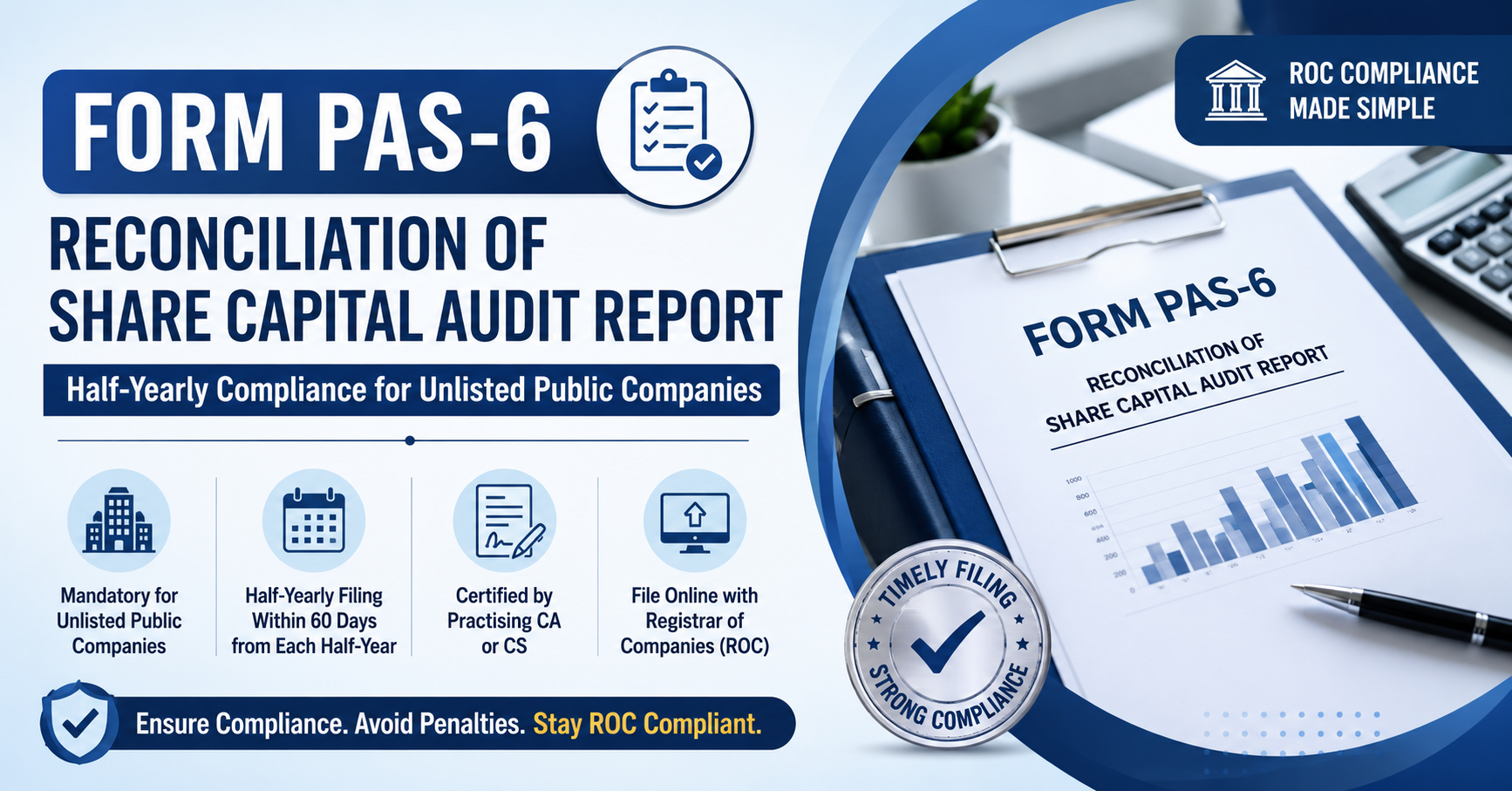
Many companies are confused about whether Form PAS-6 filing is mandatory and which companies are required to submit this half-yearly ROC compliance form.
If you are searching in Ghaziabad, Noida, Delhi NCR, and nearby areas for an Income tax consultant near me, GST consultant near me, or company registration consultant near me, understanding Form PAS-6 compliance becomes important for maintaining proper MCA and ROC compliance.
Latest Update on Form PAS-6
Form PAS-6 was introduced by the Ministry of Corporate Affairs (MCA) under Rule 9A(8) of the Companies (Prospectus and Allotment of Securities) Rules, 2014 for reconciliation of share capital audit reporting by unlisted public companies.
Recent compliance discussions also indicate that certain private companies covered under Rule 9B relating to dematerialisation requirements may need similar compliance reporting.
No major recent official amendment changing the core filing requirement of PAS-6 for unlisted public companies was found as of today.
Practical Explanation of Form PAS-6
Form PAS-6 is mainly used to verify whether the company’s share capital records match with the depository records maintained with NSDL/CDSL and Registrar & Transfer Agent (RTA).
In simple words, the ROC wants confirmation that:
· Shares issued by the company are properly reconciled
· Demat shares and physical shares match company records
· Any mismatch is identified and corrected
Example
Suppose an unlisted public company has:
· 10 lakh issued shares
· 8 lakh shares in demat form
· 2 lakh shares in physical form
The PAS-6 report verifies whether these figures match:
· Company records
· Depository records
· Registrar records
If differences are found, the company must immediately inform the depositories.
Applicability of Form PAS-6
|
Particulars |
Applicability |
|
Unlisted Public Company |
Applicable |
|
Government Company |
Generally Exempt |
|
Nidhi Company |
Generally Exempt |
|
Wholly Owned Subsidiary |
Generally Exempt |
|
Listed Company |
Not applicable under Rule 9A |
|
Certain Private Companies under Rule 9B |
May become applicable based on demat requirements |
Due Date for Filing PAS-6
|
Half-Year Period |
Due Date |
|
April to September |
Within 60 days from 30 September |
|
October to March |
Within 60 days from 31 March |
Generally, the practical due dates become:
· Around 29 November
· Around 30 May
Information Required in Form PAS-6
The following details are usually required while preparing the form:
· CIN of company
· ISIN details
· Share capital structure
· Number of shares in demat and physical form
· Details of changes in share capital
· Reasons for differences, if any
· Details of company secretary or practising professional certifying the form
Step-by-Step Filing Process of PAS-6
Step 1: Verify ISIN Details
Check whether the ISIN allotted by NSDL/CDSL is active and correctly linked.
Step 2: Reconcile Share Capital
Match:
· Issued capital
· Dematerialised shares
· Physical shares
· Depository records
Step 3: Prepare Audit Report
The reconciliation report is prepared and certified by:
· Practising CA, or
· Practising CS
Step 4: File Form PAS-6 on MCA Portal
Upload the form on the MCA portal with:
· DSC of director
· Professional certification
Step 5: Preserve Compliance Records
Maintain:
· Demat records
· RTA confirmations
· Board resolutions
· Filing acknowledgements
Consequences of Non-Compliance
Failure to comply with Rule 9A and PAS-6 filing requirements may lead to:
· ROC non-compliance
· Additional filing fees
· Penalties under Companies Act provisions
· Practical difficulties in corporate restructuring or fundraising
Companies may also face issues in:
· Share transfers
· Further issue of securities
· Due diligence during investment transactions
Importance of PAS-6 Compliance
Timely filing of PAS-6 helps companies:
· Maintain proper corporate governance
· Ensure transparency in shareholding
· Reduce legal disputes
· Improve investor confidence
· Maintain updated dematerialisation records
For startups and growing public companies in Ghaziabad, Noida, Vaishali 201019, Indirapuram 201014, Vasundhara 201012, and Delhi NCR, proper ROC compliance support from a tax consultant near me or company registration services near me can help avoid unnecessary MCA notices and penalties.
Legal Reference
Relevant Provisions
· Section 29 of the Companies Act, 2013
· Rule 9A(8) of the Companies (Prospectus and Allotment of Securities) Rules, 2014
· Companies (Prospectus and Allotment of Securities) Third Amendment Rules, 2018/2019
Official MCA Link
· https://www.mca.gov.in/content/dam/mca-aem-forms/instructionkits/Instruction%20Kit_PAS-6.pdf
Legal Position
Form PAS-6 is a half-yearly “Reconciliation of Share Capital Audit Report” form which needs to be filed with the Registrar of Companies (ROC) by unlisted public companies. The purpose of this form is to reconcile the issued share capital of the company with the shares held in dematerialised form.
The Ministry of Corporate Affairs introduced Form PAS-6 through amendment in Rule 9A(8) of the Companies (Prospectus and Allotment of Securities) Rules, 2014. The rule requires every unlisted public company covered under Rule 9A to submit Form PAS-6 within sixty days from the conclusion of each half-year. The form must be certified by a Practising Company Secretary (PCS) or Practising Chartered Accountant (CA).
The filing is generally applicable to unlisted public companies which are required to issue securities in dematerialised form and facilitate dematerialisation of existing securities under the Depositories Act, 1996.
Certain categories such as Government companies, Nidhi companies, and wholly owned subsidiaries are generally exempt from Rule 9A compliance requirements.
The form is required to be filed for every half-year:
· Half-year ending 31 March
· Half-year ending 30 September
The due date is within 60 days from the end of each half-year.
Frequently Asked Questions (FAQs)
1. What is Form PAS-6?
Form PAS-6 is a half-yearly Reconciliation of Share Capital Audit Report filed with ROC by applicable unlisted public companies.
2. Who certifies Form PAS-6?
The form must be certified by:
· Practising Chartered Accountant (CA), or
· Practising Company Secretary (CS)
3. What is the due date for PAS-6?
It must generally be filed within 60 days from the end of each half-year.
4. Is PAS-6 mandatory for all companies?
No. It mainly applies to unlisted public companies covered under Rule 9A.
5. Is PAS-6 linked with dematerialisation of shares?
Yes. The form is directly related to reconciliation of shares held in dematerialised form.
6. Can ROC impose penalties for non-filing?
Yes. Delayed or non-filing may attract additional fees and compliance consequences.
7. Is PAS-6 applicable to private limited companies?
Traditionally it applied to unlisted public companies, but certain private companies covered under Rule 9B dematerialisation provisions may also face related compliance requirements.
Conclusion
Form PAS-6 is an important ROC compliance requirement for eligible unlisted public companies in India. Since it involves reconciliation of demat shareholding records and certification by professionals, companies should maintain proper documentation and timely compliance systems.
Businesses searching for Income tax consultant near me, GST services near me, company registration services near me, Trade Mark consultant near me, or logo registration consultant near me should also ensure that MCA and ROC compliances like PAS-6 are properly handled to avoid future legal and operational complications.
For expert guidance on this topic, contact your tax professional today.
Disclaimer:
This content is for educational and knowledge purposes only. For verification and applicability to your case, please consult your tax professional.
Have Questions? We're Here to Help
Get expert advice from AMIT SIDDHI AND ASSOCIATES. Reach out to discuss your requirements.