
Will GSTR-3B Soon Become Fully Auto-Populated and Non-Editable?
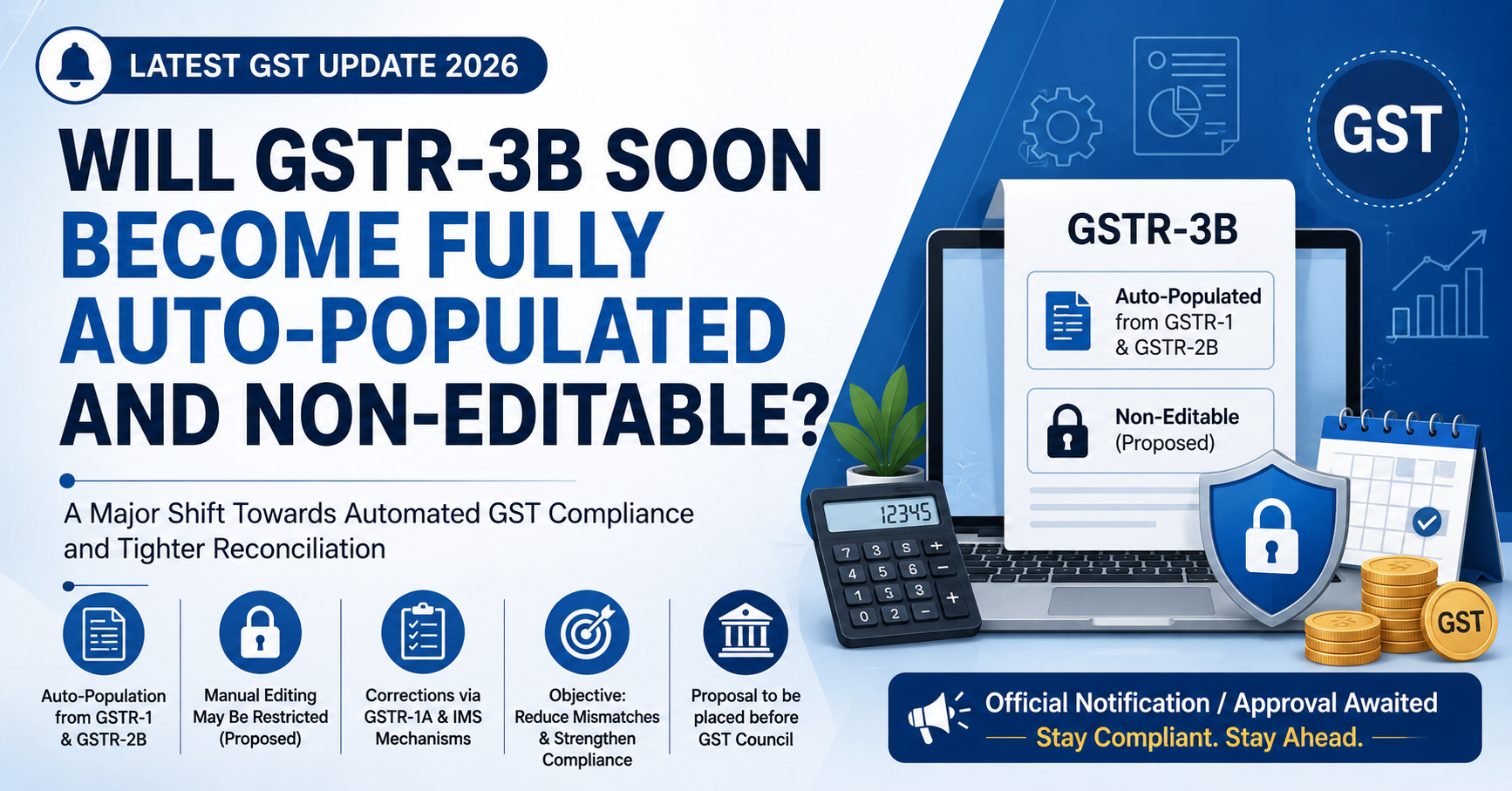
Many businesses, professionals, startups, and accountants are now asking whether Form GSTR-3B will soon become fully auto-populated and non-editable under the GST system. The discussion has gained momentum after multiple GSTN advisories and media reports suggested that the Government may restrict manual editing in GSTR-3B to reduce mismatches, fake ITC claims, and tax-liability manipulation.
If you are searching in Ghaziabad, Noida, Delhi NCR, Vaishali, Indirapuram (201014), Vasundhra (201012), or nearby areas for a GST consultant near me, tax consultant near me, or income tax consultant near me, it is important to understand that the complete “non-editable GSTR-3B” regime is still not officially notified as of May 2026.
However, partial restrictions are already operational on the GST portal, and businesses should prepare for a future where GSTR-3B may become largely system-driven and auto-locked.
Latest Update on GSTR-3B Editability (May 2026)
As of May 2026:
· No official CBIC notification or GST Council-ratified circular has been issued making the entire GSTR-3B completely non-editable.
· The Government is actively considering restricting manual editing in GSTR-3B after auto-population from GSTR-1 and GSTR-2B.
· Certain fields and tables in GSTR-3B are already non-editable through GSTN portal changes and advisories.
· Corrections are increasingly being routed through GSTR-1A, IFF, and future reconciliation mechanisms instead of direct editing in GSTR-3B.
This shows a clear policy direction toward automated GST compliance and tighter invoice-based reconciliation.
Practical Explanation for Businesses
Why Is the Government Moving Toward Auto-Population?
The GST system is increasingly becoming invoice-driven. The objective is to ensure:
|
Objective |
Impact |
|
Reduce fake ITC claims |
Better invoice matching |
|
Reduce GST mismatches |
Improved reconciliation |
|
Prevent tax leakage |
Real-time data tracking |
|
Minimize human intervention |
Automated compliance |
|
Increase transparency |
Standardized reporting |
Under the earlier system, many taxpayers manually adjusted figures in GSTR-3B even when mismatches existed between GSTR-1, GSTR-2B, and books of accounts. This created compliance gaps and departmental scrutiny.
Now, the Government appears to be shifting toward a “single source of truth” approach where:
· GSTR-1 determines outward liability.
· GSTR-2B determines eligible ITC.
· GSTR-3B becomes a system-generated summary return.
What Could Happen if Full Restriction Is Implemented?
If the proposal becomes law, taxpayers may face the following practical changes:
1. GSTR-1 Will Become Critically Important
Any mistake in invoice upload may directly impact GSTR-3B liability.
2. Monthly Reconciliation Will Become Mandatory
Businesses will need stronger reconciliation between:
· Books
· E-invoice data
· GSTR-1
· GSTR-2B
3. ITC Management Will Tighten
Claiming excess or unsupported ITC may become more difficult because system validations may automatically restrict credits.
4. Reduced Scope for Last-Minute Adjustments
Currently, some taxpayers adjust liabilities manually in GSTR-3B. Such flexibility may gradually disappear.
Practical Example
Suppose a business uploads incorrect taxable value in GSTR-1.
Under the proposed system:
· GSTR-3B liability may auto-populate directly from GSTR-1.
· Manual reduction inside GSTR-3B may not be allowed.
· Correction may only happen through GSTR-1A or future amendment returns.
Similarly, if ITC is not reflected in GSTR-2B:
· Manual ITC claim inside GSTR-3B may become restricted.
· Taxpayer may need supplier correction and IMS-based reconciliation.
Step-by-Step Compliance Preparation
Step 1: Strengthen Invoice Controls
Ensure invoices are uploaded correctly before GSTR-1 filing.
Step 2: Reconcile GSTR-1 with Books
Cross-check turnover and tax liability every month.
Step 3: Review GSTR-2B Carefully
Match supplier invoices before claiming ITC.
Step 4: Use GSTR-1A Timely
Correct mistakes before filing GSTR-3B.
Step 5: Maintain Documentation
Keep vendor communication, reconciliations, and working papers properly documented.
Step 6: Conduct Internal GST Reviews
Businesses in Ghaziabad, Noida, Delhi NCR, and nearby areas should consider periodic GST compliance audits to avoid future system-generated mismatches.
Legal Reference
Section / Rule / Framework:
· CGST Act, 2017
· CGST Rules, 2017
· GSTR-1
· GSTR-1A
· GSTR-2B
· GSTR-3B
· Invoice Furnishing Facility (IFF)
· GSTN advisories regarding auto-populated liability and non-editable fields
Official Links:
https://tutorial.gst.gov.in/userguide/returns/GSTR3B.htm
Legal Position
Recent news reports suggest that the Central Government is contemplating a major structural change to Form GSTR-3B: disabling or severely restricting manual editing once the return is auto-populated from GSTR-1 and GSTR-2B. The stated objective is to reduce GST mismatches, tighten compliance checks, and curb artificial suppression or inflation of tax liability and ITC claims. However, as of May 2026, no formal CGST Act notification or GST Council-ratified amendment has been issued that renders the entire GSTR-3B non-editable; instead, only partial, field-specific restrictions are already in effect under GSTN advisories and portal-level changes.
The Government is considering disabling the editing facility in the monthly summary return GSTR-3B once the return is auto-populated from GSTR-1 and GSTR-2B. Under this proposed model, outward-supply-linked liability and ITC-related figures would be system-computed and then locked for manual alteration, similar to the present treatment of Table 3.2 and certain liability fields.
The proposal is expected to be placed before the GST Council for approval because any substantial change in the structure or operational framework of GSTR-3B falls within the GST Council’s scope. Until a Council-approved decision and corresponding CBIC notification or GSTN circular are officially issued, the proposal remains a policy direction and not a binding statutory rule.
Even without a complete “no-editing” framework, GST compliance has already shifted significantly toward automation and reduced manual intervention.
Auto-populated tax liability in GSTR-3B, based on GSTR-1, GSTR-1A, and IFF, has become non-editable from the July 2025 tax period onward according to GSTN advisories. Taxpayers are required to make corrections through GSTR-1A before filing GSTR-3B or through subsequent GSTR-1 filings.
Similarly, Table 3.2 of GSTR-3B, covering inter-state supplies to unregistered persons, composition taxpayers, and UIN holders, became auto-populated and non-editable from the November 2025 tax period onward. Corrections must now be made through GSTR-1A or future-period GSTR-1/IFF amendments rather than direct editing in GSTR-3B.
These changes are operationally implemented through GSTN advisories and portal design modifications rather than fresh statutory amendments in the CGST Rules.
If the broader proposal is implemented, GSTR-3B may eventually become largely or fully auto-populated from GSTR-1 and GSTR-2B, with manual edits heavily restricted or removed.
In such a framework:
· Tax liability corrections would primarily flow through GSTR-1A and GSTR-1/IFF.
· ITC adjustments may move through IMS-related reconciliation tools and future correction mechanisms.
· Manual “fine-tuning” inside GSTR-3B may substantially reduce.
This aligns with the Government’s broader focus on data-driven compliance, invoice matching, fraud prevention, and tighter reconciliation controls.
The CGST Act and CGST Rules currently do not contain any express provision making the entire GSTR-3B non-editable. Existing restrictions are operational and portal-based in nature, though practically binding for taxpayers using the GST portal.
Businesses should therefore strengthen invoice-level controls, e-invoice reconciliation, GSTR-1 accuracy, and monthly GST review systems because errors in outward supplies or ITC data may automatically flow into GSTR-3B without direct correction flexibility.
The claim that the Government may restrict manual editing in GSTR-3B and move toward a fully auto-populated return is factually aligned with current policy direction and GSTN operational trends. However, the comprehensive “fully non-editable GSTR-3B” framework has not yet been formally notified under the CGST Rules as of May 2026.
FAQ
1. Has the Government officially made GSTR-3B fully non-editable?
No. As of May 2026, no official CBIC notification or GST Council-approved amendment has made the entire GSTR-3B fully non-editable.
2. Which parts of GSTR-3B are already non-editable?
Auto-populated liability fields and Table 3.2 are already non-editable for specified periods through GSTN portal implementation.
3. Can tax liability still be corrected?
Yes. Corrections are expected through GSTR-1A or subsequent GSTR-1/IFF amendments.
4. Will ITC corrections also become restricted?
The policy direction indicates that ITC adjustments may increasingly move toward GSTR-2B and IMS-based reconciliation systems instead of manual editing in GSTR-3B.
5. Is this change applicable to all taxpayers?
Currently, only specific fields are restricted. A broader change may apply to most regular GST taxpayers if officially approved in future.
6. Why should businesses prepare now?
Because the GST ecosystem is clearly moving toward automated reconciliation and invoice-based compliance.
7. Where can businesses seek professional help?
Businesses searching for GST services near me, income tax services near me, company registration consultant near me, trade mark consultant near me, or logo registration services near me should ensure they work with professionals experienced in GST reconciliations and return automation systems.
Conclusion
The direction of GST compliance in India is becoming increasingly automated, reconciliation-driven, and technology-based. While a fully non-editable GSTR-3B has not yet been officially notified, the existing GSTN advisories clearly indicate that the Government intends to reduce manual intervention in GST returns.
Businesses should therefore stop treating GSTR-3B as an adjustment tool and instead focus on accurate invoice reporting, timely GSTR-1 filing, ITC reconciliation, and strong internal controls.
If you are located in Ghaziabad (201010), Vaishali (201019), Indirapuram, Noida, Delhi NCR, or nearby areas and are searching for a GST consultant near me or tax consultant near me, now is the right time to strengthen your GST compliance systems before stricter automation becomes fully operational.
For expert guidance on this topic, contact your tax professional today.
Final Disclaimer
This content is for educational and knowledge purposes only. For verification and applicability to your case, please consult your tax professional.
Have Questions? We're Here to Help
Get expert advice from AMIT SIDDHI AND ASSOCIATES. Reach out to discuss your requirements.