
GST Appeals System Gets Structured: GSTAT Allocates Benches, Members, and Jurisdictions Across India
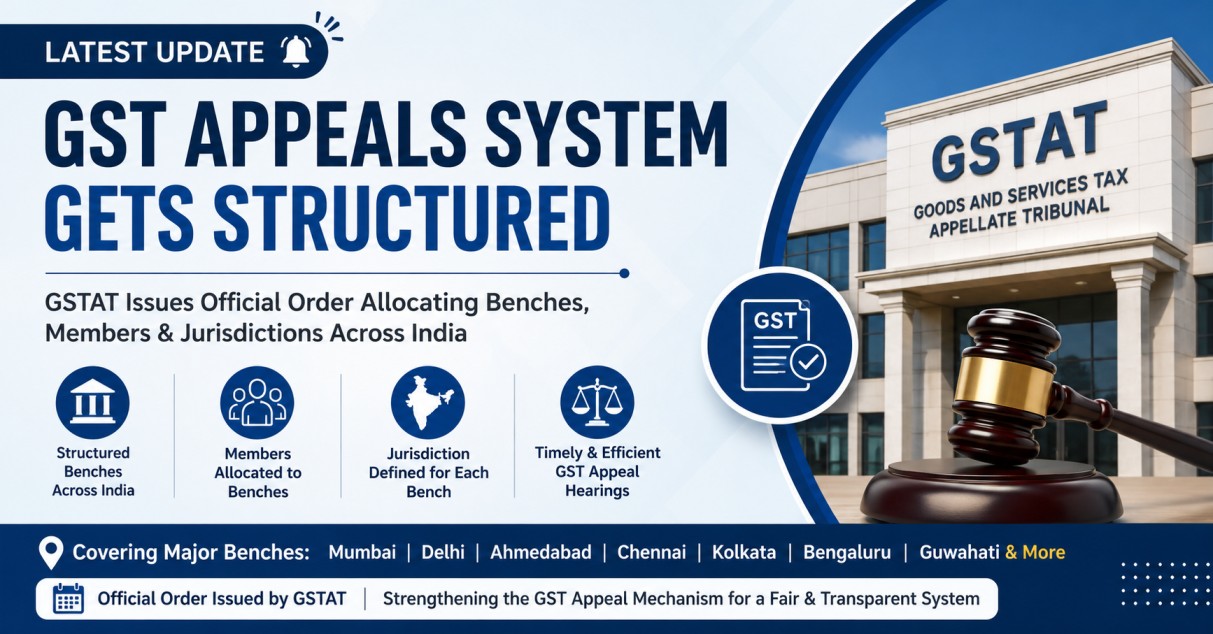
The GST appellate mechanism in India is entering a more structured phase after the Goods and Services Tax Appellate Tribunal (GSTAT) issued an official order allocating benches, judicial members, and technical members across multiple states and cities.
If you are searching in Ghaziabad, Noida, Delhi NCR, Vaishali, Vasundhra, or nearby areas for a GST consultant near me, income tax consultant near me, tax consultant near me, or company registration consultant near me, understanding the latest GSTAT structure is important because GST disputes and appeals may now move through a more organized and accessible appellate framework.
The latest GSTAT allocation order is considered a major development for businesses, professionals, startups, manufacturers, traders, exporters, and service providers dealing with GST litigation and appeal matters.
The notification covers important GSTAT benches including Delhi, Mumbai, Ahmedabad, Chennai, Bengaluru, Kolkata, Hyderabad, Jaipur, Lucknow, Ghaziabad, Pune, Chandigarh, and several other regional centers.
Latest Update Section
The Ministry of Finance, Department of Revenue, issued Office Order No. 03/2025 dated 26 December 2025 allocating benches to Judicial Members, Technical Members (Centre), and Technical Members (State) of GSTAT across India.
The order directs appointed members to join their respective benches by 21 January 2026.
The latest development is expected to operationalize the GST Appellate Tribunal system across India and strengthen GST dispute resolution mechanisms.
Recent administrative directions and procedural arrangements have also been issued for creation and functioning of GSTAT benches under the CGST Act and GSTAT Procedure Rules, 2025.
Practical Explanation
Why GSTAT Structure Matters for Businesses
Earlier, many taxpayers faced practical difficulty because GSTAT benches were not fully operational in several regions. As a result, businesses often approached High Courts directly for relief in GST appeal matters.
Now, with structured bench allocation and member appointments, GST appeals are expected to become more accessible and systematic.
This development is particularly important for:
· Manufacturers
· Exporters
· E-commerce businesses
· Service providers
· Real estate businesses
· Startups
· MSMEs
· Contractors
· Logistics companies
· IT and software businesses
Key Benefits of Structured GSTAT System
|
Area |
Expected Benefit |
|
Faster Disposal |
GST disputes may get quicker hearings |
|
Regional Access |
Taxpayers can approach nearby benches |
|
Specialized Tribunal |
GST-specific expertise available |
|
Reduced High Court Burden |
Appeals may shift from High Courts |
|
Uniform Interpretation |
Better consistency in GST rulings |
Example
Suppose a business in Ghaziabad receives a GST demand order involving wrongful ITC denial or classification dispute.
Earlier, the appellate process often involved delays and uncertainty due to non-functional tribunal infrastructure.
Now, with GSTAT benches and judicial members officially allocated, businesses may get a clearer appellate pathway for GST litigation.
If you are searching for GST services near me, income tax services near me, or GST consultant near me in Indirapuram (201014), Vasundhra (201012), Vaishali (201019), Noida, or Delhi NCR, understanding the GSTAT appeal structure can help businesses plan litigation strategy more effectively.
Important Practical Points
· GSTAT is an appellate authority for GST disputes.
· Businesses must still follow statutory timelines for filing appeals.
· Proper documentation remains essential.
· Demand orders, adjudication orders, and appellate orders should be preserved carefully.
· Electronic filing and procedural compliance will remain important.
Types of Matters Likely Before GSTAT
· Input Tax Credit disputes
· Classification disputes
· GST demand notices
· Refund rejection matters
· E-way bill penalties
· Registration cancellation disputes
· Transitional credit disputes
· Place of supply issues
· Export refund litigation
· Anti-profiteering related matters
Step-by-Step GST Appeal Process
Step 1: Adjudication Order
The GST department passes an adjudication order after issuing notice and hearing the taxpayer.
Step 2: First Appeal
The taxpayer may file first appeal before the Appellate Authority within prescribed time limits.
Step 3: GSTAT Appeal
If the taxpayer is dissatisfied with the appellate order, an appeal may be filed before GSTAT.
Step 4: Hearing Before Bench
The matter is heard before the appropriate GSTAT bench having territorial jurisdiction.
Step 5: Final Order
GSTAT may confirm, modify, or set aside the disputed order.
Step 6: Further Appeal
Substantial questions of law may later be challenged before the High Court or Supreme Court as permitted under law.
Impact on Taxpayers and Professionals
The operationalization of GSTAT may significantly affect tax litigation strategy across India.
Businesses may now need:
· Better GST documentation
· Proper reconciliation systems
· Timely response to notices
· Litigation planning
· Technical representation during appeals
Professionals offering GST services near me, tax consultant near me, company registration services near me, trade mark consultant near me, logo registration consultant near me, and income tax consultant near me may also see increased demand for GST litigation advisory and appeal management.
Legal Reference
Relevant Legal Provisions
· Section 109 of the Central Goods and Services Tax Act, 2017
· Rule 110A of the CGST Rules, 2017
· GSTAT (Procedure) Rules, 2025
· Office Order No. 03/2025 dated 26 December 2025
· Office Order No. 3/GSTAT/PB/2026 regarding creation of benches
Official and Reference Links
https://www.efiling.gstat.gov.in/downloads/manual/creation-of-Benches-to-the-members.pdf
Legal Position
The Government of India, Ministry of Finance, Department of Revenue, issued Office Order No. 03/2025 dated 26 December 2025 approving the allotment of benches to appointed members in the Goods and Services Tax Appellate Tribunal (GSTAT).
The order allocates postings to Technical Members (Centre), Technical Members (State), and Judicial Members across various benches located throughout India.
Major locations covered under the order include Mumbai, Delhi, Ahmedabad, Chennai, Bengaluru, Hyderabad, Kolkata, Jaipur, Lucknow, Chandigarh, Pune, Ghaziabad, Rajkot, Guwahati, Patna, Dehradun, Bhopal, Ernakulam, Raipur, and several other cities.
The allocation aims to operationalize GSTAT benches and provide a functional appellate mechanism for GST disputes arising under the Central Goods and Services Tax Act, 2017 and related state GST laws.
The order specifies separate postings for:
· Technical Members (Centre)
· Technical Members (State)
· Judicial Members
The appointed members have been instructed to join their respective benches by 21 January 2026.
The Government has also issued procedural directions regarding constitution and functioning of benches under Section 109(8) of the CGST Act, 2017 and Rule 110A of the CGST Rules, 2017.
Under these provisions, certain cases involving tax liability below prescribed thresholds and not involving substantial questions of law may be placed before Single Benches subject to procedural scrutiny and approval.
The GSTAT procedural framework further provides that matters may initially be listed before Division Benches to determine whether questions of law are involved.
The Principal Bench at New Delhi is expected to coordinate judicial and administrative functioning across state benches.
The operationalization of GSTAT is expected to reduce litigation burden on High Courts and streamline GST appeal hearings across India.
Frequently Asked Questions (FAQ)
1. What is GSTAT?
GSTAT stands for Goods and Services Tax Appellate Tribunal. It is a specialized appellate authority for hearing GST-related disputes.
2. Why is the GSTAT bench allocation important?
The allocation officially operationalizes tribunal functioning and provides structured jurisdiction for GST appeal hearings.
3. Which major cities have GSTAT benches?
Major benches include Delhi, Mumbai, Ahmedabad, Chennai, Bengaluru, Hyderabad, Kolkata, Jaipur, Lucknow, Ghaziabad, Pune, Chandigarh, and several other locations.
4. Will GST appeals become faster after GSTAT operationalization?
The expectation is that structured benches and member appointments may improve disposal speed and reduce litigation delays.
5. Can small businesses also file GST appeals before GSTAT?
Yes. Eligible taxpayers may file appeals before GSTAT subject to statutory procedures and appeal conditions.
6. Are High Courts still relevant in GST matters?
Yes. High Courts may continue hearing writ petitions and substantial questions of law depending on the nature of the dispute.
7. Is GSTAT applicable across India?
Yes. GST laws apply across India, and GSTAT benches are being operationalized in multiple states and regions.
8. Should businesses maintain GST records carefully?
Yes. Proper invoices, reconciliations, returns, notices, and supporting records remain critical during GST appeals.
Conclusion
The official allocation of GSTAT benches, judicial members, and technical members marks an important step toward strengthening India’s GST dispute resolution system.
The structured tribunal framework is expected to improve accessibility, procedural clarity, and efficiency in GST litigation matters across India.
Businesses, startups, professionals, and MSMEs should understand how the appellate structure may affect future GST disputes, compliance planning, and litigation strategy.
If you are located in Ghaziabad, Noida, Delhi NCR, Indirapuram, Vasundhra, Vaishali, or nearby areas and searching for a GST consultant near me, income tax consultant near me, company registration consultant near me, or GST services near me, it is advisable to stay updated regarding GSTAT procedures and appeal timelines.
For expert guidance on this topic, contact your tax professional today.
Final Disclaimer
This content is for educational and knowledge purposes only. For verification and applicability to your case, please consult your tax professional.
Have Questions? We're Here to Help
Get expert advice from AMIT SIDDHI AND ASSOCIATES. Reach out to discuss your requirements.