
Supreme Court Upholds Karnataka Bank HTM Investment Deduction: What Taxpayers Should Know
Many businesses, banks, professionals, and tax practitioners are keen to understand how appellate courts deal with new legal arguments raised during tax litigation. A recent Supreme Court decision has reaffirmed an important procedural principle regarding appeals under the Income-tax Act.
If you are searching in Ghaziabad, Noida, Delhi NCR, and nearby areas for an Income tax consultant near me, GST consultant near me, or tax consultant near me to understand recent judicial developments, this decision provides useful guidance on appellate procedure and investment valuation disputes.
Latest Update
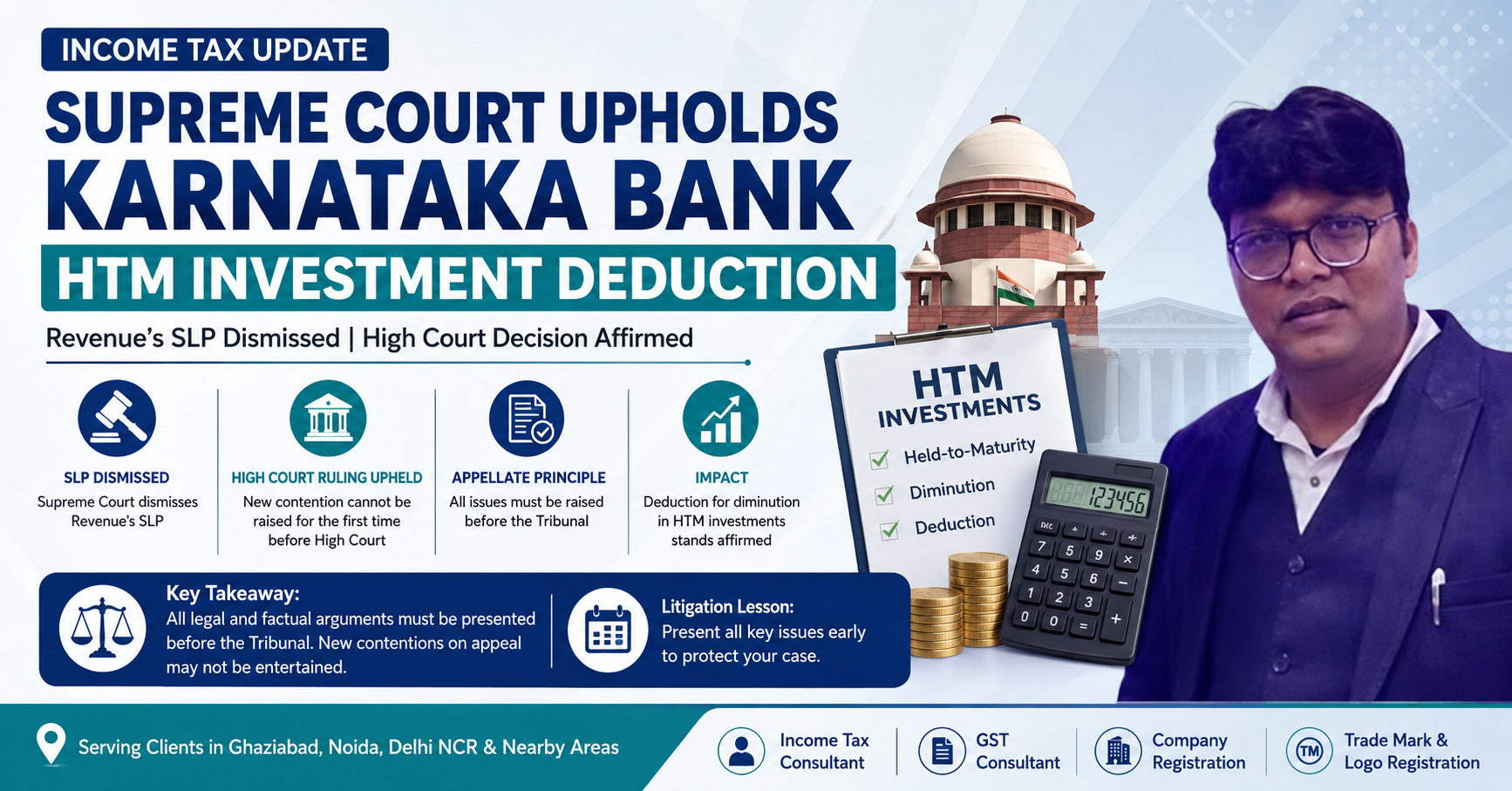
The Supreme Court has dismissed the Revenue's Special Leave Petition (SLP), thereby upholding the Karnataka High Court's ruling in favour of Karnataka Bank.
The High Court had held that the Revenue could not raise the contention regarding netting-off appreciation in the Held-to-Maturity (HTM) investment portfolio for the first time before the High Court because the issue had not been argued before the Income Tax Appellate Tribunal (ITAT).
Since the Supreme Court found no reason to interfere under Article 136 of the Constitution of India, the High Court's decision continues to stand.
Practical Explanation
Although this judgment relates specifically to Karnataka Bank, the underlying procedural principle applies much more broadly.
The decision reminds both taxpayers and tax authorities that litigation should proceed in an orderly manner. Every important argument should be presented before the Tribunal so that evidence, facts, and legal submissions can be properly examined.
If an entirely new contention is introduced only before the High Court, the Court may refuse to consider it because the Tribunal never had the opportunity to evaluate that issue.
Example
Suppose a company claims a deduction relating to investment valuation.
During proceedings before the Tribunal:
· The Revenue disputes the valuation method.
· However, it never argues that appreciation should be adjusted against depreciation.
If the Revenue later attempts to introduce this completely new argument before the High Court, the Court may reject the contention because it was never raised before the Tribunal.
This is precisely the procedural principle reaffirmed in the Karnataka Bank litigation.
Why This Matters
|
Issue |
Practical Impact |
|
New arguments on appeal |
May not be entertained by the High Court |
|
Tribunal proceedings |
All significant issues should be argued at this stage |
|
Litigation strategy |
Complete factual and legal submissions should be made early |
|
Judicial efficiency |
Prevents surprises during appellate proceedings |
Compliance and Best Practices
Businesses, banks, and tax professionals should consider the following practical approach:
1. Identify every relevant legal issue before filing or defending an appeal.
2. Present all factual and legal contentions before the Tribunal.
3. Maintain proper documentation supporting investment valuation.
4. Review earlier judicial precedents before advancing new arguments.
5. Seek professional advice during appellate proceedings rather than introducing fresh contentions at a later stage.
6. Ensure litigation strategy is comprehensive from the beginning.
7. Preserve records that support valuation methodologies used for tax purposes.
For taxpayers located in Ghaziabad (201010), Noida, Vaishali (201019), Indirapuram (201014), Vasundhra (201012), Delhi NCR, and nearby areas, obtaining timely advice from an experienced Income tax consultant near me can help reduce procedural risks during appeals. Businesses often also search for GST consultant near me, Company registration consultant near me, Trade Mark consultant near me, logo registration consultant near me, Income tax services near me, GST services near me, Company registration services near me, Trade Mark services near me, and logo registration services near me for broader compliance support.
Legal Reference
Section
Not directly at issue in the reported orders. The matter concerns treatment of investment valuation and deduction under the Income-tax Act along with appellate procedure.
Rule
Procedural principle that a new legal or factual contention cannot ordinarily be raised before a higher court if it was not urged before the Tribunal. The Karnataka High Court applied this principle, and the Supreme Court declined to interfere.
Notification / Circular
None specifically relied upon as the basis for the Revenue's netting-off contention. Earlier Karnataka Bank decisions and Tribunal rulings on valuation methodology were referred to by the courts.
Legal Position
The Supreme Court dismissed the Revenue's Special Leave Petition and upheld the Karnataka High Court's ruling that the Revenue could not raise the netting-off-appreciation contention for the first time on appeal because it had not been urged before the Tribunal. Therefore, the decision in favour of Karnataka Bank allowing deduction for diminution/depreciation in its HTM investment portfolio stands affirmed.
The matter concerns the treatment of investment valuation and deduction under the Income-tax Act together with settled principles governing appellate procedure.
The courts applied the established procedural rule that a party cannot introduce a completely new legal or factual contention before a higher forum if that contention was not argued before the forum immediately below. This principle ensures fairness by allowing the lower forum an opportunity to consider and decide the issue before appellate scrutiny.
The Karnataka High Court applied this procedural principle to the Revenue's argument relating to netting-off appreciation against diminution in the HTM investment portfolio. Since the Revenue had not raised this contention before the Tribunal, the High Court declined to entertain it.
The Supreme Court thereafter declined to exercise its extraordinary jurisdiction under Article 136 of the Constitution and dismissed the Revenue's Special Leave Petition.
This case does not involve Form 25 or any statutory Income-tax Rule form. The reported orders do not rely upon any prescribed form. The dispute concerns investment valuation, deduction, and appellate procedure.
The ruling binds the parties involved and is persuasive in similar matters. Revenue authorities should raise all relevant legal and factual contentions before the Tribunal or other appropriate lower forum. Attempting to introduce such arguments for the first time before the High Court is liable to be rejected if those issues were not previously argued.
The dismissal of the Special Leave Petition concludes the litigation on this issue for the relevant assessment year, subject to any further proceedings permissible under law.
Frequently Asked Questions
1. What did the Supreme Court decide?
The Supreme Court dismissed the Revenue's Special Leave Petition and allowed the Karnataka High Court's decision to remain effective.
2. Why was the Revenue's argument rejected?
Because the netting-off appreciation contention had not been argued before the Tribunal and was raised for the first time before the High Court.
3. Does this judgment decide investment valuation law itself?
The reported orders primarily reaffirm the procedural rule regarding new contentions in appellate proceedings while leaving the High Court's decision in favour of Karnataka Bank undisturbed.
4. Is Form 25 involved in this case?
No. The dispute does not concern Form 25 or any statutory Income-tax Rule form.
5. What lesson should taxpayers learn?
Ensure that all important legal and factual arguments are presented before the Tribunal. Waiting until a higher appeal may result in those arguments being rejected.
6. Does this decision apply to all taxpayers?
The judgment directly binds the parties. However, the procedural principle is persuasive and reflects a well-settled approach followed in appellate litigation.
Conclusion
The Supreme Court's dismissal of the Revenue's Special Leave Petition reinforces an important procedural principle in tax litigation. Parties should present all relevant legal and factual issues before the Tribunal rather than attempting to introduce new contentions at a later appellate stage.
For taxpayers, financial institutions, and professionals, the decision serves as a reminder that a well-prepared litigation strategy begins at the earliest stage of the appellate process. If you are located in Ghaziabad, Noida, Delhi NCR, or nearby areas and are looking for an Income tax consultant near me or GST consultant near me, understanding procedural compliance can be just as important as understanding substantive tax law.
For expert guidance on this topic, contact your tax professional today.
Disclaimer
This content is for educational and knowledge purposes only. For verification and applicability to your case, please consult your tax professional.
Have Questions? We're Here to Help
Get expert advice from AMIT SIDDHI AND ASSOCIATES. Reach out to discuss your requirements.