
Delhi High Court Clarifies Tax Treatment of Share Buybacks – No Tax Under Section 56(2)(x)
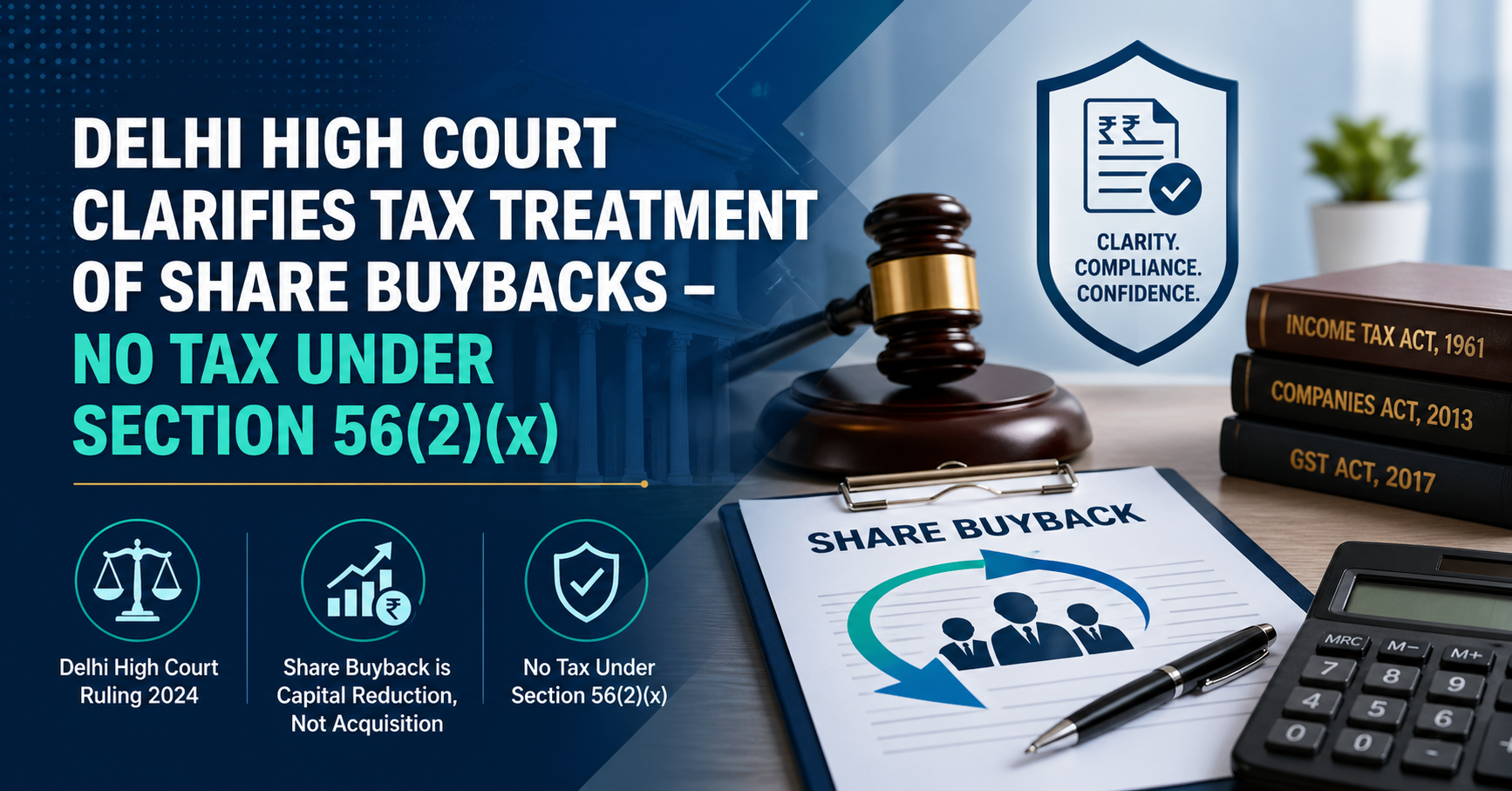
Confusion around taxation of share buybacks has led to repeated disputes during assessments. A recent Delhi High Court ruling has now provided much-needed clarity for companies.
BODY
Understanding Share Buyback Under Law
A share buyback is a process where a company repurchases its own shares from existing shareholders. This is governed by Section 68 of the Companies Act, 2013.
Key features of buyback:
-
It reduces the company’s share capital
-
Shares bought back are extinguished
Need help with this? Talk to AMIT SIDDHI AND ASSOCIATES → -
It is a capital restructuring exercise, not a business purchase
Core Issue: Applicability of Section 56(2)(x)
Section 56(2)(x) of the Income Tax Act taxes receipts of property without consideration or at a value lower than Fair Market Value (FMV).
Tax authorities previously argued:
-
Shares are “property”
-
If buyback price < FMV (as per Rule 11UA), difference = taxable income
However, this interpretation created unnecessary litigation.
Delhi High Court Ruling – Key Takeaways
In the case of Pr. Commissioner of Income-tax v. Globe Capital Market Ltd. (2024), the Court rejected this approach based on strong legal reasoning.
-
Buyback is Capital Reduction, Not Acquisition
The Court held that buyback is governed by Section 68 of the Companies Act. It is not a transaction to “acquire” an asset but a mechanism to return capital to shareholders. -
Shares Are Extinguished
-
Once shares are bought back, they cease to exist
-
They are cancelled and removed from circulation
-
Therefore, the company does not “hold” any asset after buyback
-
No “Receipt of Property”
Section 56(2)(x) applies only when a taxpayer receives property.
In buyback:
-
There is no incoming asset
-
There is no benefit retained by the company
-
Hence, the provision cannot be invoked
-
Rule 11UA Cannot Be Applied
Since Section 56(2)(x) itself does not apply, valuation rules under Rule 11UA become irrelevant.
Impact on Tax Assessments
This judgment has major implications for companies and tax authorities:
-
No addition can be made for buyback price vs FMV difference
-
Assessing Officers cannot treat such differences as deemed income
-
Litigation on this issue is expected to reduce significantly
Relevant Legal Provisions Explained
-
Section 56(2)(x) – Income from Other Sources
Taxes receipt of property at less than FMV.
Court clarified: It applies only when property is actually received. -
Section 68 of Companies Act, 2013
Governs buyback of shares.
Defines it as a capital reduction mechanism. -
Rule 11UA
Provides method to calculate FMV of shares.
Not applicable when Section 56(2)(x) itself does not apply.
Practical Example
Suppose:
-
FMV of share = ₹100
-
Buyback price = ₹70
Earlier view:
₹30 treated as income under Section 56(2)(x)
Now (after ruling):
-
No income arises
-
No tax implication for the company
Practical Tip / CA Insight
Companies planning buybacks should:
-
Ensure compliance with Companies Act provisions
-
Maintain proper documentation of valuation and approvals
-
Be aware that Section 56(2)(x) cannot be invoked in such cases
However, always evaluate other applicable provisions such as buyback tax under Section 115QA where relevant.
FAQ Section
-
Is share buyback taxable for the company?
Generally, buyback is subject to tax under Section 115QA, not under Section 56(2)(x). -
Can AO still question valuation of buyback price?
After this ruling, valuation cannot be challenged under Section 56(2)(x), but other laws may still apply. -
Does this ruling apply to all companies?
Yes, the principle applies broadly unless overturned or distinguished in future cases. -
What happens to shares after buyback?
They are extinguished and permanently cancelled. -
Is Rule 11UA relevant for buyback transactions?
No, if Section 56(2)(x) is not applicable, Rule 11UA cannot be invoked.
CONCLUSION
The Delhi High Court has brought clarity by confirming that share buybacks are capital restructuring transactions, not acquisitions. This eliminates unjustified tax additions based on FMV comparisons. Businesses should align their tax positions accordingly and avoid unnecessary disputes.
For expert guidance on this topic, contact your tax professional today.
Have Questions? We're Here to Help
Get expert advice from AMIT SIDDHI AND ASSOCIATES. Reach out to discuss your requirements.