
Section 269ST: Cash Transaction Limit of ₹2 Lakh – Rules, Penalty & Practical Guidance
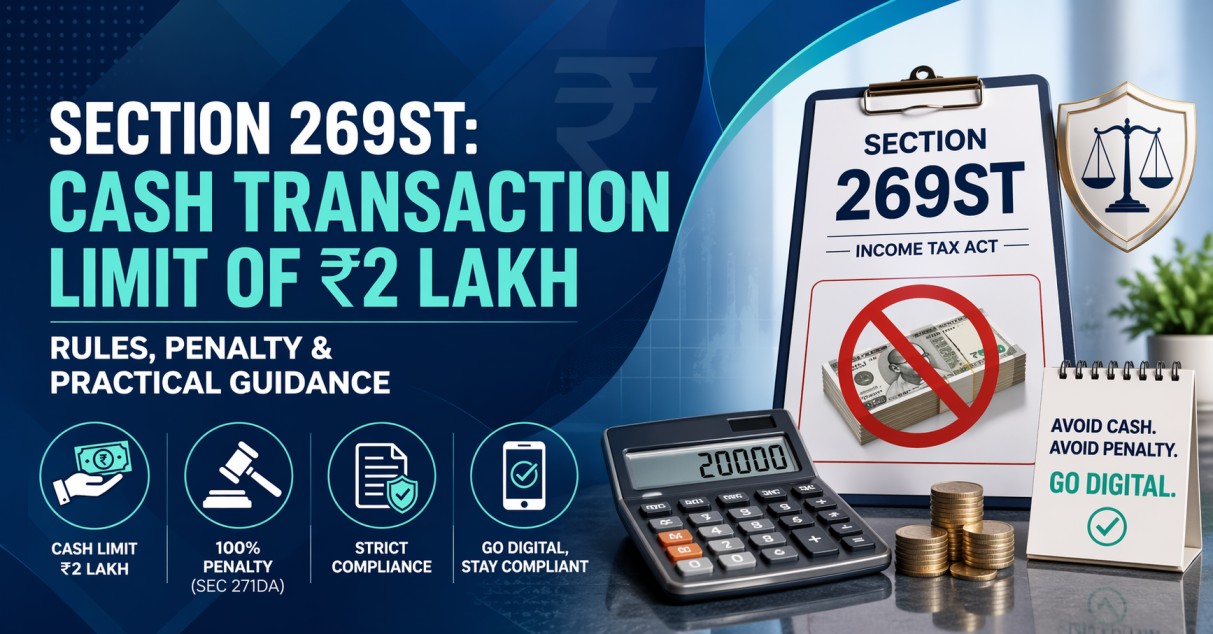
Handling large cash transactions can lead to heavy penalties if not done correctly. Section 269ST of the Income Tax Act puts strict limits to discourage cash dealings and promote transparency.
UNDERSTANDING SECTION 269ST
Section 269ST restricts the receipt of cash of ₹2,00,000 or more. The objective is to reduce black money circulation and encourage digital payments.
The restriction applies if cash is received:
- From a single person in a single day
- For a single transaction (even if paid over multiple days)
- For transactions related to one event or occasion
This means even if payments are split, the total amount is considered for compliance.
EXAMPLES FOR BETTER CLARITY
Example 1:
A trader receives ₹2,10,000 in cash from one customer in one day → Violation
Example 2:
A contractor receives ₹1,00,000 today and ₹1,50,000 tomorrow for the same project → Violation (single transaction)
Example 3:
A wedding planner receives multiple cash payments totaling ₹2,50,000 from one client for a wedding → Violation (one event)
SPLITTING CASH PAYMENTS – NOT A VALID ESCAPE
Many believe splitting payments avoids the rule, but this is incorrect.
Even if payments are:
- Made on different days
- Divided into smaller amounts
If they relate to:
- One transaction OR
- One event
Then Section 269ST still applies.
PENALTY UNDER SECTION 271DA
Violation of Section 269ST leads to a severe penalty under Section 271DA.
Key points:
- Penalty = 100% of the cash amount received
- Example: If ₹3,00,000 is received in cash → Penalty = ₹3,00,000
This makes compliance extremely important for businesses and professionals.
EXEMPTIONS UNDER SECTION 269ST
The restriction does not apply to receipts by:
- Government
- Banking companies
- Post office savings banks
- Co-operative banks
- Transactions covered under Section 269SS
These entities operate under different regulatory frameworks.
IMPORTANT LEGAL REFERENCES
- Section 269ST (Income Tax Act)
Restricts receipt of ₹2 lakh or more in cash under specified conditions. - Section 271DA
Provides for penalty equal to the amount received in violation. - Section 269SS
Covers restrictions on acceptance of loans/deposits in cash beyond limits.
These provisions collectively aim to control unaccounted cash transactions.
IMPORTANT NUANCE: “GOOD AND SUFFICIENT REASONS”
The law allows relief from penalty if the taxpayer proves there were genuine reasons for accepting cash.
However:
- The term is not clearly defined
- It depends on the discretion of the tax officer
- Documentation and justification are critical
Examples (case-dependent):
- Banking system failure
- Emergency situations
- Lack of access to digital/payment infrastructure
But relying on this clause is risky and should not be a regular practice.
PRACTICAL TIP / CA INSIGHT
To stay compliant and avoid penalties:
- Always prefer digital modes (NEFT, RTGS, UPI, cheque)
- Track customer-wise receipts carefully
- Maintain proper documentation of transactions
- Avoid accepting large cash payments even if requested by clients
- Educate staff handling billing and collections
For businesses like builders, event managers, and traders, internal controls are essential.
FAQ SECTION
Q1. Can I receive ₹1.5 lakh cash today and ₹1 lakh tomorrow from the same person?
No, if it relates to the same transaction or event, it violates Section 269ST.
Q2. Does this rule apply to business-to-business transactions?
Yes, it applies to all persons including businesses and professionals.
Q3. Is receiving ₹2 lakh in cash allowed?
No, ₹2 lakh or more is prohibited. Even exactly ₹2 lakh can trigger violation.
Q4. Can I avoid penalty by explaining genuine hardship?
Possibly, but only if you can prove “good and sufficient reasons” to the tax authority.
Q5. Does this apply to cash withdrawals from bank?
No, withdrawals from banks are not covered under this section.
CONCLUSION
Section 269ST is a strict anti-cash provision with severe penalties. Businesses and individuals must adopt digital payment methods and maintain proper transaction tracking to stay compliant and avoid unnecessary tax exposure.
For expert guidance on this topic, contact your tax professional today.
Have Questions? We're Here to Help
Get expert advice from AMIT SIDDHI AND ASSOCIATES. Reach out to discuss your requirements.