
GST Compliance Alert: Job Work Return Due on 25th April 2026 for Large Taxpayers
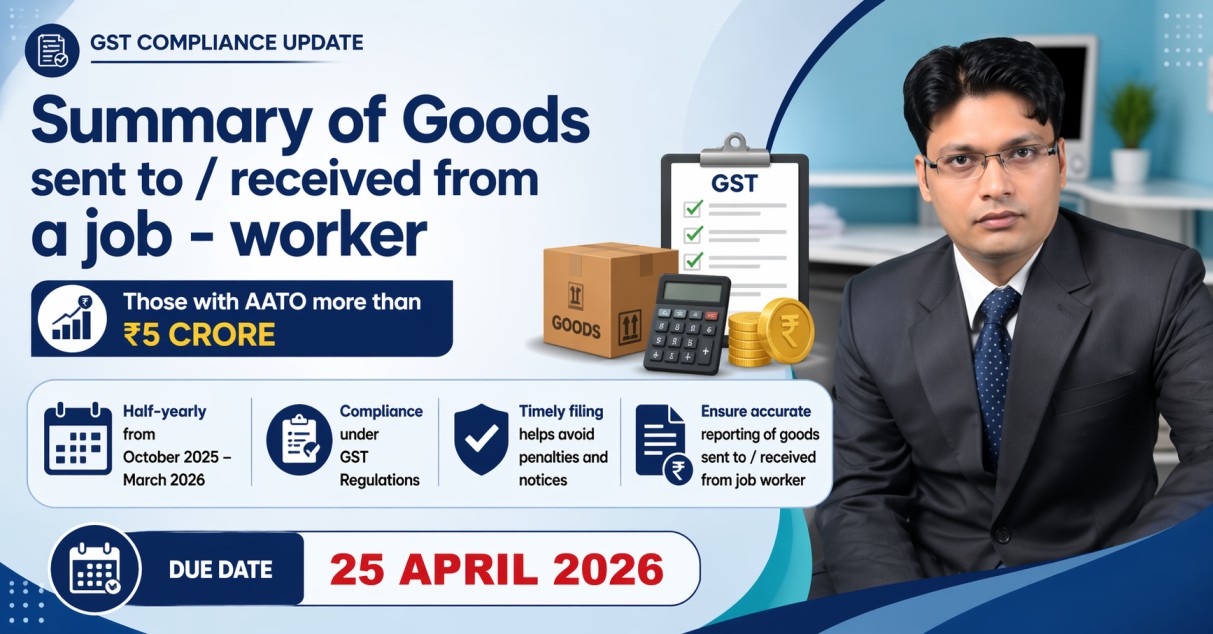
Businesses engaged in job work must stay alert to GST compliance timelines. Missing this return can lead to penalties and scrutiny.
UNDERSTANDING JOB WORK UNDER GST
Job work refers to processing or working on goods supplied by a principal manufacturer or business. The ownership of goods remains with the principal, while the job worker performs specific tasks.
Under GST, both the principal and job worker have certain compliance responsibilities, especially regarding tracking movement of goods.
WHAT IS THIS HALF-YEARLY RETURN?
Taxpayers with Aggregate Annual Turnover (AATO) exceeding Rs. 5 crore are required to furnish details of goods:
- Sent to job workers
- Received back from job workers
- Supplied directly from job worker premises
This is done through the prescribed GST return (commonly related to ITC-04 compliance).
DUE DATE FOR CURRENT PERIOD
- Period Covered: October 2025 to March 2026
- Due Date: 25th April 2026
WHO NEEDS TO FILE?
You must file this return if:
- Your AATO exceeds Rs. 5 crore
- You have sent goods for job work during the period
- You are a principal manufacturer or trader using job work services
KEY DETAILS TO BE REPORTED
The return includes:
- Description and quantity of goods sent
- Details of challans issued
- Goods received back or supplied from job worker location
- Waste or scrap generated
LEGAL REFERENCES
- Section 143 of the CGST Act: Governs job work procedures and conditions
- Rule 45 of CGST Rules: Mandates filing of details for goods sent to job workers
- GST ITC-04 Form: Prescribed format for reporting job work transactions
These provisions ensure transparency and proper tracking of goods movement without tax leakage.
CONSEQUENCES OF NON-COMPLIANCE
Failure to file or incorrect reporting may lead to:
- Penalty under Section 122 of CGST Act
- Disallowance of Input Tax Credit (ITC)
- Increased chances of GST audit or notices
REAL-LIFE EXAMPLE
A manufacturing company sends raw materials worth Rs. 50 lakhs to a job worker but fails to report it. During GST scrutiny, authorities may treat it as a deemed supply, resulting in tax liability along with penalties.
PRACTICAL TIP / CA INSIGHT
- Maintain proper challan records for all job work transactions
- Reconcile job work data with stock and GST returns
- File ITC-04 well before the due date to avoid last-minute errors
- Use accounting or GST software to track movement efficiently
FAQ SECTION
- What is the frequency of ITC-04 filing?
For taxpayers with AATO above Rs. 5 crore, it is half-yearly. - Is ITC-04 mandatory even if no transactions occurred?
Yes, a NIL return should be filed to stay compliant. - Can goods be sent directly from job worker to customer?
Yes, subject to conditions under Section 143. - What happens if goods are not returned within time?
They are treated as deemed supply and GST becomes payable. - Is there any late fee for delayed filing?
Currently, there is no specific late fee, but penalties may apply under general provisions.
CONCLUSION
Timely filing of job work returns is essential for businesses with high turnover. Proper documentation and reconciliation can help avoid penalties and ensure smooth GST compliance.
For expert guidance on this topic, contact your tax professional today.
Have Questions? We're Here to Help
Get expert advice from AMIT SIDDHI AND ASSOCIATES. Reach out to discuss your requirements.