
Karnataka High Court Clarifies Section 153C Proceedings: Search Powers Are Person-Centric, Not Premises-Centric
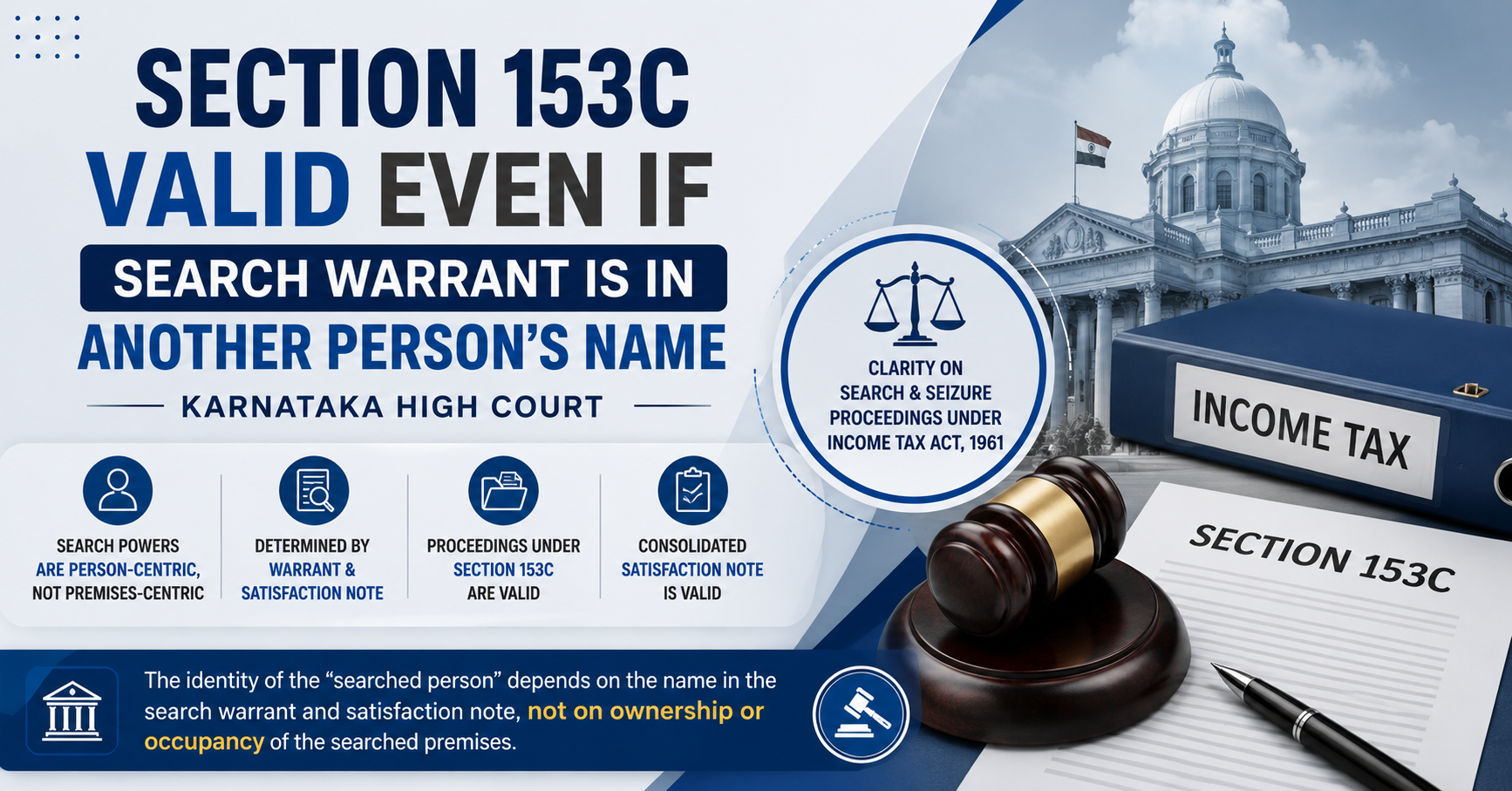
Income tax search and seizure cases often raise questions regarding who can be assessed after a search operation. One common issue is whether a person whose premises are searched can automatically be treated as a “searched person” under the Income-tax Act, 1961.
If you are searching in Ghaziabad, Noida, Delhi NCR, Vaishali, Indirapuram, Vasundhara, and nearby areas for an income tax consultant near me, tax consultant near me, or income tax services near me, understanding the distinction between Sections 153A and 153C is important for search-related tax proceedings.
A recent Karnataka High Court judgment has clarified that the status of a searched person depends on the name mentioned in the search warrant and satisfaction note, not merely on the ownership or occupation of the premises searched.
Latest Update
The Karnataka High Court, in Deputy Commissioner of Income-tax Central Circle-1(4) v. C.R. Ram Mohan Raju (Writ Appeal No. 382 of 2026), held that proceedings under Section 153C are valid against a person whose premises were searched if the search warrant was issued in another person's name.
The judgment reinforces the principle that search powers under Section 132 are person-centric and not premises-centric.
Practical Explanation
The judgment provides important guidance for taxpayers and tax authorities.
Many taxpayers assume that if their residence, office, or business premises are searched during a tax investigation, they automatically become the “searched person” under the Income-tax Act.
The Karnataka High Court has clarified that this assumption is incorrect.
The legal status depends on the search authorization itself.
Example
Suppose a search warrant is issued against Mr. A.
During the investigation, authorities search a property owned by Mr. B because they believe documents relating to Mr. A are kept there.
Even though Mr. B’s property is physically searched:
· Mr. A remains the searched person.
· Mr. B may be treated as an “other person.”
· If documents belonging to Mr. B are seized and satisfy legal conditions, proceedings may be initiated against Mr. B under Section 153C.
Comparison Between Sections 153A and 153C
|
Particulars |
Section 153A |
Section 153C |
|
Applicable To |
Searched Person |
Other Person |
|
Basis |
Named in Search Warrant |
Documents seized belong to another person |
|
Trigger |
Search under Section 132 |
Satisfaction regarding seized material |
|
Assessment |
Direct assessment of searched person |
Assessment of third party |
|
Satisfaction Note |
Not primary issue |
Mandatory jurisdictional requirement |
This distinction is critical because the procedural requirements differ significantly.
Why This Judgment Is Important
1. Clarifies Jurisdiction
The judgment removes uncertainty regarding who can be assessed under Section 153A and who falls under Section 153C.
2. Reduces Litigation
Many disputes arise because taxpayers argue that searching a property automatically makes them the searched person. The ruling addresses this issue directly.
3. Strengthens Search Jurisprudence
The decision confirms that search powers under Section 132 are person-focused rather than property-focused.
4. Supports Administrative Efficiency
The court accepted a consolidated satisfaction note when the same Assessing Officer handled both cases, reducing procedural duplication.
5. Provides Guidance for Future Cases
The judgment is expected to become an important precedent in search and seizure matters involving multiple parties and common premises.
Step-by-Step Compliance Process After Search
Step 1: Verify the Search Warrant
Check whose name appears in the warrant of authorization.
Step 2: Examine Seized Documents
Determine whether the seized documents belong to the searched person or another person.
Step 3: Review Satisfaction Recording
The Assessing Officer must record satisfaction before initiating proceedings under Section 153C.
Step 4: Assess Jurisdiction
Identify whether the taxpayer falls under Section 153A or Section 153C.
Step 5: Respond to Notices Timely
Provide accurate responses and supporting documentation during assessment proceedings.
Step 6: Seek Professional Guidance
Complex search-related proceedings often require specialized assistance from an income tax consultant near me or tax consultant near me experienced in search and seizure matters.
Legal Reference
Section
· Section 132 – Search and Seizure
· Section 153A – Assessment of Searched Person
· Section 153C – Assessment of Other Person
Rule
· Not applicable (Statutory provisions under Income-tax Act, 1961)
Notification / Circular
· CBDT Circular No. 24/2015 (Recording of Satisfaction for Section 153C Proceedings)
Official Source Links
https://www.casemine.com/judgement/in/69029a1af9d34958f6b46b09
Legal Position
The Karnataka High Court upheld that Section 153C proceedings are valid against an occupant of searched premises when the search warrant was issued in another person's name. The court ruled that the "searched person" is determined by the name in the warrant and satisfaction note, not by premises ownership.
Section 132 empowers authorities to conduct search operations. The warrant of authorization is person-specific and not premises-centric.
Section 153A applies to the searched person, meaning the person named in the warrant.
Section 153C applies to other persons when seized materials belong to them but relate to the searched person's case.
The court clarified that a person is deemed searched only if they are named in the warrant and satisfaction note. Mere search of their premises does not automatically make them the searched person.
In this case, K. Narayan Raju was the searched person because the warrant was issued in his name. The residence of C.R. Ram Mohan Raju was searched because authorities suspected that documents connected with K. Narayan Raju were located there.
Since the warrant was not issued in the name of C.R. Ram Mohan Raju, he qualified as an “other person.” Accordingly, proceedings initiated against him under Section 153C were valid and lawful.
The court further held that a consolidated satisfaction note is legally valid where the same Assessing Officer handles both the searched person's assessment and the other person's assessment.
The final legal position emerging from the judgment is that proceedings under Section 153C against the occupant of premises are legally sustainable when the search warrant has been issued in another person's name. The determining factor is the name appearing in the warrant and satisfaction note rather than ownership, possession, or occupation of the premises.
Frequently Asked Questions (FAQs)
1. Can Section 153C apply if my premises were searched?
Yes. If the search warrant was issued in another person's name and seized material belongs to you, proceedings under Section 153C may be initiated.
2. Does ownership of the searched property determine searched person status?
No. The Karnataka High Court has clarified that the determining factor is the name appearing in the search warrant and satisfaction note.
3. What is the difference between Sections 153A and 153C?
Section 153A applies to the person named in the warrant, while Section 153C applies to another person whose documents or assets are discovered during the search.
4. Is a satisfaction note mandatory under Section 153C?
Yes. Recording satisfaction is a jurisdictional requirement before initiating proceedings under Section 153C.
5. Can one satisfaction note cover both persons?
According to the Karnataka High Court, a consolidated satisfaction note is valid when the same Assessing Officer handles both matters.
6. How can taxpayers protect their rights during search proceedings?
Taxpayers should maintain proper records, respond promptly to notices, and consult qualified professionals for representation.
7. Where can businesses seek assistance?
Businesses located in Ghaziabad (201010), Vaishali (201019), Indirapuram (201014), Vasundhara (201012), Noida, and Delhi NCR often search for GST consultant near me, income tax consultant near me, company registration consultant near me, Trade Mark consultant near me, logo registration consultant near me, GST services near me, company registration services near me, Trade Mark services near me, and logo registration services near me for professional compliance support.
Conclusion
The Karnataka High Court has delivered significant clarity on the operation of Sections 132, 153A, and 153C of the Income-tax Act. The ruling confirms that search proceedings are person-centric and that the identity of the searched person depends on the warrant of authorization rather than ownership or occupation of the searched premises.
Taxpayers should carefully evaluate the search warrant, satisfaction note, and seized materials before determining the appropriate legal position. The judgment is likely to play a major role in future litigation involving search and seizure assessments.
For taxpayers and businesses in Ghaziabad, Noida, Delhi NCR, and nearby areas, understanding these provisions is essential when dealing with income tax search proceedings and related assessments.
For expert guidance on this topic, contact your tax professional today.
Disclaimer
This content is for educational and knowledge purposes only. For verification and applicability to your case, please consult your tax professional.
Have Questions? We're Here to Help
Get expert advice from AMIT SIDDHI AND ASSOCIATES. Reach out to discuss your requirements.