
7 Red Flags That Can Trigger an Income Tax Notice in India (2026 Guide)
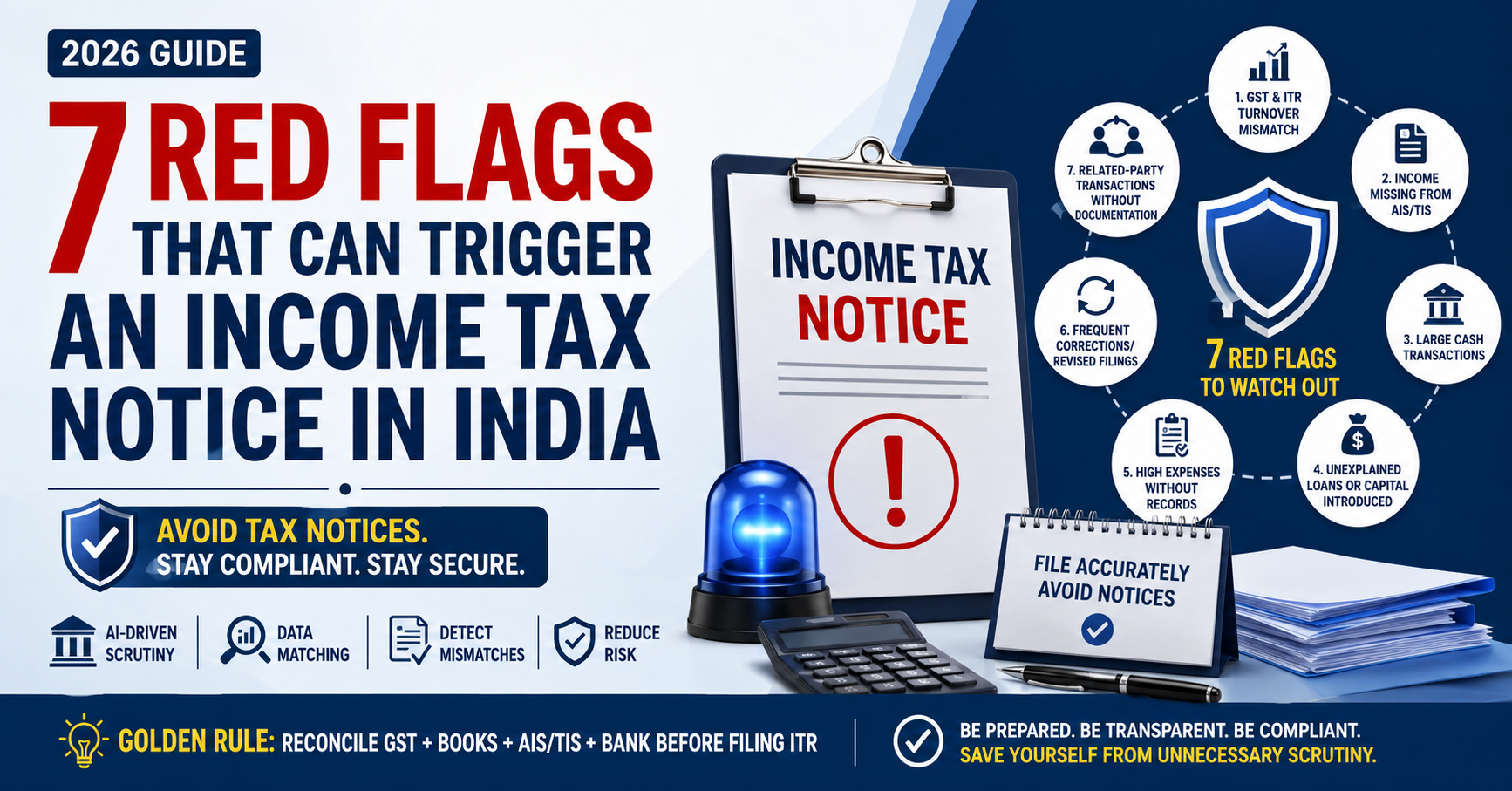
Income tax notices are increasingly being issued due to automated data verification systems used by the Income Tax Department. With advanced AI-driven analytics, tax authorities can now cross-check information from GST returns, bank transactions, AIS, TIS, Form 26AS, and income tax returns to identify discrepancies.
If you are searching in Ghaziabad, Noida, Delhi NCR, Vaishali (201019), Indirapuram (201014), Vasundhra (201012), or nearby areas for an Income tax consultant near me, GST consultant near me, or tax consultant near me, understanding these common scrutiny triggers can help you avoid unnecessary notices and compliance issues.
Latest Update
The Income Tax Department continues to use AI-driven data analytics and automated cross-verification mechanisms to identify mismatches in taxpayer information. As per available verified information, more than 1.6 lakh tax returns are under scrutiny during 2025-26 due to data inconsistencies, unexplained transactions, and reporting mismatches.
No separate recent official amendment changing these scrutiny triggers has been found as of today.
LEGAL POSITION
Legal Reference
|
Section / Rule |
Relevance |
|
Section 139(9) |
Defective return notice for mismatches |
|
Section 143(1) |
Automated scrutiny for AIS/TIS mismatches |
|
Section 142(1) |
Scrutiny notice for unexplained transactions |
|
Section 143(2) |
Detailed scrutiny for high-risk profiles |
|
Section 69A/69C |
Unexplained loans/capital & excessive expenses |
|
Section 40A(3) |
Cash expenses exceeding prescribed limits |
|
Section 285BA (SFT) |
Reporting of high-value transactions |
Official Source Links
https://www.incometax.gov.in/iecacPortal/
https://www.incometaxindia.gov.in/faqs-and-guidance-notes-on-forms-as-per-income-tax-rules-2026
https://www.incometaxindia.gov.in/tax-tools
All 7 red flags mentioned are genuine triggers for income tax scrutiny notices in India. The department now uses automated data-matching across GST returns, AIS/TIS, bank records (SFT), and accounting books to flag mismatches.
The Income Tax Department uses AI-driven data analytics (Insight Portal) to cross-match GST returns (GSTR-1/3B) versus ITR turnover, AIS/TIS information such as interest, dividends, capital gains and rent versus declared income, bank SFT data including cash deposits exceeding ₹10 lakh in savings accounts and ₹50 lakh in current accounts, and accounting records versus tax filings.
Red Flags Breakdown
1. GST & ITR Turnover Mismatch
Your GST returns (GSTR-1/3B) show ₹1.2 crore turnover, but your ITR declares only ₹60 lakh business income. This gap is a major trigger because GST and Income Tax data are now fully integrated.
Why it triggers: The department's automated system flags any discrepancy between GST turnover and ITR business income. Even a 5-10% mismatch can generate an instant notice.
How to avoid: Reconcile GSTR-3B, GSTR-1, and your accounting books before filing ITR. Ensure business income in ITR matches GST turnover.
2. Income Missing from AIS/TIS
Your Annual Information Statement (AIS) shows ₹15,000 FD interest and ₹8,000 dividend income, but you declared only salary income in ITR. This is the most common trigger for notices.
Examples that trigger notices:
- Interest income from FDs or bonds not declared.
- Rental income or TDS from other sources ignored.
- Capital gains and ESOP/RSU income not reported.
- Foreign income not disclosed.
Why it triggers: AIS and TIS records are automatically compared with the income disclosed in the return. Even small mismatches may trigger scrutiny under Section 143(1).
How to avoid: Cross-check Form 26AS, AIS, and TIS before filing and reconcile every reported transaction.
3. Large Cash Transactions
Depositing ₹12 lakh cash in a savings account or ₹55 lakh in a current account triggers SFT reporting under Section 285BA.
Threshold limits:
- Cash deposit of ₹10 lakh or more in savings account.
- Cash deposit of ₹50 lakh or more in current account.
- Cash expenses exceeding ₹2 lakh per transaction.
- Cash payment exceeding ₹10,000 per day per person may attract disallowance under Section 40A(3).
Why it triggers: Large cash movements may indicate unreported income or unexplained sources of funds.
How to avoid: Maintain documentary evidence and proper banking trails for significant cash transactions.
4. Unexplained Loans or Capital Introduced
If ₹50 lakh capital is introduced into a business or a large loan is received without proper documentation, the transaction may attract scrutiny under Section 69A.
Why it triggers: The source of funds must be established with evidence.
How to avoid: Maintain loan agreements, gift deeds, confirmations, PAN details, and bank statements supporting the transaction.
5. High Expenses Without Supporting Records
A business may claim substantial expenses but fail to maintain invoices, vouchers, or payment records.
Why it triggers: The department may treat such expenses as unexplained expenditure under Section 69C or disallow them under Section 40A(3).
How to avoid: Preserve invoices, contracts, payment proofs, and vendor documentation.
6. Frequent Corrections or Revised Filings
Repeated revisions of ITRs with major changes in turnover, deductions, or income may attract deeper examination.
Why it triggers: Multiple revisions may indicate inaccurate reporting or inconsistency in disclosures.
How to avoid: Review and verify all information before filing the original return.
7. Related-Party Transactions Without Proper Documentation
Payments or transactions with related entities without adequate transfer pricing documentation can trigger scrutiny under Section 92.
Why it triggers: Related-party transactions are considered high-risk areas for income shifting and profit manipulation.
How to avoid: Maintain transfer pricing reports, agreements, benchmarking studies, and valuation documents wherever applicable.
The most important recommendation is to reconcile GST records, accounting books, AIS/TIS information, and bank transactions before filing the Income Tax Return.
Practical Explanation
Many taxpayers assume that filing an ITR is enough. However, modern tax compliance requires consistency across all reporting platforms.
|
Compliance Area |
What Department Checks |
|
GST Returns |
Turnover reported |
|
ITR |
Business income declared |
|
AIS/TIS |
Interest, dividends, gains |
|
Bank Records |
High-value transactions |
|
Accounting Books |
Revenue and expenses |
|
Related Party Transactions |
Documentation and compliance |
Real-Life Example
Suppose a trader in Noida reports ₹1 crore turnover in GST returns but only ₹80 lakh in the Income Tax Return. Even if the difference occurred due to accounting adjustments, the mismatch may automatically generate a notice.
Similarly, a salaried employee may forget to disclose FD interest of ₹12,000 reflected in AIS. Although the amount appears small, automated systems can still flag the discrepancy.
This is why taxpayers looking for Income tax services near me or GST services near me should perform detailed reconciliations before filing.
Step-by-Step Compliance Process
Step 1: Download AIS and Form 26AS
Review all reported transactions and income entries.
Step 2: Reconcile GST Data
Match GSTR-1 and GSTR-3B with accounting records and turnover reported in the ITR.
Step 3: Verify Bank Statements
Check all high-value deposits, withdrawals, and transfers.
Step 4: Review Expense Documentation
Ensure invoices, vouchers, and supporting records are available.
Step 5: Verify Loans and Capital Introductions
Keep proper agreements and source documents.
Step 6: Review Related-Party Transactions
Prepare documentation wherever transfer pricing provisions apply.
Step 7: File and E-Verify Accurately
Verify all figures before submission and complete e-verification within the prescribed timeline.
Frequently Asked Questions (FAQs)
1. Can a small AIS mismatch trigger an Income Tax notice?
Yes. Even small differences between AIS data and the income declared in the return may trigger automated verification.
2. Is every GST and ITR mismatch considered tax evasion?
No. Some mismatches arise due to accounting or reporting differences, but they should be properly explained and documented.
3. What is SFT reporting?
SFT (Statement of Financial Transactions) is a reporting mechanism through which banks and other institutions report specified high-value transactions to the Income Tax Department.
4. Are cash transactions always problematic?
Not necessarily. However, large cash transactions without proper documentation are more likely to attract scrutiny.
5. Why are related-party transactions closely monitored?
Because they can potentially be used for shifting profits or manipulating taxable income. Proper documentation is therefore essential.
6. Should businesses reconcile GST and Income Tax data before filing?
Yes. Reconciliation of GST returns, accounting books, bank records, AIS, and ITR is one of the most effective ways to reduce the risk of notices.
7. Can I seek professional assistance for compliance reviews?
Yes. Many businesses and professionals search for GST consultant near me, Company registration consultant near me, Trade Mark consultant near me, logo registration consultant near me, and tax consultant near me to ensure compliance before filing returns.
Conclusion
The Income Tax Department's technology-driven scrutiny framework makes it essential for taxpayers to maintain consistency across GST filings, accounting records, AIS/TIS information, bank transactions, and income tax returns.
Whether you are a salaried employee, professional, startup, or business owner in Ghaziabad (201010), Noida, Delhi NCR, Vaishali, Indirapuram, Vasundhra, or nearby areas searching for Income tax consultant near me, GST services near me, Company registration services near me, Trade Mark services near me, or logo registration services near me, proactive reconciliation and documentation can significantly reduce the risk of notices.
For expert guidance on this topic, contact your tax professional today.
Disclaimer
This content is for educational and knowledge purposes only. For verification and applicability to your case, please consult your tax professional.
Have Questions? We're Here to Help
Get expert advice from AMIT SIDDHI AND ASSOCIATES. Reach out to discuss your requirements.