
Partnership Firm / LLP Income Tax Return (ITR) Filing for FY 2025-26 (AY 2026-27)
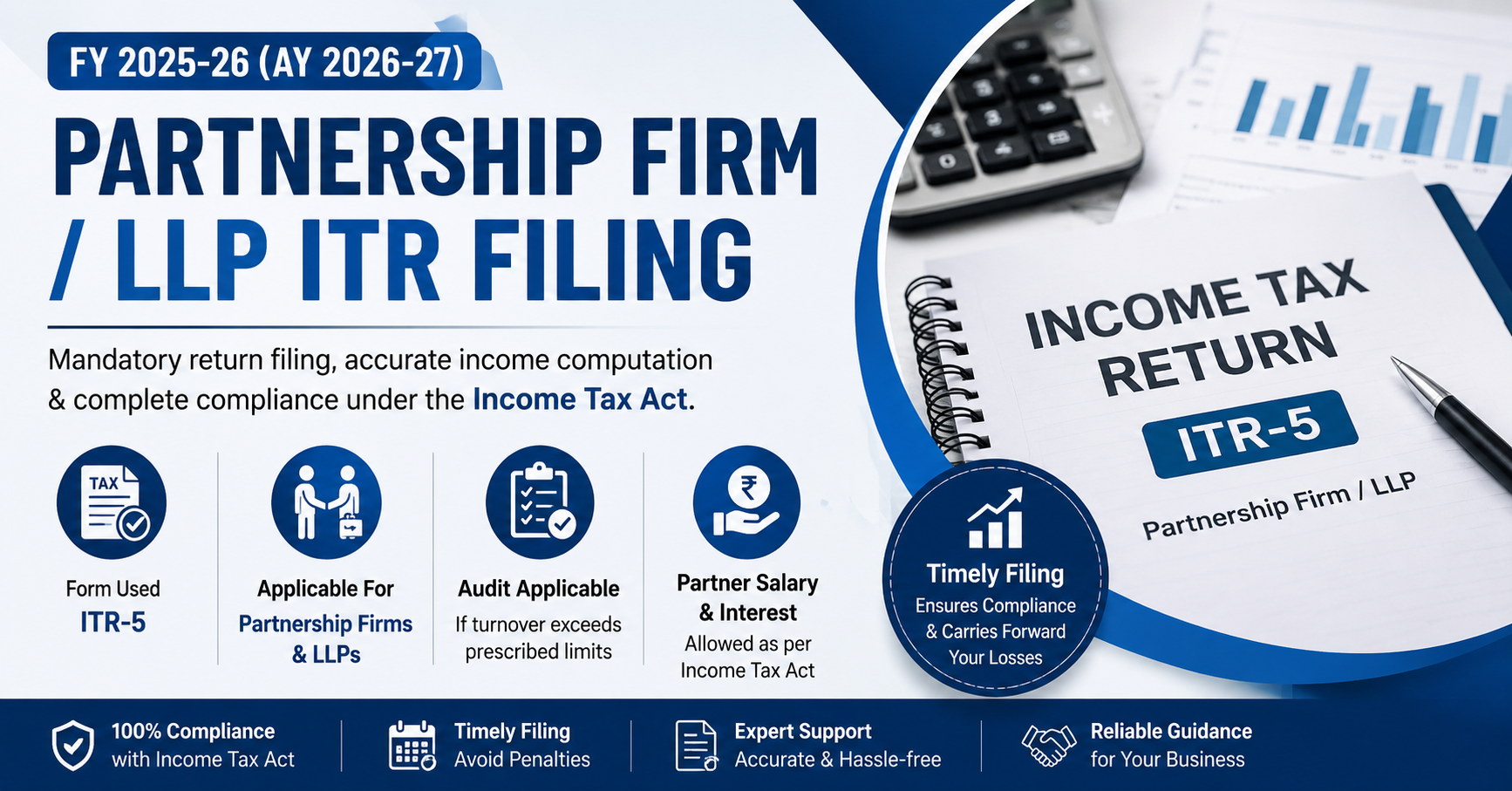
Every Partnership Firm and Limited Liability Partnership (LLP) registered in India has a legal responsibility to file its Income Tax Return (ITR), irrespective of whether it has earned a profit or incurred a loss during the financial year. Filing the return on time not only ensures compliance with the Income Tax Act but also helps avoid penalties, interest, and loss of important tax benefits.
If you are searching in Ghaziabad, Noida, Delhi NCR, Vaishali, Indirapuram, Vasundhara, or nearby areas for an Income Tax consultant near me, Tax consultant near me, or Income Tax services near me, understanding the ITR filing requirements for partnership firms and LLPs can help you stay fully compliant.
Latest Update
As of FY 2025-26 (AY 2026-27), Partnership Firms and LLPs are required to file their income tax returns in Form ITR-5 as prescribed under the Income Tax Act.
No recent official change affecting the basic filing requirement for Partnership Firms or LLPs has been notified as of today. Taxpayers should continue complying with the applicable provisions, due dates, and audit requirements prescribed under the Income Tax Act.
Legal Reference
Applicable Form
ITR-5
Relevant Provisions
- Income-tax Act, 1961
- Section 139 – Filing of Income Tax Return
- Section 40(b) – Deduction of Partner's Salary, Bonus, Commission and Interest
- Section 44AB – Tax Audit
- Applicable Income-tax Rules relating to ITR-5
Legal Position
Every Partnership Firm and Limited Liability Partnership (LLP) is required to file its Income Tax Return, irrespective of whether it has earned a profit or incurred a loss during the financial year.
The applicable return form is ITR-5.
Taxable income should be computed after considering all eligible business income, allowable expenses, deductions, depreciation, and other applicable provisions under the Income Tax Act.
Partner remuneration, salary, bonus, commission, and interest on capital are allowable as deductions only to the extent and subject to the conditions prescribed under Section 40(b) of the Income-tax Act.
A tax audit becomes applicable where the turnover or gross receipts exceed the prescribed limits under Section 44AB of the Income-tax Act or where other audit conditions become applicable.
Filing the Income Tax Return within the prescribed due date is essential to carry forward eligible business losses and maintain compliance under the Income Tax Act.
Why Filing ITR-5 is Important
Many businesses assume that if there is no profit or if business operations were minimal, filing an Income Tax Return is optional. This is incorrect.
Timely filing offers several advantages:
- Ensures legal compliance
- Helps carry forward business losses
- Reduces the possibility of notices
- Improves financial credibility
- Facilitates bank loans and credit assessments
- Supports participation in government tenders
- Simplifies future tax assessments
Difference Between Partnership Firm and LLP
|
Particulars |
Partnership Firm |
LLP |
|
Governing Law |
Partnership Act |
LLP Act, 2008 |
|
Legal Status |
Not a separate legal entity |
Separate legal entity |
|
Liability |
Generally unlimited |
Limited liability |
|
ITR Form |
ITR-5 |
ITR-5 |
|
Audit Requirement |
Based on prescribed limits |
Based on prescribed limits |
Partner Remuneration and Interest
One of the most important aspects while filing ITR for Partnership Firms is the computation of partner remuneration and interest.
The Income Tax Act permits deduction for:
- Partner salary
- Bonus
- Commission
- Remuneration
- Interest on capital
However, these deductions are allowed only when:
- Authorized by the partnership deed.
- Paid to working partners where required.
- Within the limits prescribed under Section 40(b).
Incorrect computation may lead to disallowance during assessment.
Tax Audit Requirement
Not every Partnership Firm or LLP is required to undergo a tax audit.
A tax audit may become mandatory when:
- Turnover exceeds the prescribed limits under Section 44AB.
- Other conditions specified under the Income Tax Act are applicable.
Proper maintenance of books of accounts significantly simplifies the audit process and ensures accurate return filing.
Step-by-Step ITR Filing Process
Step 1: Collect Financial Records
Gather books of accounts, bank statements, invoices, expense records, and supporting documents.
Step 2: Compute Business Income
Calculate taxable income after considering allowable deductions, depreciation, partner remuneration, and other applicable adjustments.
Step 3: Verify Audit Applicability
Determine whether tax audit provisions apply based on turnover and statutory conditions.
Step 4: Prepare Form ITR-5
Complete all required schedules accurately, including business income, deductions, tax computation, and partner details.
Step 5: Verify Tax Liability
Calculate advance tax, self-assessment tax, TDS, and other applicable tax credits.
Step 6: File the Return
Submit the return electronically within the prescribed due date.
Step 7: Preserve Records
Maintain supporting documents for future reference, assessments, and audits.
Common Mistakes to Avoid
- Filing after the due date
- Incorrect partner remuneration calculation
- Claiming ineligible deductions
- Ignoring audit applicability
- Incorrect reporting of income
- Not reconciling books with bank statements
- Missing TDS credits
- Failure to maintain proper accounting records
Benefits of Professional ITR Filing
Professional assistance helps ensure:
- Accurate tax computation
- Correct partner remuneration calculation
- Compliance with audit provisions
- Proper tax planning
- Timely filing
- Reduced risk of notices
- Better documentation
- Compliance with all statutory requirements
If you are located in Ghaziabad, Noida, Delhi NCR, Vaishali (201019), Indirapuram (201014), Vasundhara (201012), or nearby areas and are searching for an Income Tax consultant near me, Tax consultant near me, GST consultant near me, Company registration consultant near me, Trade Mark consultant near me, Income Tax services near me, GST services near me, Company registration services near me, or Trade Mark services near me, obtaining professional guidance can help ensure timely and accurate compliance.
Frequently Asked Questions (FAQs)
1. Is ITR filing mandatory for Partnership Firms even if there is no income?
Yes. Partnership Firms are generally required to file their Income Tax Return irrespective of profit or loss.
2. Which ITR form is applicable for Partnership Firms and LLPs?
Form ITR-5 is applicable.
3. Can a Partnership Firm claim partner salary as an expense?
Yes, subject to the conditions and limits prescribed under Section 40(b) of the Income-tax Act.
4. Is tax audit compulsory for every LLP?
No. Tax audit is applicable only if the prescribed conditions under Section 44AB are satisfied.
5. What happens if the return is filed late?
Late filing may result in interest, fees, penalties (where applicable), and loss of certain benefits such as carrying forward eligible business losses.
6. Can an LLP file ITR without an audit?
Yes, if it does not fall under the mandatory tax audit provisions.
7. Why should books of accounts be maintained properly?
Proper accounting records facilitate accurate tax computation, audit compliance, and smooth assessments.
Conclusion
Filing the Income Tax Return for a Partnership Firm or LLP is much more than a statutory obligation. It demonstrates financial discipline, ensures compliance with the Income Tax Act, and protects valuable tax benefits such as the carry forward of eligible losses. Accurate computation of taxable income, correct treatment of partner remuneration, and timely filing of ITR-5 are essential for avoiding disputes and ensuring smooth business operations.
For businesses operating in Ghaziabad, Noida, Delhi NCR, Vaishali, Indirapuram, Vasundhara, and nearby areas, professional assistance can simplify the filing process and help maintain full compliance with the applicable tax provisions.
For expert guidance on this topic, contact your tax professional today.
Disclaimer
This content is for educational and knowledge purposes only. For verification and applicability to your case, please consult your tax professional.
Have Questions? We're Here to Help
Get expert advice from AMIT SIDDHI AND ASSOCIATES. Reach out to discuss your requirements.