
Company ITR Filing (ITR-6): Complete Guide for Companies
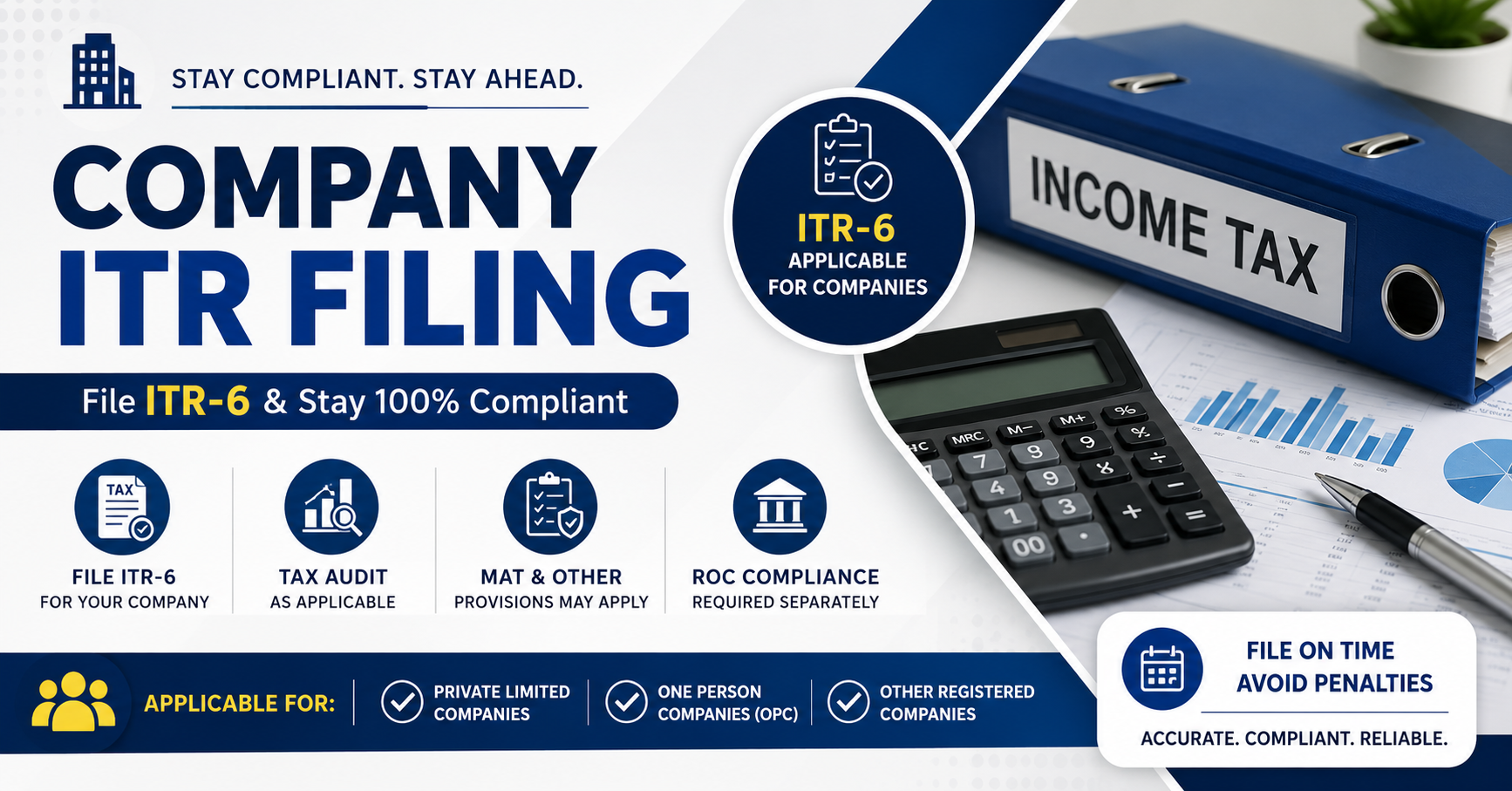
Every company registered under the Companies Act has income tax compliance responsibilities, irrespective of whether it has earned profits during the financial year. Filing the correct Income Tax Return (ITR) is one of the most important statutory obligations and helps businesses avoid penalties, interest, and unnecessary notices from the Income Tax Department.
If you are searching in Ghaziabad, Noida, Delhi NCR, or nearby areas for an Income Tax consultant near me, Tax consultant near me, or Income Tax services near me, understanding the Company ITR Filing process is the first step toward ensuring complete tax compliance.
Latest Update
No recent official update found as of today regarding the applicability of ITR-6 for companies. Companies should continue to comply with the applicable provisions of the Income-tax Act and file their returns within the prescribed due dates.
Legal Reference
Income-tax Act, 1961
Income Tax Return Form: ITR-6
Applicable To:
- Private Limited Companies
- One Person Companies (OPC)
- Other registered companies required to file ITR-6
Legal Position
Company ITR Filing covers income tax return filing for companies along with mandatory audit and compliance requirements. Proper financial reporting and tax compliance must be ensured as per the provisions of the Income-tax Act.
Form Used: ITR-6
The return is applicable for:
- Private Limited Companies
- One Person Companies (OPC)
- Other registered companies
Important points include:
- Tax audit may be mandatory as applicable under the Income-tax Act.
- ROC compliance is a separate statutory requirement under the Companies Act.
- Minimum Alternate Tax (MAT) and other applicable provisions may apply depending on the company's financial position and applicable tax laws.
What is Company ITR Filing?
Company Income Tax Return Filing is the annual process through which a company reports its income, expenses, taxes paid, deductions, and financial information to the Income Tax Department.
Unlike individual taxpayers, companies have more detailed reporting requirements because they maintain statutory books of accounts, prepare financial statements, and comply with various provisions of both the Income-tax Act and the Companies Act.
Accurate filing ensures transparency, strengthens financial credibility, and supports smooth business operations.
Who Needs to File ITR-6?
ITR-6 is generally applicable to:
|
Type of Company |
Eligible |
|
Private Limited Company |
✔ Yes |
|
One Person Company (OPC) |
✔ Yes |
|
Registered Company |
✔ Yes |
Companies should verify the applicable return form based on their legal status and tax provisions.
Documents Required for Company ITR Filing
Generally, the following documents are required:
- PAN of the company
- Certificate of Incorporation
- Financial Statements
- Balance Sheet
- Profit & Loss Account
- Bank Statements
- GST details (where applicable)
- TDS certificates
- Tax Audit Report (if applicable)
- Details of Advance Tax and Self-Assessment Tax
- Digital Signature Certificate (DSC)
- Previous year's Income Tax Return
Maintaining proper documentation helps in accurate reporting and reduces the chances of errors during filing.
Understanding Tax Audit
Certain companies are required to undergo a tax audit under the applicable provisions of the Income-tax Act.
A tax audit helps verify:
- Accuracy of financial statements
- Proper maintenance of books of accounts
- Compliance with tax provisions
- Correct reporting of income and expenses
The audit report forms an important part of the company's tax compliance process wherever applicable.
What is Minimum Alternate Tax (MAT)?
Minimum Alternate Tax (MAT) is a special tax provision applicable to certain companies. It ensures that companies paying little or no tax due to various deductions still pay a minimum level of tax where the provisions apply.
Whether MAT applies depends on the company's financial statements and applicable legal provisions.
Professional evaluation is recommended before filing the return.
ROC Compliance vs Income Tax Filing
Many business owners mistakenly believe that filing ROC forms completes all legal compliance.
However, these are separate compliances.
|
ROC Compliance |
Company ITR Filing |
|
Governed under Companies Act |
Governed under Income-tax Act |
|
Filed with MCA |
Filed with Income Tax Department |
|
Covers corporate filings |
Covers tax reporting |
|
Annual company compliance |
Annual tax compliance |
A company generally needs to comply with both requirements separately.
Step-by-Step Company ITR Filing Process
Step 1
Collect all financial records and supporting documents.
Step 2
Prepare financial statements.
Step 3
Determine taxable income after considering allowable deductions and adjustments.
Step 4
Complete tax audit requirements wherever applicable.
Step 5
Prepare Form ITR-6.
Step 6
Verify tax payments including TDS and advance tax.
Step 7
File the Income Tax Return electronically.
Step 8
Complete verification using the authorised Digital Signature Certificate.
Common Mistakes to Avoid
- Filing the wrong ITR form.
- Delaying return filing beyond the due date.
- Ignoring tax audit requirements.
- Mismatch between financial statements and tax return.
- Incorrect reporting of TDS.
- Failure to comply with separate ROC requirements.
- Not considering MAT where applicable.
Avoiding these mistakes helps reduce the risk of notices and penalties.
Why Professional Assistance Matters
Company taxation involves multiple compliance requirements beyond simply submitting an income tax return.
Professional assistance helps in:
- Accurate tax computation
- Compliance with applicable provisions
- Proper documentation
- Timely filing
- Review of tax audit applicability
- Guidance on MAT and other tax provisions
- Reduced risk of future tax disputes
If you are located in Ghaziabad, Vaishali (201019), Indirapuram (201014), Vasundhara (201012), Noida, or Delhi NCR and are searching for an Income Tax consultant near me, GST consultant near me, Company registration consultant near me, or Income Tax services near me, obtaining professional guidance can make the compliance process more efficient and reliable.
Frequently Asked Questions (FAQs)
1. Which form is used for Company Income Tax Return Filing?
Companies generally file their income tax return using ITR-6, as applicable.
2. Is ROC filing the same as Income Tax Filing?
No. ROC compliance and Income Tax Return filing are separate legal requirements.
3. Is tax audit compulsory for every company?
Tax audit requirements depend on the applicable provisions of the Income-tax Act.
4. What is MAT?
Minimum Alternate Tax (MAT) is a special tax provision that may apply to certain companies.
5. Can an OPC file ITR-6?
Yes. One Person Companies (OPCs) are generally covered under this service where ITR-6 is applicable.
6. Why should companies file their returns on time?
Timely filing helps avoid interest, penalties, compliance issues, and supports better financial credibility.
Conclusion
Company Income Tax Return Filing is an essential annual compliance for registered companies. Proper preparation of financial statements, timely filing of ITR-6, compliance with audit requirements where applicable, and separate ROC compliance help businesses remain legally compliant and financially organised.
If you are looking for Tax consultant near me, Income Tax consultant near me, GST services near me, Company registration services near me, or professional tax compliance support in Ghaziabad, Noida, and Delhi NCR, timely professional assistance can help ensure accurate and hassle-free compliance.
For expert guidance on this topic, contact your tax professional today.
Disclaimer
This content is for educational and knowledge purposes only. For verification and applicability to your case, please consult your tax professional.
Have Questions? We're Here to Help
Get expert advice from AMIT SIDDHI AND ASSOCIATES. Reach out to discuss your requirements.