
GSTAT Ruling: Mismatch or Excess ITC ≠ Automatic Fraud; Section 74 Quashed Without Evidence of Suppression
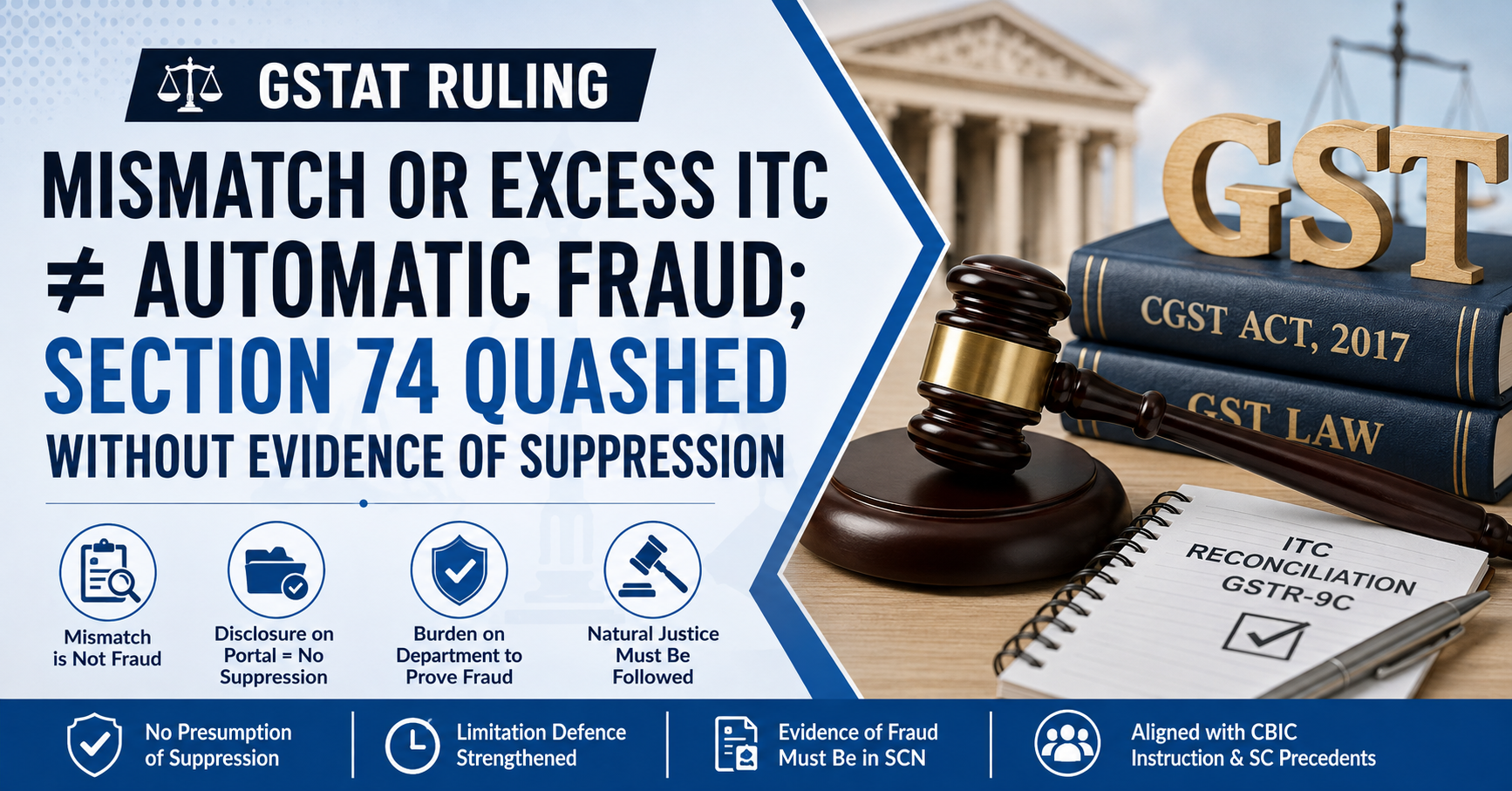
Many GST-registered businesses face notices when Input Tax Credit (ITC) reported in different GST returns does not reconcile. A mismatch or excess self-assessed ITC, however, does not automatically establish fraud, wilful misstatement, or suppression of facts for invoking Section 74 of the CGST Act.
If you are searching in Ghaziabad, Noida, Delhi NCR and nearby areas for a tax consultant near me, income tax consultant near me, or GST consultant near me, it is important to understand why the GST Appellate Tribunal's ruling matters when responding to an ITC-related demand.
Latest Update
The Goods and Services Tax Appellate Tribunal (GSTAT), Thiruvananthapuram Bench, in M/s. Santhome Latex Enterprises v. The Commissioner of CGST, examined whether excess ITC and non-response to an audit enquiry could justify proceedings under Section 74.
The Tribunal held that Section 74 cannot be invoked mechanically. The Department must establish tangible evidence of fraud, wilful misstatement, or deliberate suppression with intent to evade tax. The ruling also considered CBIC Instruction No. 05/2023-GST and Supreme Court principles concerning suppression.
Why This GSTAT Ruling Matters
The decision is important for taxpayers because it reinforces the distinction between an ITC compliance error and fraudulent conduct.
|
Issue |
What the ruling indicates Need help with this? Talk to AMIT SIDDHI AND ASSOCIATES → |
|
GSTR-2A/3B mismatch |
Not, by itself, proof of fraud |
|
Excess self-assessed ITC |
Does not automatically establish suppression |
|
Portal disclosures |
Can support the position that facts were already disclosed |
|
Non-reply to audit |
Cannot automatically be treated as suppression |
|
New appellate ground |
Cannot ordinarily be used to sustain a demand without proper opportunity |
|
Section 74 |
Requires fraud, wilful misstatement or suppression with intent to evade tax |
This does not mean that every ITC mismatch is automatically permissible. A taxpayer can still face tax, interest, or other consequences where ITC is actually ineligible. The important distinction is whether the statutory conditions for the more serious Section 74 proceedings have been established with the required evidence.
The ruling may also strengthen limitation-related arguments where a Section 74 demand cannot legally be sustained and the Department seeks to rely upon the normal limitation framework. Such arguments must, however, be examined period-wise and according to the applicable law.
For taxpayers maintaining detailed reconciliations, the case also highlights the practical value of transparent disclosures. Records uploaded through statutory returns and reconciliations can become important evidence when the Department alleges that information was deliberately concealed.
Practical Explanation with an Example
Suppose a registered business reports ITC in GSTR-3B that later does not fully reconcile with information appearing in GSTR-2A. The difference may result from several accounting, reporting, timing, or supplier-related issues. The mismatch itself does not establish that the taxpayer deliberately concealed information.
For example, if the taxpayer has maintained invoice-level records and disclosed relevant reconciliation information through its statutory filings, it can potentially demonstrate that the underlying transactions were not hidden.
The position becomes different if the Department possesses specific evidence showing that the taxpayer deliberately created false documents, knowingly made a wilful misstatement, or concealed material facts with an intention to evade tax. Section 74 is concerned with such conduct, not merely with the existence of a numerical mismatch.
Step-by-Step Compliance Approach
1. Read the SCN carefully.
Identify whether the notice actually sets out specific evidence supporting fraud, wilful misstatement, or suppression, or merely repeats standard statutory language.
2. Reconcile the ITC.
Prepare invoice-wise reconciliation between purchase records, GSTR-2A/2B, GSTR-3B, annual returns and other relevant records.
3. Review GSTR-9C disclosures.
Where applicable, identify whether the disputed figures and reconciliations were already disclosed through GSTR-9C or other statutory filings.
4. Examine the legal basis of Section 74.
A taxpayer should specifically address why the facts alleged by the Department do or do not establish the ingredients required for Section 74.
5. Check for new grounds.
If an appellate authority relies on an allegation that was not part of the original SCN, examine the issue from the perspective of natural justice and opportunity of hearing.
6. Preserve limitation arguments.
Where Section 74 is challenged, consider whether the demand remains legally sustainable under the normal limitation provisions, based on the relevant tax period and applicable law.
If you are in Ghaziabad, Vaishali, Indirapuram, Vasundhra, Noida or Delhi NCR and need professional assistance, searches such as “GST consultant near me” or “GST services near me” may help identify professionals who can review an SCN and supporting records.
Legal Reference
- Section: Section 74 of the Central Goods and Services Tax Act, 2017 — determination of tax not paid, short paid, erroneously refunded, or ITC wrongly availed or utilised by reason of fraud, wilful misstatement or suppression of facts.
- Related provisions: Section 16(2), Section 42(1), Section 65 and Explanation 2 to Section 74 of the CGST Act.
- Instruction: CBIC Instruction No. 05/2023-GST concerning invocation of Section 74(1).
- Judicial precedents referred to: Cosmic Dye Chemical and Ballarpur Industries, concerning the requirement of wilful suppression with intent to evade tax.
- Case: M/s. Santhome Latex Enterprises v. The Commissioner of CGST, GSTAT, Thiruvananthapuram Bench.
- Official Source Links: The verified material supplied for this article does not contain the full official URLs. No source URL has therefore been invented or substituted.
Legal Position
The dispute arose from a departmental audit of a centrifugal rubber latex manufacturer for the period July 2017 to March 2022. Based on mismatches between GSTR-2A and GSTR-3B, the Department issued a Show Cause Notice (SCN) under Section 74(1), alleging excess ITC of ₹8,56,877 along with interest and penalty. The SCN relied on boilerplate language, asserting that taking ineligible ITC “would amount to suppression of facts” with intent to evade tax, without providing specific material evidence of fraud.
The original adjudicating authority dropped the demand after acknowledging that the taxpayer had filed detailed GSTR-9C reconciliations and reversed ineligible credits through self-assessment. The Joint Commissioner (Appeals), however, reversed the decision. The appellate authority sustained the demand on a different ground, namely the taxpayer's alleged non-reply to the audit enquiry and final audit report, and treated that conduct as “suppression” under Explanation 2 to Section 74.
The GSTAT undertook a strict legal analysis and set aside the demand. It reiterated that Section 74 applies only where there is fraud, wilful misstatement, or suppression of facts with intent to evade tax. Mere contravention of eligibility conditions under Section 16(2) or reconciliation provisions under Section 42(1) does not automatically attract Section 74. The burden lies on the Department to establish clear and categorical evidence that the ITC transgression resulted from a deliberate act to evade tax.
The Tribunal further held that even where a taxpayer takes ITC without verifying eligibility, the mere act of taking such ITC does not amount to suppression in the absence of a statutory presumption. In the case considered, the taxpayer had uploaded invoice-wise details and reconciliations through GSTR-9C on the common portal. The relevant facts were therefore already disclosed.
The Tribunal also rejected the argument that non-reply to an audit enquiry constituted suppression. Where the underlying information is already available on the portal through annual returns, non-response to an audit notice cannot automatically be converted into suppression. The Tribunal further observed that Section 65 does not contemplate a statutory reply to the Final Audit Report, making the Revenue's reliance on that ground legally unsustainable.
Another important principle concerned natural justice. An appellate authority cannot sustain a demand on a ground that was not raised in the original SCN. The argument regarding non-reply to the audit was introduced only at the appellate stage. The Tribunal considered this contrary to principles of natural justice and fatal to the Revenue's case.
The ruling also relied upon CBIC Instruction No. 05/2023-GST, which requires Section 74(1) to be invoked only where investigation indicates material evidence of fraud or suppression, with such evidence forming part of the SCN. The Tribunal additionally applied Supreme Court jurisprudence, including Cosmic Dye Chemical and Ballarpur Industries, under which suppression must be wilful and accompanied by intent to evade tax; a mere omission is not sufficient where the facts are known to both sides.
Frequently Asked Questions
1. Does a GSTR-2A and GSTR-3B mismatch automatically amount to fraud?
No. The GSTAT ruling indicates that a mismatch by itself does not establish fraud, wilful misstatement, or suppression with intent to evade tax. The Department must establish the necessary ingredients for Section 74 with appropriate evidence.
2. Can excess ITC automatically attract Section 74?
No. Even if ITC is found to be ineligible, Section 74 requires the additional statutory elements of fraud, wilful misstatement, or suppression of facts with intent to evade tax. An ITC eligibility dispute and a fraud allegation are not automatically the same thing.
3. Does failure to reply to an audit enquiry prove suppression?
According to the ruling discussed here, non-reply cannot automatically be converted into suppression where the underlying information was already available through statutory filings. The Tribunal also considered the absence of a statutory requirement under Section 65 to reply to the Final Audit Report.
4. Can an appellate authority introduce a completely new ground?
The Tribunal emphasized natural justice and held that a demand cannot be sustained on a ground that was not raised in the original SCN without giving the taxpayer the appropriate opportunity. Introducing a new allegation only at the appellate stage can therefore be legally significant.
5. Why is CBIC Instruction No. 05/2023-GST important?
The instruction is relevant because it requires invocation of Section 74(1) to be supported by material evidence indicating fraud or suppression. The evidence forming the basis for such invocation is expected to be reflected in the SCN.
6. Does this ruling mean taxpayers can claim any amount of ITC?
No. The ruling does not remove the statutory conditions governing ITC. An ineligible credit can still have tax consequences. The decision principally concerns whether the facts justify invoking the fraud-based provisions and extended limitation under Section 74.
7. What should a taxpayer do after receiving a Section 74 notice?
The taxpayer should examine the SCN, reconcile the disputed ITC, collect supporting invoices and records, review previous disclosures, and assess whether the Department has actually established the ingredients of Section 74. Professional review should be considered where significant tax, interest, or penalty is involved.
Conclusion
The GSTAT ruling in Santhome Latex Enterprises reinforces an important principle: an ITC mismatch or ineligible self-assessed credit does not, by itself, prove fraud or suppression for Section 74 purposes. The Revenue must establish the required elements through tangible evidence, while taxpayers should preserve transparent reconciliations and statutory disclosures.
For businesses in Ghaziabad, Noida and Delhi NCR looking for income tax services near me, GST services near me, company registration services near me, Trade Mark services near me, or logo registration services near me, professional compliance support can help address tax and regulatory issues systematically. Searches for an income tax consultant near me, GST consultant near me, company registration consultant near me, Trade Mark consultant near me, or logo registration consultant near me can be useful when selecting appropriate professional assistance.
For expert guidance on this topic, contact your tax professional today.
This content is for educational and knowledge purposes only. For verification and applicability to your case, please consult your tax professional.
Have Questions? We're Here to Help
Get expert advice from AMIT SIDDHI AND ASSOCIATES. Reach out to discuss your requirements.