
Beneficiary’s Share of Trust Loss: ITAT Says “Compute Trust Income First”
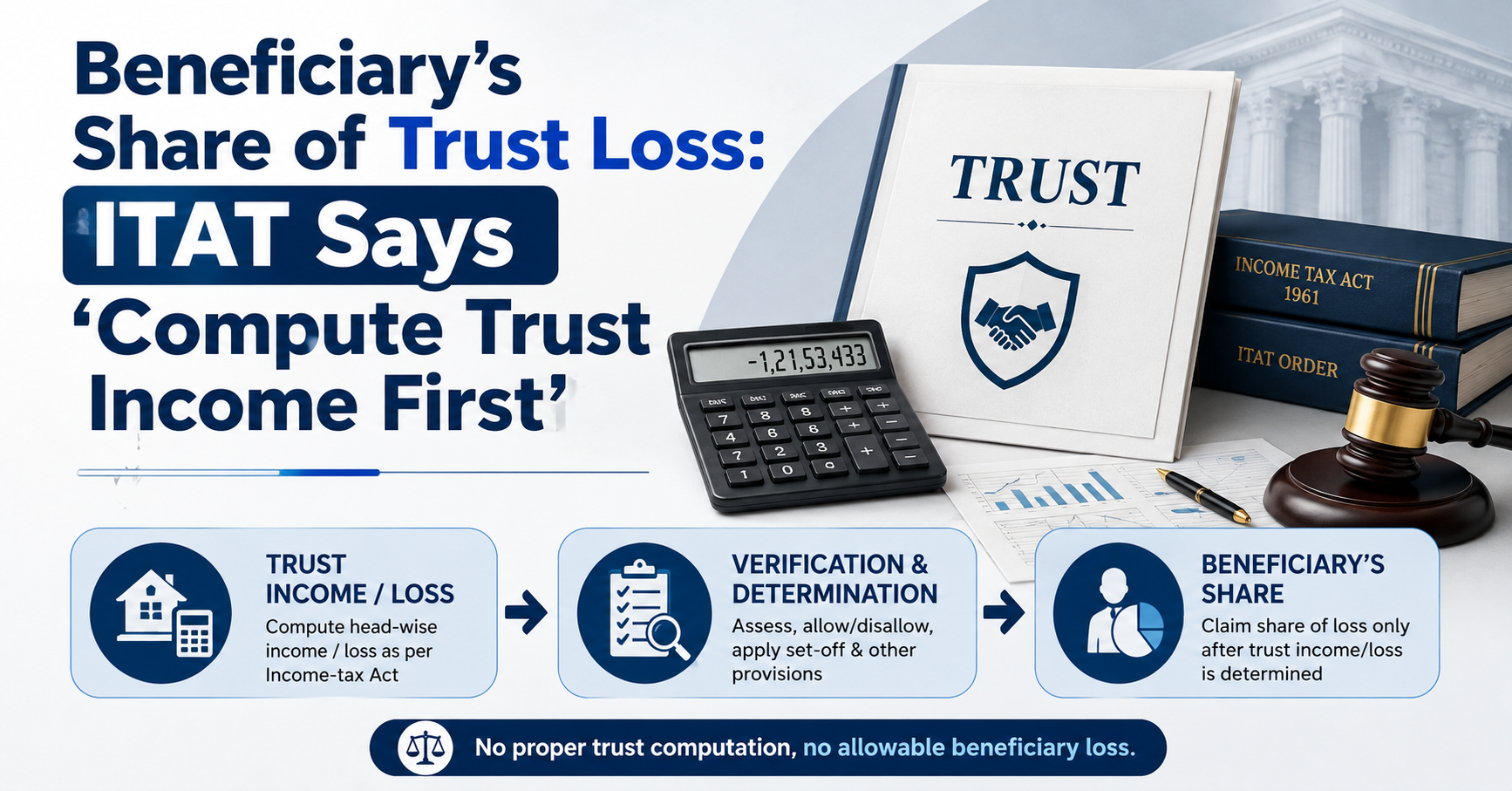
A beneficiary cannot automatically claim a share of loss reported by a trust in his or her individual income-tax return. The trust’s income or loss must first be properly computed and determined in accordance with the Income-tax Act.
If you are searching in Ghaziabad, Noida, Delhi NCR and nearby areas for an Income tax consultant near me or tax consultant near me, this recent Hyderabad ITAT ruling is particularly relevant when dealing with private trusts, beneficiaries and pass-through claims of income or loss.
The Hyderabad Bench of the Income Tax Appellate Tribunal (ITAT), in Dy. CIT, Circle 3(1), Hyderabad vs. Indira Kamineni, ITA No. 2445/Hyd/2025, order dated 3 July 2026, considered whether a beneficiary could claim her proportionate share of trust losses when the trust’s income or loss itself had not first been determined under the Income-tax Act.
The Tribunal held that even where a trust is determinate or non-discretionary, a beneficiary’s entitlement to claim a share of loss arises only after the trust’s income or loss is computed and determined according to law.
Latest Update
The latest case-specific update covered in this article is the Hyderabad ITAT order dated 3 July 2026 in ITA No. 2445/Hyd/2025 concerning Indira Kamineni for Assessment Year 2018-19.
The key takeaway from the order is that a beneficiary cannot simply insert a self-computed share of a trust’s loss into the individual return. The underlying trust income or loss must first be computed and determined under the Income-tax Act.
The matter was ultimately restored to the Assessing Officer for fresh examination.
Legal Reference
Case: Dy. CIT, Circle 3(1), Hyderabad vs. Smt. Indira Kamineni
ITA: No. 2445/Hyd/2025
Assessment Year: 2018-19
Court: Income Tax Appellate Tribunal, Hyderabad Bench
Order Date: 3 July 2026
Relevant statutory provisions: Section 161 — Liability of representative assessee; Section 166 — Direct assessment or recovery not barred, Income-tax Act, 1961.
Official statutory references:
Income-tax Act, 1961 — Section 161: Liability of representative assessee
Income-tax Act, 1961 — Section 166: Direct assessment or recovery not barred
Official ITAT reference: The Hyderabad ITAT cause list records ITA No. 2445/Hyd/2025 for Assessment Year 2018-19 in the case of Indira Kamineni.
Notification/Circular: No specific notification or circular is the basis of this particular ITAT decision.
Legal Position
The assessee, Indira Kamineni, was an individual and a beneficiary of KSN Trust, which was a determinate or non-discretionary trust. For Assessment Year 2018-19, she filed her return declaring nil income. In her return, she claimed a 70% share of the trust’s losses under the heads “Income from House Property” and “Income from Other Sources”. The amounts claimed were Rs. 1,21,53,433 under Income from House Property and Rs. 81,30,924 under Income from Other Sources, based on the assessee’s own computation.
The Assessing Officer disallowed the loss claim and completed the assessment under section 143(3) read with sections 143(3A) and 143(3B). The Commissioner of Income-tax (Appeals) subsequently allowed the claim, treating the trust as determinate and holding that the beneficiary was entitled to her share of the losses. The Revenue challenged this decision before the Hyderabad Bench of the ITAT.
The Tribunal considered the relevance of sections 161 and 166 of the Income-tax Act. These provisions allow the Revenue, in appropriate circumstances, to assess the trustee as a representative assessee or to make a direct assessment of the beneficiary. However, the Tribunal clarified that these provisions do not dispense with the foundational requirement that the trust’s income or loss must first be computed and determined in accordance with the Income-tax Act.
Therefore, even in the case of a determinate trust, a beneficiary cannot claim a share of loss merely on the basis of a computation prepared by the beneficiary. The trust’s income or loss must first be worked out in accordance with the applicable provisions of the Act. In the absence of such determination, a self-computed share of loss cannot automatically be accepted in the beneficiary’s return.
The Tribunal consequently set aside the order of the CIT(A) and restored the matter to the Assessing Officer for fresh examination. The decision therefore reinforces an important procedural requirement: the determination of the trust’s income or loss must precede the beneficiary’s claim for a corresponding share.
Practically, where a determinate trust has not filed its return or where its loss has not been worked out and verified under the Income-tax Act, the beneficiary cannot simply plug a self-computed “share of loss” into his or her ITR. The trust’s computation needs to be examined with reference to the applicable provisions, including head-wise computation, allowable deductions, disallowances and relevant set-off or carry-forward provisions.
What Does This ITAT Ruling Mean?
The decision is important because it distinguishes between having a beneficial interest in a trust and having a legally determined amount of loss that can be claimed in the beneficiary’s return.
A beneficiary may have a fixed percentage interest in a determinate trust. However, that percentage by itself does not establish the final tax loss available for claim. The underlying trust computation must first establish the amount of income or loss under the Income-tax Act.
For example, suppose a beneficiary has a 70% interest in a determinate trust and the trust has incurred property-related expenses. The beneficiary cannot simply calculate 70% of the expenses and claim that amount as a loss in the individual ITR. The trust’s income under the relevant head must first be computed after applying the applicable tax provisions. Only the legally determined result can form the basis for considering the beneficiary’s corresponding share.
This approach places importance on evidence, statutory computation and consistency between the trust’s tax position and the beneficiary’s return.
Trust Loss vs Beneficiary’s Claim
|
Issue |
Trust |
Beneficiary |
|
Basic computation |
Income/loss must be computed first |
Claim depends on determined trust result |
|
Beneficial interest |
Determines entitlement percentage |
Does not by itself establish the loss amount |
|
Self-computed loss |
Subject to statutory verification |
Cannot automatically be claimed |
|
Head-wise computation |
Required |
Share should correspond to determined result |
|
Assessment risk |
Trust computation may be examined |
Claim may be disallowed if underlying loss is undetermined |
The practical message is simple: first determine the trust’s income or loss; then consider the beneficiary’s share.
Compliance Process for Determinate Trusts
Step 1: Confirm the nature of the trust.
Determine whether the trust is determinate or discretionary and review the trust deed to establish the beneficiaries and their respective interests.
Step 2: Prepare the trust’s complete tax computation.
Compute income or loss under the relevant heads, including Income from House Property, Income from Other Sources and any other applicable head.
Step 3: Apply statutory adjustments.
The computation should account for applicable deductions, disallowances, set-off provisions and restrictions affecting the amount of loss.
Step 4: File and document the trust’s return.
For practical compliance, the trust’s return, computation and supporting documents should be maintained properly so that the underlying income or loss can be established.
Step 5: Determine the beneficiary’s share.
Only after the trust’s income or loss is properly determined should the beneficiary’s proportionate entitlement be considered.
Step 6: Match the beneficiary’s ITR with the trust position.
The beneficiary’s return should be supported by consistent documentation and should not contain an independently calculated loss that differs from the legally determined trust position.
Step 7: Document disputed positions.
If the trust’s loss is under scrutiny, assessment or appeal, the status should be clearly documented. An unverified or undetermined loss should not automatically be treated as available for the beneficiary.
Why Practitioners Should Take Note
The ruling highlights the importance of coordinated tax compliance between a trust and its beneficiaries. A beneficiary’s return should not be prepared in isolation when the claim depends on the income or loss of a trust.
Practitioners should therefore ensure that the trust’s tax computation is complete and available before advising beneficiaries to claim their respective shares. Particular attention should be given to head-wise computation and applicable restrictions because the accounting loss of a trust and the tax loss allowable under the Income-tax Act may not necessarily be identical.
This is also important where a trust has not filed its return, where its computation is under examination, or where the claimed loss is based only on an internal working. The ITAT ruling indicates that such circumstances can create a significant risk of disallowance and remand.
If you are looking for Income tax services near me, GST services near me, Company registration services near me, Trade Mark services near me or logo registration services near me in Ghaziabad, Noida or Delhi NCR, it is useful to obtain professional advice based on the specific compliance requirement involved.
FAQs
1. Can a beneficiary directly claim a trust’s loss in an individual ITR?
Not merely on the basis of the beneficiary’s own computation. The Hyderabad ITAT held that the trust’s income or loss must first be computed and determined under the Income-tax Act before the beneficiary can claim the corresponding share.
2. Does the ruling apply even when the trust is determinate?
Yes. The Tribunal’s reasoning specifically recognises that even for a determinate or non-discretionary trust, the beneficiary’s entitlement to claim the loss depends on the trust’s income or loss first being properly computed and determined.
3. What is the role of sections 161 and 166?
Sections 161 and 166 deal with the assessment of income involving representative assessees and direct assessment of the person for whose benefit income is receivable. The ITAT clarified that these provisions do not eliminate the requirement to determine the trust’s income or loss in accordance with the Act.
4. What if the trust has not filed its return?
If the trust has not filed its return or its loss has not otherwise been properly determined, a beneficiary claiming a self-computed share of that loss may face disallowance. The underlying trust computation needs to be established first.
5. Can an internal computation prepared by the beneficiary support the loss claim?
The ITAT ruling makes it clear that a beneficiary’s own computation, by itself, is insufficient where the underlying trust income or loss has not been determined under the Act.
6. What should trustees and beneficiaries do going forward?
They should coordinate the trust’s tax filing and computation with the beneficiaries’ tax positions. The trust’s income or loss should be properly computed, including applicable deductions, disallowances and set-off restrictions, before beneficiary-level claims are made.
7. Is this relevant for taxpayers searching for a tax consultant near me?
Yes. Where a trust and its beneficiaries have interconnected tax positions, professional review can help ensure that the trust computation and beneficiary return are consistent and properly documented.
Conclusion
The Hyderabad ITAT ruling in Dy. CIT, Circle 3(1), Hyderabad vs. Indira Kamineni reinforces an important compliance principle for private and determinate trusts: a beneficiary’s share of loss cannot be established merely by applying the beneficiary’s percentage interest to a self-prepared computation.
The trust’s income or loss must first be computed and determined in accordance with the Income-tax Act. Only then can the beneficiary’s corresponding share be properly considered.
For practitioners and taxpayers, the practical approach is clear: maintain proper trust-level tax compliance, complete the head-wise computation, consider applicable disallowances and set-off restrictions, and ensure that beneficiary claims are supported by the determined tax position of the trust.
If you are based in Ghaziabad, including areas such as Vaishali, Indirapuram or Vasundhra, or in Noida and Delhi NCR, professional assistance can be useful where trust taxation and beneficiary-level reporting need to be coordinated.
For expert guidance on this topic, contact your tax professional today.
This content is for educational and knowledge purposes only. For verification and applicability to your case, please consult your tax professional.
Have Questions? We're Here to Help
Get expert advice from AMIT SIDDHI AND ASSOCIATES. Reach out to discuss your requirements.