
Cancellation of GST Registration on Request: New Rule 20
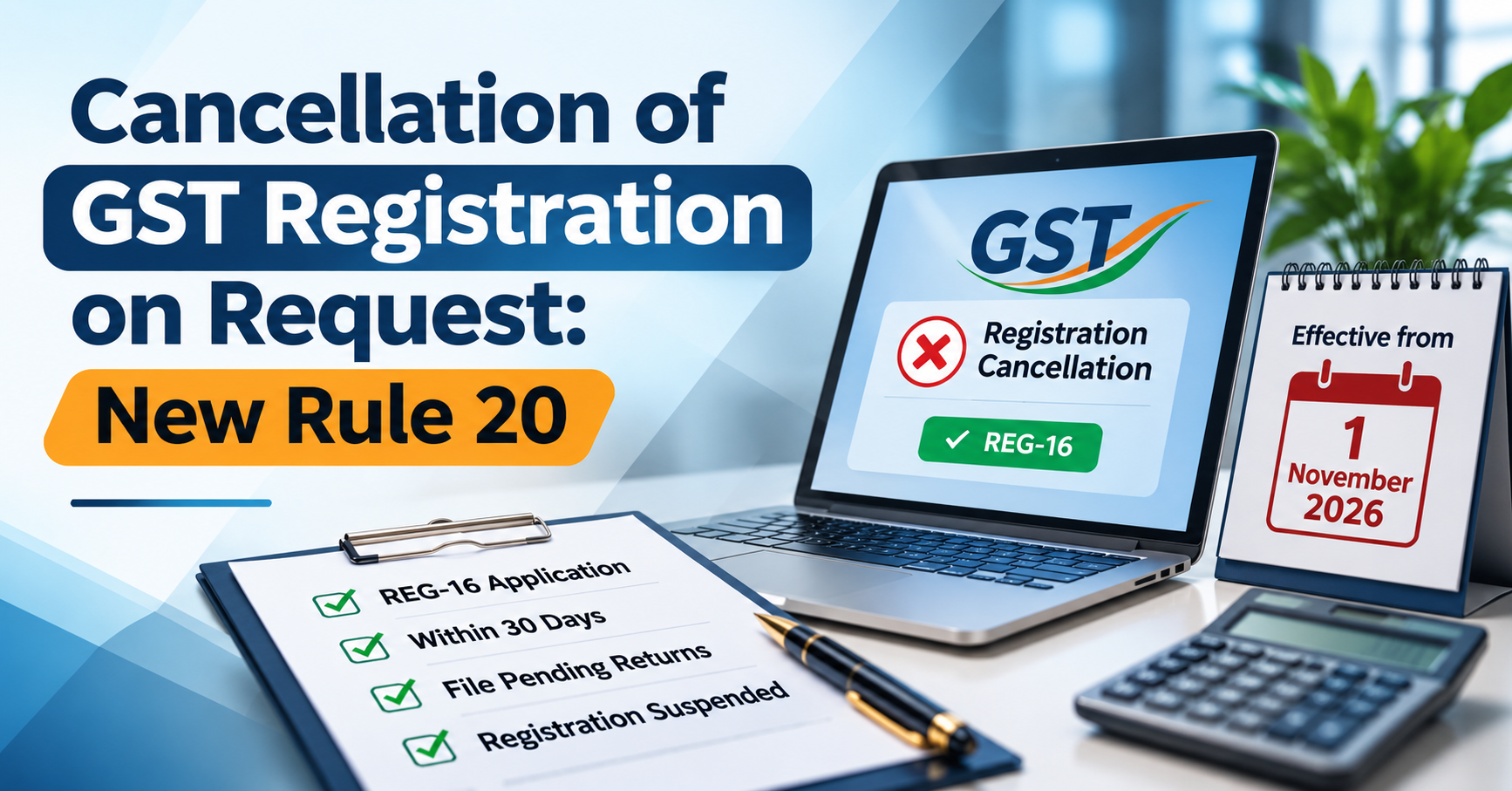
Cancellation of GST Registration on Request: New Rule 20 Effective from 1 November 2026
The GST registration cancellation process has been significantly revised from 1 November 2026 to make taxpayer-requested cancellations more systematic, time-bound and transparent. The amended Rule 20 of the CGST Rules, 2017 introduces simplified portal-based cancellation, defined timelines for departmental action and deemed approval in specified circumstances.
1. Application for Cancellation – FORM GST REG-16
Under the substituted Rule 20(1), a registered taxpayer seeking voluntary cancellation under Section 29(1) of the CGST Act, 2017 must:
-
Submit an application electronically in FORM GST REG-16.
-
File the application within 30 days from the occurrence of the event requiring cancellation.
-
Provide details of inputs held in stock, inputs contained in semi-finished or finished goods, and capital goods held in stock.
-
Disclose the applicable tax liability on such stock and details of payments made.
-
Attach relevant supporting documents, wherever necessary.
Special relaxation: The 30-day filing requirement does not apply in the case of the death of a sole proprietor. The legal heirs of the deceased proprietor can initiate the cancellation process under the prescribed procedure.
2. Filing of Pending GST Returns Before Cancellation
The amended Rule 20 makes return compliance an important precondition for filing the cancellation application.
Before submitting FORM GST REG-16:
-
All GST returns and applicable statements, including FORM GST CMP-08, must be filed up to the relevant period for which the cancellation is sought.
-
If GSTR-1 or details of outward supplies through the Invoice Furnishing Facility (IFF) have been furnished for a tax period, the corresponding GSTR-3B must also be filed for that period.
After submitting the cancellation application, the taxpayer must also furnish the remaining applicable returns up to the application date or the requested cancellation date, as prescribed under the rule.
3. GST Registration Will Remain Suspended During Proceedings
One important change is that the GST registration will automatically stand suspended once the cancellation application is submitted.
The suspension will continue until the cancellation proceedings are completed.
This provision helps prevent normal taxable business operations from continuing under a registration for which cancellation has already been requested.
4. Automatic Cancellation Through the GST Portal
The revised Rule 20 introduces a simplified electronic cancellation mechanism.
The GST portal can automatically cancel the registration where the following conditions are fulfilled:
-
All prescribed returns and statements have been filed within the applicable timelines.
-
All outstanding tax, interest, late fees, penalties and other payable amounts have been paid.
-
Either of the following conditions is satisfied:
-
The output tax liability on supplies made to registered persons (B2B supplies), as reported in GSTR-1/GSTR-1A or through IFF, does not exceed Rs. 2,50,000 in any month during the period from registration to the cancellation application; OR
-
Where applicable, FORM GST GSTR-10 is filed within three days from the due date for furnishing the remaining returns specified under Rule 20(3).
Once these conditions are satisfied, the common portal will electronically cancel the registration with effect from the date requested by the taxpayer and communicate the cancellation through FORM GST REG-38.
5. Time Limit for GST Officer to Process Cancellation
Where the application does not qualify for automatic portal-based cancellation, it will be forwarded to the jurisdictional proper officer for examination.
The amended procedure provides the following timelines:
-
15 days: The officer must examine the application and either approve it or issue a deficiency notice in FORM GST REG-03.
-
15 days: The taxpayer must submit the required returns, clarification, information or documents in FORM GST REG-04 after receiving the notice.
-
15 days: If the officer is satisfied with the taxpayer's reply, the cancellation order must be issued in FORM GST REG-19.
-
15 days: If the officer is not satisfied, the application may be rejected through FORM GST REG-05.
If the taxpayer fails to respond within the prescribed 15-day period, the application will be deemed rejected and communicated through FORM GST REG-05A.
6. Deemed Approval – Protection Against Administrative Delay
Another significant provision is deemed approval.
If the proper officer fails to take action within 15 days:
-
From the date of receiving the application forwarded for examination; or
-
From the date of receiving the taxpayer's reply to the deficiency notice,
the application for cancellation will be deemed approved.
The approval will be communicated electronically through FORM GST REG-19.
This provision establishes a time-bound mechanism and provides relief to taxpayers from unnecessary delays in cancellation proceedings.
7. Important Provision: Change in Effective Date of Cancellation
The amended Rule 20 also addresses situations where the department believes that the effective date of cancellation should be earlier than the date originally approved.
In such cases:
-
The officer may issue a notice in FORM GST REG-34.
-
The taxpayer gets 30 days to submit a reply in FORM GST REG-35.
-
If the officer accepts the explanation, proceedings will be dropped through FORM GST REG-36 within 30 days of receiving the reply.
-
If the explanation is not accepted, the officer may change the effective date and issue FORM GST REG-37 within 30 days of receiving the reply.
-
If no reply is submitted, the officer may pass the order within 60 days from the date of issuing the notice.
-
If no order is issued within 60 days, the proceedings will be deemed dropped.
Once the effective date has been changed under this procedure, it cannot be changed again.
8. Important Compliance Points for Businesses
Businesses planning to close operations or surrender GST registration should ensure the following:
-
Reconcile GSTR-1, GSTR-3B and books of accounts before applying.
-
Clear outstanding GST liabilities, interest, late fees and penalties.
-
Review ITC and stock-related tax liabilities.
-
Ensure all applicable returns, including CMP-08, are filed.
-
Track notices and respond within the prescribed timelines.
-
Complete the applicable final return requirements after cancellation.
It is also important to note that cancellation does not extinguish tax liabilities or other statutory obligations relating to periods before the effective cancellation date.
Conclusion
The revised Rule 20, effective from 1 November 2026, is a significant step towards simplifying voluntary GST registration cancellation. Automatic portal-based cancellation, fixed departmental timelines and deemed approval provisions are expected to make the process more transparent and taxpayer-friendly.
Businesses should nevertheless ensure complete return filing and payment compliance before initiating cancellation to avoid unnecessary delays or rejection.
For expert guidance on this topic, contact your tax professional today.
Official Source: Notification No. 05/2026–Central Tax dated 26 October 2026, issued under Section 164 of the CGST Act, 2017, substituting Rule 20 of the CGST Rules, 2017 with effect from 1 November 2026.
Have Questions? We're Here to Help
Speak with AMIT SIDDHI AND ASSOCIATES. Reach out to discuss your requirements.