
Can Wife Obtain Husband’s Income Tax Return Through RTI? Delhi High Court Clarifies Position
Maintenance disputes often involve questions regarding the husband’s actual income, assets, and tax disclosures. Many spouses attempt to obtain income-tax records through the Right to Information (RTI) Act to establish the financial capacity of the other party.
The issue became important in Kapil Agarwal v. CPIO Income-tax Officer, Moradabad, where the High Court of Delhi examined whether a wife could obtain her husband’s income-tax details through an RTI application during pending maintenance proceedings.
This judgment is highly relevant for litigants, tax professionals, RTI applicants, and family law practitioners in Ghaziabad, Noida, Delhi NCR, and across India who frequently deal with maintenance and matrimonial disputes.
Latest Update
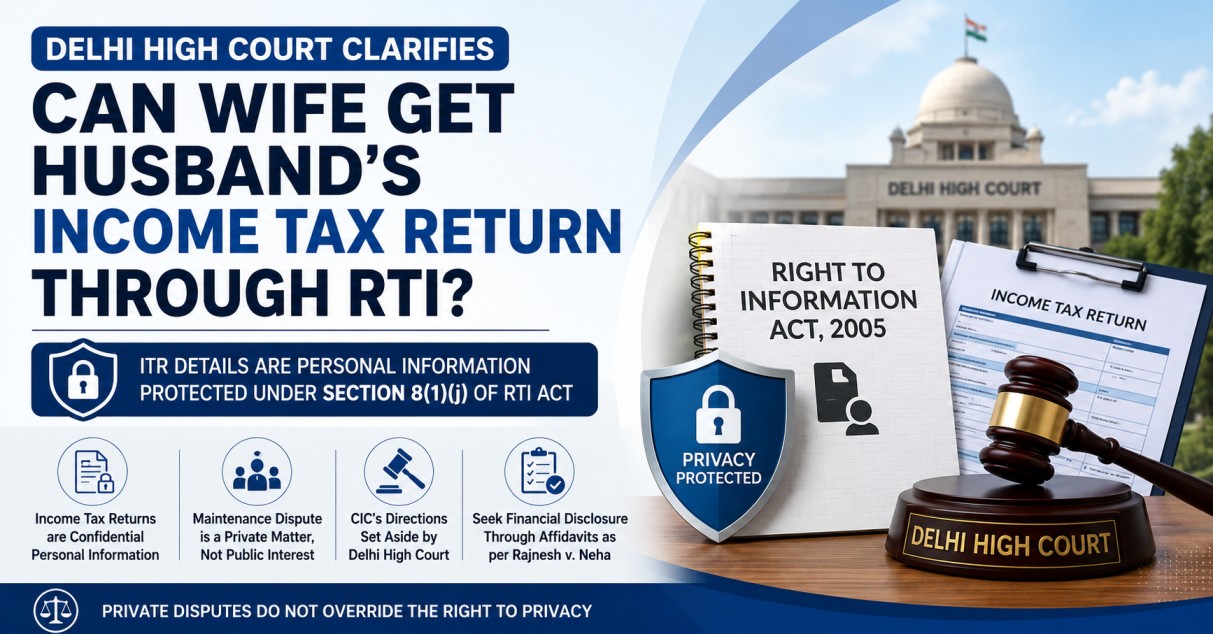
The Delhi High Court in W.P. (C) No. 8481 of 2021 set aside the order of the Central Information Commission (CIC), holding that income-tax returns and taxable income details are personal information protected under Section 8(1)(j) of the RTI Act.
The Court further clarified that a private maintenance dispute does not amount to “larger public interest” for disclosure of confidential income-tax information.
No recent official update found as of today.
Practical Explanation of the Judgment
Why Did the Court Refuse Disclosure?
The RTI Act allows citizens to seek information from public authorities. However, Section 8(1)(j) protects personal information where disclosure has no relation to public activity or public interest and would amount to an unwarranted invasion of privacy.
The Court considered income-tax returns to be confidential financial information filed with the Income Tax Department.
The Court clarified that:
|
Issue |
Court’s View |
|
Income-tax return details |
Personal information |
|
Taxable income disclosure |
Protected under RTI exemption |
|
Maintenance dispute |
Private dispute |
|
Larger public interest |
Not established |
|
Alternative remedy available |
Yes, through court-directed affidavits |
Importance of Rajnesh v. Neha
The Supreme Court in Rajnesh v. Neha introduced mandatory disclosure affidavits in maintenance cases.
These affidavits generally include:
· Salary details
· Business income
· Assets and liabilities
· Bank accounts
· Investments
· Monthly expenditure
· Dependents
Therefore, the Delhi High Court observed that maintenance courts already have a mechanism to determine actual income without violating privacy protections under RTI law.
Practical Impact on Maintenance Cases
For Wives Seeking Maintenance
A spouse cannot automatically obtain the husband’s income-tax return through RTI merely because maintenance litigation is pending.
Instead, the proper course is:
1. Seek disclosure before the family court
2. Request filing of income affidavits
3. Ask for bank statements and financial records through court procedures
4. Cross-examine incorrect disclosures
For Husbands and Taxpayers
The judgment strengthens taxpayer confidentiality and privacy rights.
It confirms that:
· ITRs are sensitive personal information
· Financial privacy is legally protected
· RTI cannot be used as a shortcut for private litigation discovery
Example for Better Understanding
Suppose a wife in Noida files a maintenance case alleging that her husband earns ₹25 lakh annually but declares only ₹5 lakh before the court.
If she files an RTI application directly with the Income Tax Department seeking his income-tax returns, the department may reject the request based on Section 8(1)(j) of the RTI Act.
However, she may still request the family court to:
· Direct filing of detailed financial affidavits
· Summon financial documents
· Examine inconsistencies in disclosure
This distinction is very important for litigants searching online for “Income tax consultant near me,” “Tax consultant near me,” or legal guidance relating to maintenance and income disclosure matters in Delhi NCR, Ghaziabad, Vasundhra, Indirapuram, or Vaishali.
Step-by-Step Compliance Process in Maintenance Cases
Step 1: File Maintenance Petition
The aggrieved spouse files proceedings under applicable laws such as:
· Section 125 CrPC
· Hindu Marriage Act
· Domestic Violence Act
Step 2: Court Orders Financial Disclosure
Courts may direct both parties to file:
· Income affidavits
· Asset disclosures
· Liability statements
Step 3: Verification of Financial Information
The opposite party may:
· Challenge incorrect disclosures
· Seek supporting documents
· Request bank records through court
Step 4: Court Determines Maintenance
The court evaluates:
· Actual earning capacity
· Standard of living
· Dependents
· Liabilities
· Lifestyle indicators
Legal Reference
Relevant Provisions and Judgments
· Section 8(1)(j), Right to Information Act, 2005
· Rajnesh v. Neha
· Delhi High Court Judgment: Kapil Agarwal v. CPIO Income-tax Officer, Moradabad
· W.P. (C) No. 8481 of 2021 CM APPL. No. 26235 of 2021
Official Links:
· Right to Information Act, 2005
· Income Tax Department Official Website
· Supreme Court of India Official Website
· Delhi High Court Official Website
Legal Position
The wife sought disclosure of her husband’s income-tax details through an RTI application during the pendency of maintenance proceedings.
The Central Information Commission (CIC) directed the Income-tax Department to disclose the husband’s net taxable income from FY 2007-08 onwards.
The husband challenged the CIC order before the Delhi High Court, contending that income-tax returns are personal information protected under Section 8(1)(j) of the RTI Act.
The Court held that income-tax returns and taxable income details are personal information and are exempt from disclosure under Section 8(1)(j) of the RTI Act.
It ruled that a private maintenance dispute does not constitute a larger public interest so as to justify disclosure of such confidential information.
The CIC’s directions were set aside, and the Court observed that the wife could seek financial disclosure through affidavits of assets and liabilities as mandated in Rajnesh v. Neha.
Frequently Asked Questions (FAQs)
1. Can a wife get her husband’s income-tax return through RTI?
Generally, no. The Delhi High Court has held that income-tax returns are personal information protected under Section 8(1)(j) of the RTI Act.
2. Is taxable income considered confidential information?
Yes. The Court recognized taxable income and ITR details as confidential personal information.
3. Does maintenance litigation create “public interest” under RTI?
No. The Court held that a private matrimonial dispute does not constitute larger public interest for RTI disclosure purposes.
4. How can financial information be obtained in maintenance cases?
Financial information may be sought through court-directed affidavits, disclosures, and judicial procedures.
5. What was the relevance of Rajnesh v. Neha?
The Supreme Court in Rajnesh v. Neha created a structured system of financial disclosure affidavits in maintenance proceedings.
6. Can courts still examine concealed income?
Yes. Courts may investigate inconsistencies, summon documents, and evaluate lifestyle evidence while determining maintenance.
Conclusion
The Delhi High Court has clearly reaffirmed that income-tax returns are protected personal information and cannot ordinarily be disclosed under the RTI Act merely because maintenance proceedings are pending.
The judgment balances two important legal principles:
· Right to privacy of taxpayers
· Fair financial disclosure in matrimonial litigation
Instead of RTI proceedings, parties must rely on court-supervised disclosure mechanisms such as affidavits of assets and liabilities prescribed under Rajnesh v. Neha.
Individuals searching for GST consultant near me, Income tax services near me, Company registration consultant near me, Trade Mark consultant near me, or legal-tax advisory services in Ghaziabad, Noida, Delhi NCR, and nearby areas should understand that financial disclosure in family disputes follows judicial procedures rather than RTI-based access to confidential tax records.
For expert guidance on this topic, contact your tax professional today.
Have Questions? We're Here to Help
Get expert advice from AMIT SIDDHI AND ASSOCIATES. Reach out to discuss your requirements.