
TDS Return Filing in India – Complete Guide to Quarterly TDS Returns, Forms, Due Dates & Compliance
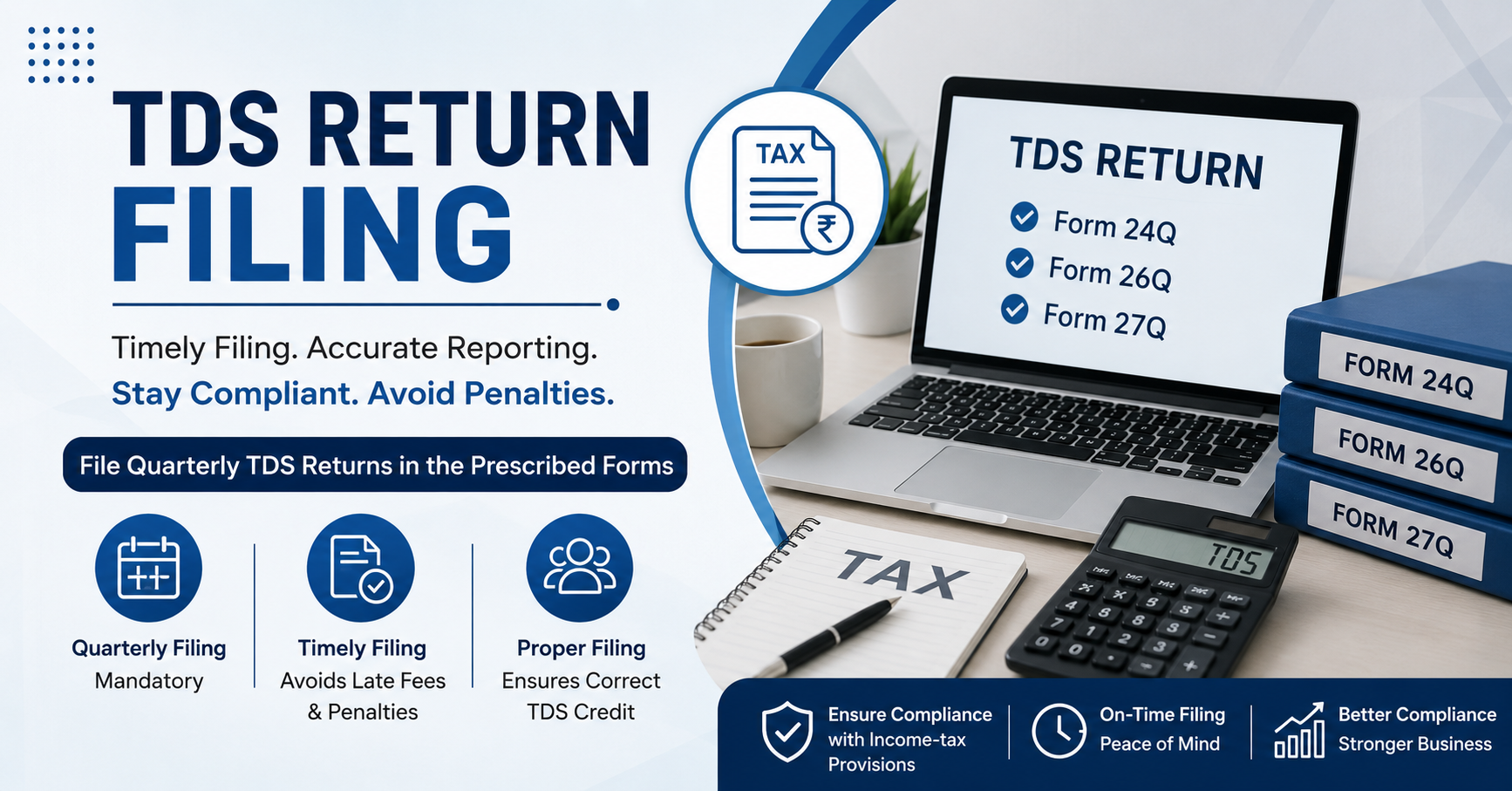
Tax Deducted at Source (TDS) is an important part of India's tax collection system. Every person or entity required to deduct TDS must file quarterly TDS returns within the prescribed due dates. Proper filing helps the Income-tax Department update the deductee's tax records and ensures that the deducted tax is correctly reflected for claiming tax credit.
If you are searching in Ghaziabad, Noida, Delhi NCR, or nearby areas for a Tax consultant near me, Income tax consultant near me, or Income tax services near me, understanding the TDS return filing process can help you avoid unnecessary notices, late fees, and compliance issues.
Latest Update
No recent official amendment affecting the basic quarterly TDS return filing process has been notified as of today. However, deductors should always use the latest return preparation utility and comply with the applicable provisions of the Income-tax Act, 1961, and the Income-tax Rules, 1962.
Practical Explanation
Think of TDS return filing as reporting to the Income-tax Department how much tax you deducted and deposited on behalf of others.
For example:
· A company deducts TDS from employees' salaries.
· A business deducts TDS while paying professional fees.
· A contractor deducts TDS while making certain contractual payments.
After depositing the TDS, the deductor must also file the quarterly TDS return.
Without filing the return:
· Deductees may not receive TDS credit.
· Form 26AS may not reflect the deduction correctly.
· The deductor may receive notices.
· Additional statutory fees and penalties may apply.
Common TDS Return Forms
|
Form |
Purpose |
Applicable To |
|
24Q |
Salary payments |
Employers |
|
26Q |
Resident non-salary payments |
Businesses, Firms, Companies |
|
27Q |
Payments to Non-Residents |
Businesses making foreign payments |
Why Accurate Filing Matters
|
Correct Filing |
Incorrect Filing |
|
Proper TDS Credit |
TDS mismatch |
|
No unnecessary notices |
Compliance issues |
|
Better record keeping |
Correction returns required |
|
Reduced litigation |
Penalties may apply |
Step-by-Step TDS Return Filing Process
Step 1
Deduct TDS under the applicable provisions.
Step 2
Deposit the deducted tax within the prescribed due date.
Step 3
Collect:
· PAN details
· Challan details
· Deductee information
· Payment details
Step 4
Prepare the appropriate quarterly return.
Step 5
Validate the return using the prescribed utility.
Step 6
Upload the TDS return through the prescribed filing system.
Step 7
Preserve the acknowledgment and filing records for future reference.
Common Mistakes to Avoid
· Incorrect PAN of deductee
· Wrong challan mapping
· Mismatch between books and TDS return
· Delay in filing quarterly returns
· Incorrect section selection
· Duplicate entries
· Wrong amount reported
· Ignoring correction statements
Benefits of Timely TDS Return Filing
· Compliance with Income-tax provisions
· Correct reflection of TDS credit
· Better financial records
· Reduced risk of notices
· Avoidance of statutory late filing fees
· Smooth income tax return processing for deductees
Who Should File TDS Returns?
Quarterly TDS returns are generally applicable to:
· Companies
· LLPs
· Partnership Firms
· Proprietorship Businesses
· Trusts
· Government offices
· Educational institutions
· Hospitals
· Employers deducting salary TDS
· Any other deductor covered under the Income-tax Act
If you are located in Ghaziabad (201010), Vaishali (201019), Indirapuram (201014), Vasundhara (201012), Noida, Delhi, or anywhere in NCR and are looking for an Income tax consultant near me, Tax consultant near me, or Income tax services near me, professional guidance can help ensure accurate and timely compliance.
Legal Reference
Relevant Provisions
· Income-tax Act, 1961
o Section 192 – TDS on Salary
o Section 193 to Section 196D – Various TDS provisions
o Section 200 – Duty of person deducting tax
o Section 200(3) – Filing of TDS statements
o Section 203AA (where applicable)
o Section 206 – Prescribed forms
o Section 234E – Fee for late filing of TDS statement
o Section 271H – Penalty for failure to furnish TDS statement
· Income-tax Rules, 1962
o Rule 31A – Furnishing of TDS Statements
Official Sources
Legal Position
Under the provisions of Section 200(3) of the Income-tax Act, 1961, every person who deducts tax at source is required to furnish quarterly statements of tax deducted at source in the prescribed form and within the prescribed time.
The manner, form, and due dates for furnishing these statements are prescribed under Rule 31A of the Income-tax Rules, 1962.
The commonly prescribed forms include:
· Form 24Q for tax deducted from salary payments.
· Form 26Q for tax deducted on payments other than salary made to residents.
· Form 27Q for tax deducted on payments made to non-residents and foreign companies where applicable.
Failure to furnish the TDS statement within the prescribed time may attract a fee under Section 234E. In addition, Section 271H provides for levy of penalty in specified cases relating to failure to furnish or furnishing incorrect TDS statements, subject to the conditions provided under the Act.
Accurate reporting of deductee details, PAN, challan information, amount paid, tax deducted, and tax deposited is essential for proper credit of TDS to the deductee.
Frequently Asked Questions (FAQs)
1. Is quarterly TDS return filing mandatory?
Yes. Every person required to deduct TDS must furnish TDS statements in the prescribed form within the applicable due dates.
2. Which form is used for salary TDS?
Form 24Q is used for reporting TDS deducted from salary.
3. Which form is used for contractor or professional payments?
Form 26Q is generally used for resident non-salary payments.
4. What is Form 27Q?
Form 27Q is used for reporting TDS on certain payments made to non-residents.
5. What happens if the TDS return is filed late?
Late filing may attract fees under Section 234E and penalty provisions under Section 271H, subject to the conditions specified in the Income-tax Act.
6. Can an incorrect TDS return be corrected?
Yes. A correction statement can generally be filed to rectify eligible errors in the original TDS return.
7. Why is accurate TDS return filing important?
It ensures proper TDS credit to deductees, reduces compliance issues, and helps avoid statutory consequences arising from incorrect reporting.
Conclusion
Quarterly TDS return filing is an essential compliance responsibility for every deductor under the Income-tax Act. Accurate reporting, timely filing, and proper reconciliation not only help avoid statutory fees and penalties but also ensure that deductees receive the correct tax credit.
Whether you are a business owner, startup, employer, professional, or organization searching for an Income tax consultant near me, GST consultant near me, Company registration consultant near me, Trade Mark consultant near me, logo registration consultant near me, Income tax services near me, GST services near me, Company registration services near me, Trade Mark services near me, or logo registration services near me in Ghaziabad, Noida, Delhi NCR, and nearby areas, staying compliant with TDS provisions is a key part of sound financial management.
For expert guidance on this topic, contact your tax professional today.
Disclaimer
This content is for educational and knowledge purposes only. For verification and applicability to your case, please consult your tax professional.
Have Questions? We're Here to Help
Get expert advice from AMIT SIDDHI AND ASSOCIATES. Reach out to discuss your requirements.