
MCA Introduces New “Super Forms” – E-CHNG & E-CON Under Companies (Incorporation) Amendment Rules, 2026
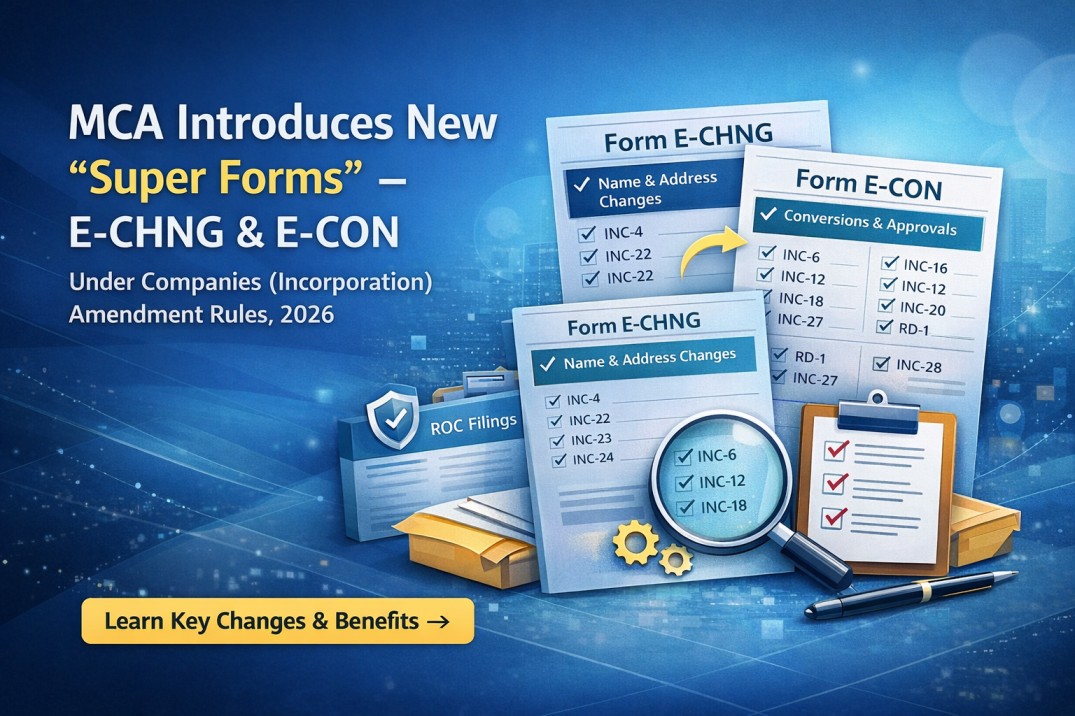
Multiple ROC filings and repetitive compliance have long been a challenge for companies. The latest draft amendment by MCA aims to simplify this process significantly.
Background of the Amendment
The Ministry of Corporate Affairs issued a draft notification on April 8, 2026, proposing the Companies (Incorporation) Amendment Rules, 2026.
The objective is clear:
- Reduce compliance burden
- Eliminate duplication
- Improve ease of doing business
Introduction of “Super Forms”
The draft proposes replacing multiple forms with just two comprehensive forms:
1. Form E-CHNG (Change Management Form)
Purpose
To consolidate filings related to name, registered office, and structural changes.
Forms Proposed to be Replaced
- INC-4 – Change in share capital
- INC-22 – Change of registered office
- INC-23 – Shifting of registered office (RD approval)
- INC-24 – Change of company name
Practical Impact
Instead of filing multiple forms for different changes, companies can now file a single integrated form.
Example:
If a company shifts its registered office and changes its name simultaneously, only E-CHNG will be required.
2. Form E-CON (Conversion & Approval Form)
Purpose
To handle company conversions, approvals, and regulatory filings.
Forms Proposed to be Replaced
- INC-6 – Conversion of OPC
- INC-12 – Section 8 License application
- INC-18 – Conversion of Section 8 company
- INC-20 – Revocation of license
- INC-27 – Conversion of company type
- RD-1 – Applications to Regional Director
- INC-28 – Filing of court/NCLT orders
Practical Impact
This reduces multiple filings into one streamlined process, especially for restructuring and conversion cases.
Key Highlights of the Draft Rules
1. Ease of Doing Business
- Elimination of multiple filings
- Reduction in duplicate data submission
- Faster processing timelines
2. Major Change for Section 8 Companies
- Proposed permission to convert:
- Section 8 company (limited by guarantee) → Company limited by shares
Legal Reference:
- Section 8 of Companies Act, 2013 – Governs non-profit companies
This is a significant relaxation, offering flexibility in structuring.
3. Flexible Physical Verification of Registered Office
- Registrar can authorize third parties
- Local witnesses may be involved
- Reduces procedural delays
Legal Reference:
- Section 12 of Companies Act, 2013 – Registered office requirements
4. Reduction in Compliance Burden
- Fewer forms
- Simplified documentation
- Less professional cost and time
Status of the Amendment
- Currently in draft stage
- Public comments invited until May 9, 2026
- Will become effective only after final notification in Official Gazette
Practical Tip / CA Insight
Companies should:
- Review upcoming changes and prepare internal compliance systems
- Maintain updated records for seamless transition
- Plan restructuring or conversions after final notification to benefit from simplified forms
Early awareness can help businesses avoid last-minute confusion and compliance errors.
FAQs
1. Are E-CHNG and E-CON forms applicable now?
No, they are part of draft rules and will apply only after final notification.
2. Will old forms be discontinued?
Yes, once implemented, existing forms will be replaced by these super forms.
3. Is this beneficial for startups?
Absolutely, startups will benefit from reduced compliance and faster approvals.
4. Can multiple changes be filed together?
Yes, E-CHNG allows multiple changes like name and address in one form.
5. What is the benefit for professionals?
Less repetitive work and improved efficiency in handling client compliance.
Conclusion
The proposed introduction of E-CHNG and E-CON marks a major step toward simplifying corporate compliance in India. Businesses should stay updated and prepare to leverage these changes once notified.
For expert guidance on this topic, contact your tax professional today.
Have Questions? We're Here to Help
Get expert advice from AMIT SIDDHI AND ASSOCIATES. Reach out to discuss your requirements.