
ITR Filing FY 2025-26 (Non-Audit) Checklist for Business, Professionals, Firms & LLP
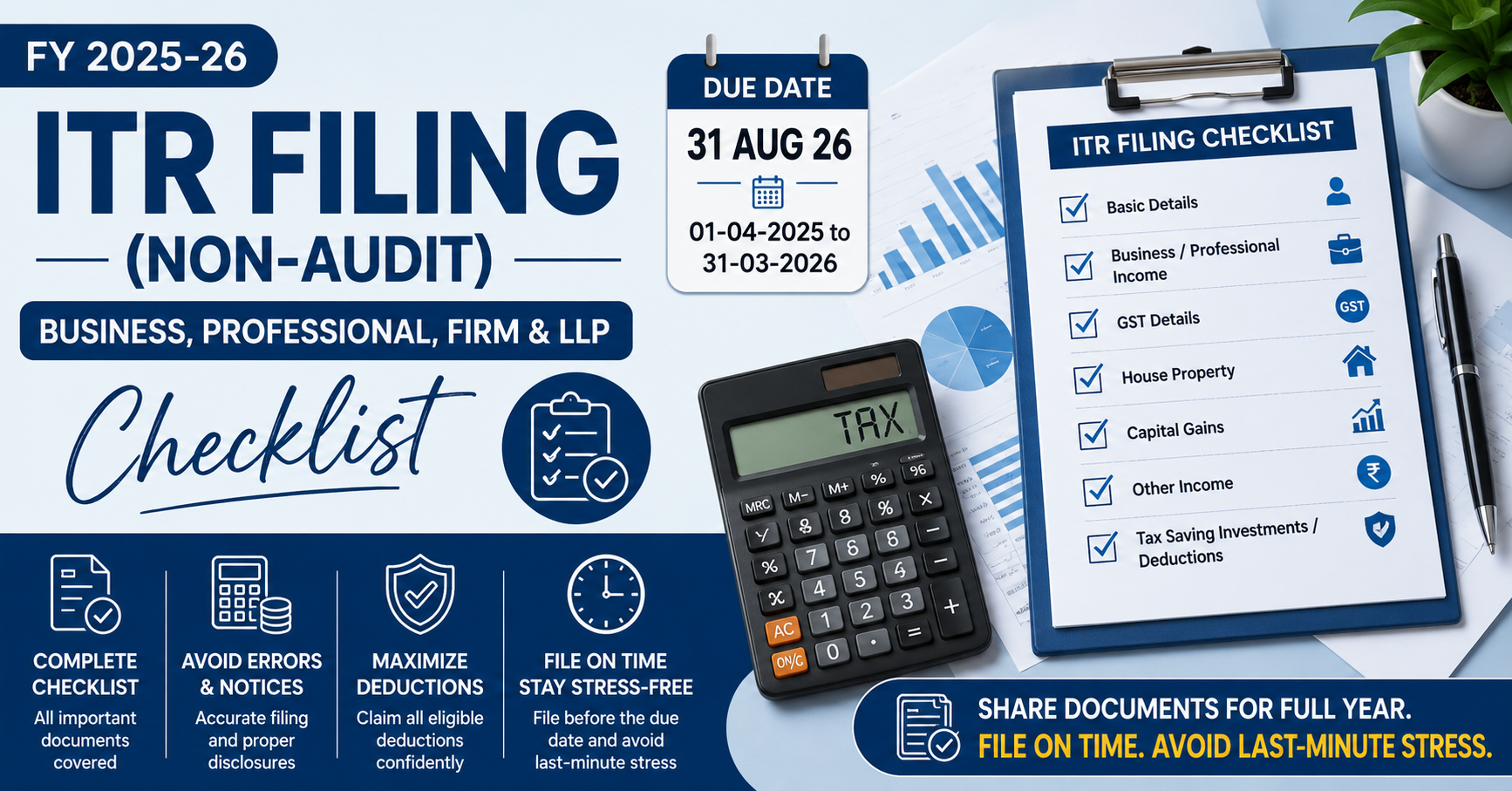
Many businesses, professionals, firms, and LLPs struggle every year while preparing documents for Income Tax Return filing. Missing bank statements, incomplete GST reconciliations, unreported capital gains, or forgotten deductions often create delays and notices during ITR filing.
If you are searching in Ghaziabad, Noida, Vaishali, Indirapuram, Vasundhra, Delhi NCR, and nearby areas for an Income tax consultant near me, GST consultant near me, or tax consultant near me for assistance with ITR filing FY 2025-26, understanding the correct document checklist can help you avoid last-minute stress.
For non-audit business and professional taxpayers, maintaining complete records for the full financial year from 01-04-2025 to 31-03-2026 is extremely important. Whether you are a sole proprietor, freelancer, consultant, partnership firm, or LLP, proper documentation ensures smooth filing, accurate tax computation, and faster compliance.
Latest Update
As per the currently applicable due-date framework, the due date for filing non-audit Income Tax Returns for FY 2025-26 (AY 2026-27) is generally 31 August 2026.
Date & Period
· Due Date: 31 August 2026
· Financial Year: 01-04-2025 to 31-03-2026
No recent official update changing the due date has been found as of today.
Practical Explanation of the Checklist
Many taxpayers think only PAN, Aadhaar, and bank statements are sufficient for filing ITR. However, business and professional taxpayers often require much deeper reconciliation.
For example:
|
Situation |
Important Documents Required |
|
GST Registered Business |
GSTR-1, GSTR-3B, sales reconciliation |
|
Freelancer / Consultant |
Bank statements, invoices, expense details |
|
Trader in Shares |
Capital gains report, holding statement |
|
Rental Income |
Rent receipts, interest certificate |
|
LLP / Firm |
Balance Sheet, P&L, partner details |
Why Bank Reconciliation is Important
Many notices are issued because receipts in bank accounts do not match turnover shown in ITR or GST returns. Proper reconciliation helps reduce mismatch risks.
Why Capital Gain Reporting Matters
Share trading, mutual fund redemption, crypto transactions, and property sales are now heavily tracked through AIS and Annual Information Statement reporting.
If capital gains are not properly disclosed, taxpayers may receive notices later.
Importance of Foreign Asset Disclosure
If a taxpayer holds foreign bank accounts, overseas investments, foreign property, or crypto assets through foreign exchanges, proper disclosure may become mandatory depending on residential status and applicable schedules.
Importance of Deduction Proofs
Many taxpayers claim deductions under sections like 80C, 80D, and 80G but fail to keep valid receipts. During assessment or scrutiny, absence of proof may result in disallowance.
If you are searching for Income tax services near me, GST services near me, or company registration services near me in Ghaziabad 201010, Noida, or Delhi NCR, maintaining a yearly digital folder of all compliance documents can significantly simplify return filing.
Step-by-Step ITR Filing Preparation Process
Step 1: Collect Identity Documents
Keep PAN, Aadhaar, mobile number, email ID, and portal login credentials ready.
Step 2: Download Full-Year Bank Statements
Collect all bank statements from 01-04-2025 to 31-03-2026.
Step 3: Finalize Business Data
If books are maintained, prepare:
· Balance Sheet
· Profit & Loss Account
· Debtors and Creditors list
· Stock details
If books are not maintained, prepare:
· Sales summary
· Expense summary
· Cash and bank reconciliation
Step 4: GST Reconciliation
Compare turnover reported in:
· Books of account
· GSTR-1
· GSTR-3B
· AIS/TIS records
Step 5: Gather Property Documents
Collect:
· Rent receipts
· Loan statements
· Interest certificate
· Property tax receipts
Step 6: Prepare Capital Gain Reports
Download reports from:
· Stock broker
· Mutual fund platform
· Crypto exchange
Step 7: Collect Deduction Proofs
Keep all receipts and certificates for:
· LIC
· PF
· ELSS
· Medical insurance
· Donations
· Education loan interest
Step 8: Verify AIS & Form 26AS
Always reconcile income with:
· AIS
· TIS
· Form 26AS
Step 9: File Before Due Date
Avoid waiting until the last week of August 2026.
If you are looking for GST consultant near me, Trade Mark consultant near me, logo registration consultant near me, or company registration consultant near me in Indirapuram 201014, Vaishali 201019, Vasundhra 201012, or nearby locations, timely compliance planning can help avoid errors and penalties.
Common Mistakes to Avoid
Ignoring Savings Bank Interest
Even small savings account interest should be reported.
Forgetting Dividend Income
Dividend income from shares and mutual funds is taxable and must be disclosed.
Wrong Capital Gain Classification
Incorrectly classifying short-term and long-term gains can create tax calculation errors.
GST and ITR Turnover Mismatch
Mismatch between GST turnover and ITR turnover is a common reason for notices.
Missing Foreign Asset Reporting
Taxpayers with foreign investments should carefully review disclosure requirements.
Delayed Filing
Late filing may lead to:
· Late fees
· Interest
· Carry-forward loss restrictions
· Compliance notices
Legal Reference
Income Tax Return Filing – Income-tax Act, 1961
Section 139 of the Income-tax Act, 1961
Income Tax Rules relating to ITR filing and disclosures.
Official Income Tax Portal:
https://www.incometax.gov.in
CBDT Official Website:
https://www.incometaxindia.gov.in
Income Tax Return Forms:
https://www.incometax.gov.in/iec/foportal/downloads/income-tax-returns
GST Portal:
https://www.gst.gov.in
LEGAL POSITION
ITR Filing FY 2025-26 (Non-Audit)
Business, Professional, Firm & LLP Checklist
Date & Period:
31 Aug 26
01-04-2025 to 31-03-2026
Additional Disclosures (If Applicable):
Shareholding / Investment in Shares
Directorship in Companies / LLP
Foreign Assets (Bank A/c, Investments, Property, etc.)
1. Basic Details (Mandatory)
PAN
Aadhaar
Income Tax Portal Password (if available)
Mobile Number & Email ID
Bank Statements / Passbook (for full period)
Loan Statements
2. Business / Professional / Firm / LLP Income
If Books Maintained:
Balance Sheet
Profit & Loss Account
If Books Not Maintained:
Sales Details (full period)
Expense Details
Bank Statements
Closing Bank Balance
Debtors, Creditors, Stock, Cash
3. GST Registered Cases
GSTR-1, GSTR-3B (for full period)
Turnover reconciliation
4. House Property
Property Address
Rent Received (during the period)
Home Loan Documents:
Loan Statement / Interest Certificate
Property Tax Receipt
Sanction letter (for sanction date)
5. Capital Gains
A. Shares / Mutual Funds / Securities
Gain/Loss Report (entry & exit wise – full period)
Annual Holding Statement
B. Immovable Property
Purchase & Sale Deed
Sale Expense Details
C. Other Assets (Gold, Jewellery, Crypto, etc.)
Purchase & Sale Details
Proof (Bills, Invoices, Wallet Statements)
6. Other Income
Savings Bank Interest
Fixed Deposit Interest
Dividend Income
Agricultural Income
Commission / Other Income
7. Tax Saving Investments / Deductions
LIC, PF, ELSS
School Fees
Home Loan Principal
Tax Saving FD
NPS, Sukanya, NTC
Medical Insurance / Expenses
Education Loan Interest
Donations (80G)
Rent Receipt (no HRA)
EV Loan Interest
Share documents for full year. File on time. Avoid last-minute stress.
The checklist provided is comprehensive and appropriate for non-audit ITR filing for businesses, professionals, firms and LLPs for FY 2025–26 (due 31 August 2026 for non‑audit cases).
Use the listed basic documents such as PAN, Aadhaar, bank statements, and loan statements for identity verification and reconciliation purposes.
For business or professional income, provide books of accounts including Balance Sheet and Profit & Loss Account where books are maintained. If books are not maintained, provide sales details, expense details, and proper bank statement reconciliation.
GST registered persons should provide GSTR-1, GSTR-3B, and turnover reconciliation.
For house property income, maintain rent details and home-loan related documents including interest certificates and property tax receipts.
For capital gains reporting, maintain complete entry and exit-wise transaction reports for shares, mutual funds, securities, immovable property, and other assets.
All other income proofs such as interest certificates, dividend statements, and deduction-related investment proofs should be maintained properly.
The usual due date for non-audit business and professional returns for FY 2025-26 is 31 August 2026. Timely filing helps avoid late fees, notices, and interest liabilities.
Frequently Asked Questions (FAQ)
1. What is the due date for non-audit ITR filing for FY 2025-26?
The general due date for non-audit business and professional taxpayers for FY 2025-26 is 31 August 2026.
2. Is GST reconciliation necessary for ITR filing?
Yes. GST turnover should match books and ITR disclosures wherever applicable.
3. Are bank statements mandatory for ITR filing?
Yes. Full-year bank statements are important for reconciliation and verification purposes.
4. Do freelancers and consultants also need expense details?
Yes. Professionals and freelancers should maintain income and expense records properly.
5. Is capital gain reporting compulsory even for small transactions?
Yes. Shares, mutual funds, crypto, and property transactions should be disclosed correctly.
6. What if books of accounts are not maintained?
Taxpayers should still provide sales details, expense summaries, and supporting bank statements.
7. Should foreign assets be disclosed?
Depending on residential status and applicable reporting requirements, disclosure may be mandatory.
8. Can late filing create penalties?
Yes. Delay may result in late fees, interest liabilities, and compliance notices.
Conclusion
Preparing documents in advance makes ITR filing easier, faster, and more accurate. Businesses, professionals, firms, and LLPs should maintain proper financial records throughout the year rather than waiting until the filing deadline.
If you are located in Ghaziabad, Noida, Delhi NCR, Vaishali, Indirapuram, or nearby areas and searching online for tax consultant near me, Income tax consultant near me, GST services near me, or company registration services near me, maintaining a structured compliance checklist can help ensure smooth filing and reduce the chances of notices.
Timely reconciliation of bank statements, GST returns, capital gains, deductions, and property income is one of the most important steps for successful ITR filing.
For expert guidance on this topic, contact your tax professional today.
Final Disclaimer
This content is for educational and knowledge purposes only. For verification and applicability to your case, please consult your tax professional.
Have Questions? We're Here to Help
Get expert advice from AMIT SIDDHI AND ASSOCIATES. Reach out to discuss your requirements.