
Avoid Tax Notices in AY 2026-27: ITR-7 Filing Guide for Trusts & NGOs
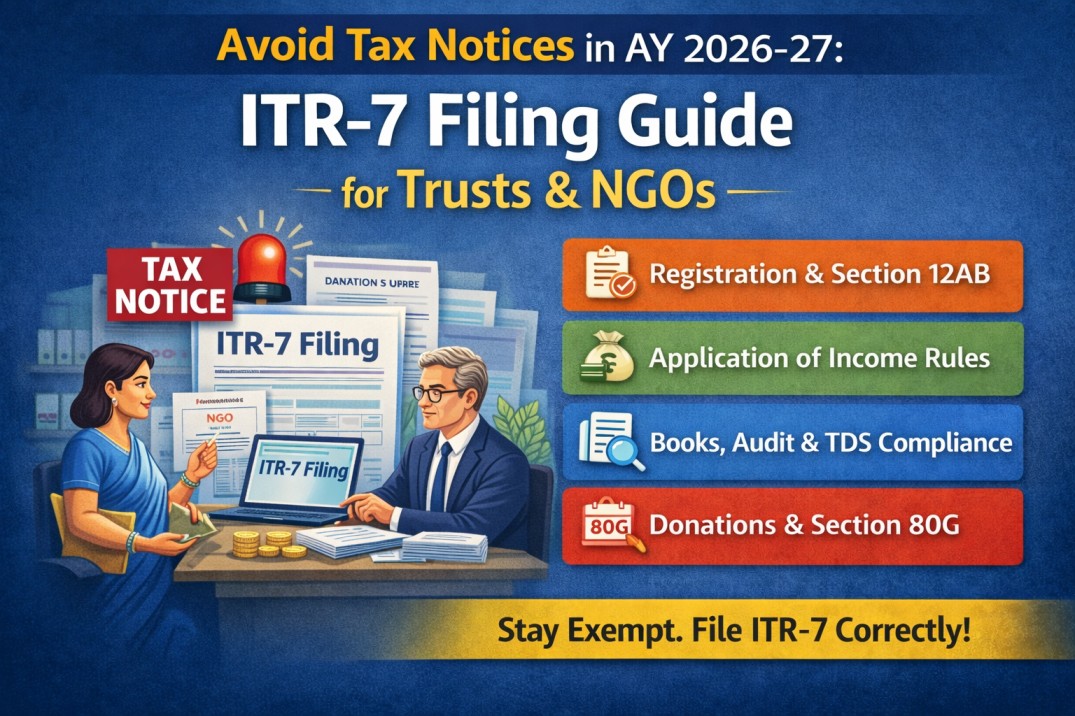
Trusts and NGOs often face tax notices due to improper exemption claims or incorrect return filing. Understanding ITR-7, registration requirements, and compliance rules is essential to maintain tax-exempt status and avoid penalties.
Who Should File ITR-7?
ITR-7 is applicable for entities claiming exemption under:
- Section 11 – Income from property held for charitable or religious purposes
- Section 12 – Income of trusts or institutions
- Section 10(23C) – Certain funds, institutions, universities, hospitals
Applicable entities include:
- Charitable Trusts
- Religious Trusts
- NGOs / Section 8 Companies
Due Dates for AY 2026-27
- Without audit: 31st July
- With audit: 30th September / 31st October
Late filing consequences:
- Loss of exemption benefits
- Penalty under Section 234F
- Interest under Sections 234A, 234B, 234C
Registration Requirement (Section 12AB)
To claim exemption:
- Trust/NGO must be registered under Section 12AB
- Registration must be valid and renewed periodically
Without registration → income becomes fully taxable.
Application of Income (Section 11)
To claim exemption:
- At least 85% of income must be applied for charitable purposes
- Remaining 15% can be accumulated
If not applied:
- Option to accumulate income using Form 10
Taxable Income for Trusts
Income becomes taxable if:
- Funds are used for non-charitable purposes
- Investment is made in prohibited modes (Section 11(5) violation)
- Benefit is provided to specified persons (Section 13)
Tax rate: Maximum Marginal Rate (MMR)
Books of Accounts & Audit
Mandatory requirements:
- Maintain books of accounts
- Keep donation records (corpus and general)
Audit (Section 12A(1)(b)) required if:
- Income exceeds basic exemption limit
Audit Report: Form 10B
Important Forms for Trust Compliance
- ITR-7 – Income tax return
- Form 10B – Audit report
- Form 10 – Accumulation of income
- Form 10BD – Statement of donations
- Form 10BE – Donation certificate
TDS & Compliance Checks
- Reconcile income with Form 26AS and AIS
- Verify donations and grants received
- Ensure proper donor records for 80G compliance
Mismatch may lead to scrutiny.
Section 80G & Donor Benefits
- Registered NGOs can provide tax deduction to donors
- Must file Form 10BD and issue Form 10BE
Non-compliance may lead to cancellation of 80G benefits.
Transition to Income-tax Act, 2025
Expected changes:
-
Section 11 → Section 335
-
Section 12AB → Section 340
-
Section 10(23C) → Section 338
Key Highlights:
- Introduction of “Tax Year”
- Simplified compliance structure
- No major change in exemption framework
Practical Example
A charitable trust earns ₹50 lakh:
- Applies ₹42.5 lakh (85%) → fully exempt
- Applies only ₹30 lakh → balance taxable unless properly accumulated
CA INSIGHT / PRACTICAL TIP
- Always track 85% application rule carefully
- Maintain clear documentation for donations and expenses
- File Form 10 and audit report on time to retain exemption
- Avoid transactions with related parties to prevent violation of Section 13
FAQ SECTION
- Is ITR-7 mandatory for NGOs?
Yes, if claiming exemption under Sections 11, 12, or 10(23C). - What happens if 85% income is not applied?
Unspent income becomes taxable unless accumulated as per rules. - Is audit compulsory for trusts?
Yes, if income exceeds exemption limit. - Can trusts claim business income exemption?
Yes, if it is incidental to charitable objectives and separate books are maintained. - What leads to cancellation of exemption?
Violation of Section 13 or non-compliance with registration conditions.
CONCLUSION
For trusts and NGOs, maintaining exemption status is the most critical aspect of tax compliance. Proper documentation, timely filing of ITR-7, and adherence to income application rules ensure smooth operations and avoid tax notices.
For expert guidance on this topic, contact your tax professional today.
Have Questions? We're Here to Help
Get expert advice from AMIT SIDDHI AND ASSOCIATES. Reach out to discuss your requirements.