
GST Appeals Deadline 30 June 2026: Important GSTAT Filing Rules Every Business Must Know
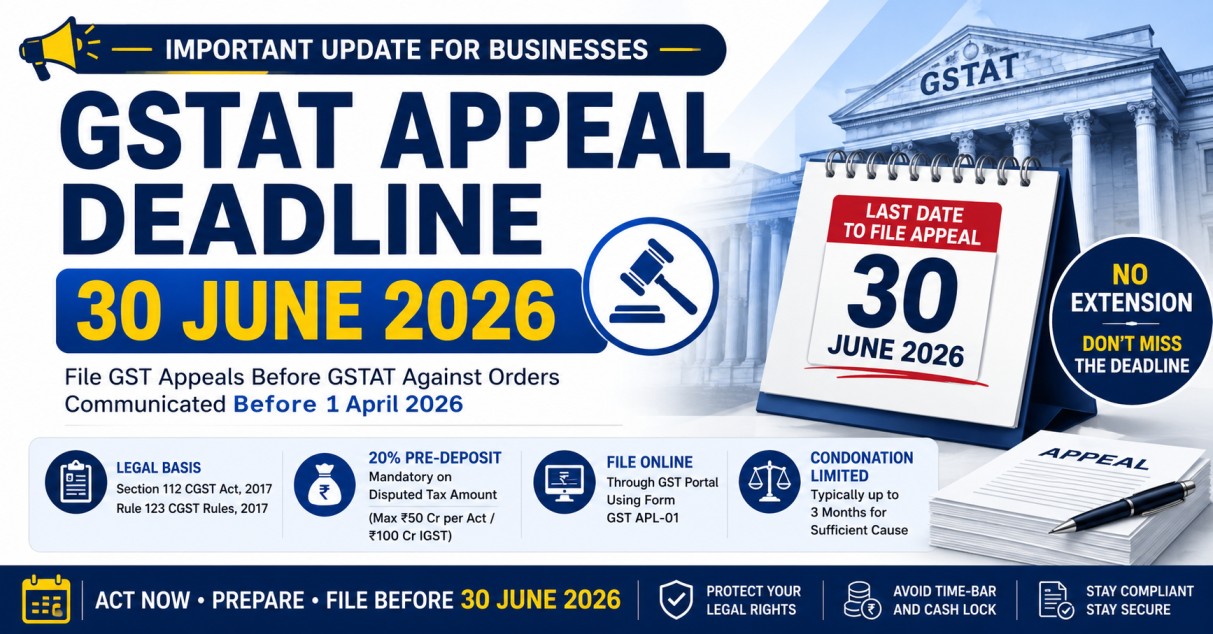
Many businesses, professionals, and startups are confused about the final deadline for filing GST appeals before the GST Appellate Tribunal (GSTAT) under the CGST Act, 2017. Missing the statutory timeline can permanently block the right to challenge GST demands, penalties, ITC disputes, valuation issues, and refund rejections.
If you are searching in Ghaziabad, Noida, Vaishali, Indirapuram, Vasundhra, Delhi NCR, and nearby areas for a GST consultant near me, tax consultant near me, or income tax consultant near me to understand GST appeal filing requirements, it is important to know that the 30 June 2026 deadline under Notification S.O. 4220(E) is now one of the most critical GST compliance timelines for pending legacy cases.
Businesses that fail to act before the prescribed deadline may permanently lose their appellate remedy before GSTAT.
Latest Update on GST Appeal Deadline
Notification No. S.O. 4220(E) dated 17 September 2025 has officially fixed 30 June 2026 as the final deadline for filing GST appeals before GSTAT in cases where orders were issued or communicated before 1 April 2026.
The notification has been issued under Section 112 of the CGST Act, 2017 and applies across India.
The GST portal and CBIC notification archives have also confirmed the operational framework for GSTAT appeal filing through electronic mode.
Practical Explanation of GSTAT Appeal Deadline
The GSTAT appeal mechanism is extremely important for businesses facing GST disputes involving:
- Input Tax Credit (ITC)
- Wrong tax demand
- Penalty notices
- Refund rejection
- Classification disputes
- Valuation disputes
- E-way bill penalties
The 30 June 2026 deadline mainly affects old pending cases where orders were already passed before 1 April 2026.
Why Businesses Are Concerned
The biggest challenge is the mandatory 20% pre-deposit requirement because it directly impacts cash flow.
For example:
|
Particulars |
Amount |
|
Admitted Tax |
₹1 Crore |
|
Disputed Tax |
₹4 Crore |
|
Mandatory 20% Deposit |
₹80 Lakh |
|
Total Immediate Outflow |
₹1.8 Crore |
This amount must generally be deposited in cash and cannot be adjusted against GST liability.
For MSMEs, exporters, traders, manufacturers, startups, and service providers, this creates major working capital pressure.
Businesses in Ghaziabad 201010, Vaishali 201019, Indirapuram 201014, Noida, and Delhi NCR are actively reviewing old GST litigation files because late filing may permanently close appeal rights.
Many taxpayers are now searching online for:
- GST services near me
- Tax consultant near me
- Income tax services near me
- GST consultant near me
to complete tribunal compliance before the deadline.
GSTAT Filing Process Step-by-Step
Step 1: Review Pending GST Orders
Identify all GST orders communicated before 1 April 2026.
Step 2: Calculate Limitation Period
Verify whether the matter falls under the special deadline of 30 June 2026.
Step 3: Compute Pre-Deposit
Calculate:
- Admitted liability
- 20% disputed tax pre-deposit
Step 4: Deposit Payment
Deposit the amount using GST payment mechanism and preserve challans.
Step 5: Prepare Appeal Documents
Compile:
- GST orders
- Grounds of appeal
- Annexures
- Supporting evidence
- Ledger extracts
Step 6: File Form GST APL-01
File electronically through GST portal under Rule 123.
Step 7: Track Appeal Status
Monitor ARN, notices, hearing dates, and GSTAT dashboard updates.
GSTAT Bench Structure
|
Case Type |
Bench |
|
Matters below ₹50 lakh |
Single Member Bench |
|
Matters above ₹50 lakh |
Division Bench |
|
National-level matters |
Principal Bench |
The GSTAT system is expected to face heavy filing pressure due to pending litigation accumulated over several years.
Common Mistakes Businesses Must Avoid
Missing the Outer Deadline
Many taxpayers assume delay condonation is unlimited. This is incorrect.
Wrong Calculation of Pre-Deposit
Incorrect deposit calculations may lead to defective filing.
Waiting Till Last Week
Portal load and document mismatch may create technical problems near deadline.
Confusing GST Forms
Form 25 is not applicable in GSTAT appeal filing.
Ignoring Professional Review
Improper drafting may weaken legal arguments before tribunal.
If you are searching for company registration consultant near me, GST consultant near me, trade mark consultant near me, logo registration consultant near me, or tax advisory services in Noida and Delhi NCR, it is advisable to review all pending GST litigation well before June 2026.
Legal Reference
Section & Rule
- Section 112 of the CGST Act, 2017
- Rule 123 of the CGST Rules, 2017
Notification
- Notification No. S.O. 4220(E) dated 17.09.2025
Official Source Links
- https://taxinformation.cbic.gov.in/view-pdf/1001166/ENG/Notifications
- https://www.gst.gov.in/newsandupdates/read/600
Legal Position
Notification S.O. 4220(E) dated 17 September 2025, published in the Official Gazette, explicitly states that in all cases where the order or decision has been issued or communicated before 01.04.2026, the last date for filing appeal before the GST Appellate Tribunal shall be 30 June 2026.
This applies to second appeals under Section 112(1) of the CGST Act, 2017. Orders issued after 1 April 2026 will follow the normal limitation period of three months from the communication date.
Rule 123 of the CGST Rules governs the electronic filing process through the GST portal.
Form GST APL-01 is required for filing GST appeals before GSTAT. Section 112(8) requires:
- Full payment of admitted tax, interest, and penalty
- Additional pre-deposit of 20% of disputed tax amount
The maximum cap is:
- ₹50 crore per Act
- ₹100 crore under IGST
The pre-deposit cannot be adjusted against output tax liability. The amount must be deposited separately in cash through the prescribed GST payment process.
Condonation of delay is possible only in limited circumstances where sufficient cause is established. Judicial precedents generally permit limited condonation periods. However, appeals filed after the outer statutory deadline may become time-barred.
The operationalization of GSTAT has also increased filing pressure because large numbers of pending legacy disputes are now moving toward tribunal adjudication.
Form 25 has no relevance in this GST appeal framework and any such reference creates confusion with unrelated provisions under other laws.
The legal position fully aligns with Section 112 of the CGST Act, Rule 123 of the CGST Rules, and Notification S.O. 4220(E) as applicable on 12 May 2026.
Frequently Asked Questions (FAQ)
1. What is the last date for GSTAT appeal filing for old GST orders?
The last date is 30 June 2026 for orders issued or communicated before 1 April 2026.
2. Which section governs GSTAT appeals?
Section 112 of the CGST Act, 2017 governs GSTAT appeals.
3. Is 20% pre-deposit mandatory?
Yes. Section 112(8) requires mandatory pre-deposit along with admitted dues.
4. Can GST pre-deposit be adjusted against output tax liability?
No. Separate payment is required.
5. Which form is used for GSTAT appeal filing?
Form GST APL-01 is used for appeal filing.
6. Can delay be condoned after 30 June 2026?
Limited condonation may be possible in certain cases, but appeals beyond the outer statutory limit may become time-barred.
7. Does Form 25 apply in GST appeals?
No. Form 25 is unrelated to GSTAT appeals.
Conclusion
The GSTAT deadline of 30 June 2026 is one of the most significant compliance cut-offs for pending GST disputes in India. Businesses with legacy GST litigation should immediately review pending appellate matters, calculate pre-deposit liabilities, and prepare documentation for filing.
Taxpayers delaying action may permanently lose their right to challenge GST demands before the tribunal.
Businesses in Ghaziabad, Noida, Vaishali, Vasundhra, Indirapuram, Delhi NCR, and nearby areas should proactively review all pending GST matters with professional assistance to avoid procedural lapses.
For expert guidance on this topic, contact your tax professional today.
Disclaimer
This content is for educational and knowledge purposes only. For verification and applicability to your case, please consult your tax professional.
Have Questions? We're Here to Help
Get expert advice from AMIT SIDDHI AND ASSOCIATES. Reach out to discuss your requirements.