
GST Demand Quashed for Ignoring Reply – What Taxpayers Must Know
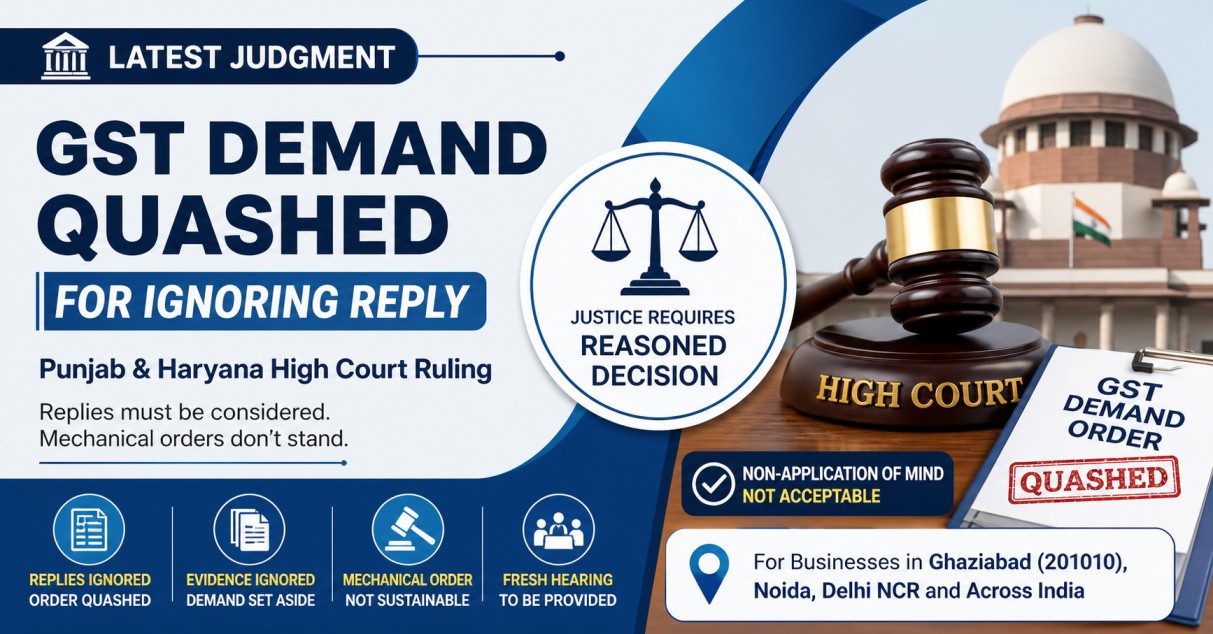
GST demand notices are increasing, and many taxpayers search for clarity on whether authorities must consider their replies. This issue became critical in a recent High Court case where a GST demand was quashed due to non-consideration of the taxpayer’s response.
If you are a business owner in Ghaziabad, Noida, or Delhi NCR dealing with GST notices, understanding this ruling can protect you from unfair tax demands and help you respond effectively.
✅ Latest Update
Based on the available case record and references to CBIC circulars dated 26 June 2024 and 12 September 2025, the High Court emphasized proper adjudication standards under GST law.
No recent official update found as of today beyond this ruling context.
⚖️ Legal Reference
Section: Section 73 of the CGST/PGST Act, 2017
Rule: Not clearly specified in the available case extract; the dispute centered on ITC reversal and adjudication fairness rather than a standalone rule ruling.
Notification/Circular: CBIC circulars dated 26 June 2024 and 12 September 2025
Official Source Links:
https://www.casemine.com/judgement/in/69e52ff40611f82f24402f01
Backup references:
https://taxguru.in/goods-and-service-tax/gst-order-quashed-due-non-application-mind-ignoring-replies-ph-hc.html
https://www.gstpress.com/caselaw/cm3wlvdwy0423fttberb92lq7?from_page=2
🔎 Legal Position
The Punjab & Haryana High Court in Bagga Vet Pharma v. State of Punjab dealt with a GST dispute concerning alleged short reversal of input tax credit on common inputs said to have been used for both taxable and exempt supplies. The department had issued a notice and later confirmed a demand under Section 73 of the CGST/PGST Act, 2017.
The taxpayer’s core defence was that ITC had been availed only in relation to taxable supplies and not for exempt goods, and that the department had ignored the supporting ledgers and reconciliation placed on record. The petitioner also relied on CBIC circulars dated 26 June 2024 and 12 September 2025 to strengthen its submission that the reversal demand was not justified on the facts.
The High Court found that the impugned order did not deal with these replies in a meaningful way. The Court noted that the authority had acted mechanically and had not given proper reasons for rejecting the taxpayer’s case.
This is important because GST adjudication is not supposed to be a one-line confirmation of a demand; it must reflect consideration of the taxpayer’s explanation, documents, and legal arguments. When an order fails this basic standard, it can be struck down for non-application of mind and violation of natural justice.
In practical terms, the decision does not mean that ITC reversal disputes can never be raised by the department. It means that if the department wants to sustain such a demand, it must examine the factual distinction between taxable and exempt supplies, address the taxpayer’s evidence, and give clear reasons.
The Court’s remedy was also limited and balanced. It quashed the order and remitted the matter for fresh consideration after granting a fair hearing, rather than issuing a final ruling on the tax liability itself.
For GST taxpayers, the case reinforces a familiar but powerful principle: reasoned adjudication matters as much as the substantive tax issue. A demand based on assumptions or a cursory rejection of replies is vulnerable in writ proceedings, especially where the order shows no genuine evaluation of the material filed by the taxpayer.
📊 Practical Explanation (Simple Understanding)
What Went Wrong in This Case?
The GST officer:
- Issued a notice for ITC reversal
- Received reply with documents
- Ignored the reply
- Passed a demand order without reasoning
What the Court Said
The Court clearly stated:
✔ Authorities must apply their mind
✔ Replies must be properly examined
✔ Orders must contain clear reasoning
📌 Real-Life Example
| Scenario | Wrong Approach | Correct Approach |
|---|---|---|
| ITC on mixed supplies | Demand raised without checking records | Verify books, ledgers, reconciliation |
| Taxpayer reply | Ignored | Must be evaluated |
| Order | One-line confirmation | Detailed reasoning required |
Why This Matters for You
If you receive a GST notice and your reply is ignored, you have legal grounds to challenge the order.
For businesses in Ghaziabad (201010), Noida, or Delhi NCR, this is especially relevant due to increasing GST scrutiny.
🧾 Step-by-Step Compliance Process
Step 1: Carefully Read the GST Notice
Understand:
- Section (e.g., Section 73)
- Reason for demand
- Time limit to respond
Step 2: Prepare Proper Reply
Include:
- Detailed explanation
- Ledger copies
- Reconciliation statements
- Supporting documents
Step 3: Submit Reply on Portal
Always:
✔ Upload documents
✔ Keep acknowledgement
Step 4: Attend Personal Hearing
If offered, never skip it.
Step 5: Review Order Carefully
Check:
- Whether your reply is discussed
- Whether reasoning is provided
Step 6: Take Action if Order is Defective
If reply ignored:
✔ File appeal
✔ Consider writ petition
❓ Frequently Asked Questions (FAQ)
1. Can GST demand be quashed if reply is ignored?
Yes, courts have clearly held that ignoring replies violates natural justice.
2. What is Section 73 under GST?
It deals with demand for tax not paid or short paid without fraud or intention to evade tax.
3. Is ITC reversal mandatory for exempt supplies?
Yes, but only after proper calculation and verification of facts.
4. What if the GST officer passes a mechanical order?
You can challenge it in appeal or High Court.
5. Do I need professional help for GST notices?
Yes. Searching for a GST consultant near me or income tax consultant near me can help avoid costly mistakes.
📍 Local Relevance (Ghaziabad & NCR Businesses)
If you operate in:
- Ghaziabad (201010)
- Vaishali (201019)
- Indirapuram (201014)
- Vasundhra (201012)
- Noida or Delhi NCR
You may already be facing GST scrutiny or notices.
Many businesses search for:
- GST services near me
- Income tax services near me
- Company registration services near me
This case shows why expert handling is critical.
🏁 Conclusion
This High Court ruling sends a strong message: GST authorities cannot ignore taxpayer replies and pass mechanical orders.
For taxpayers, the takeaway is clear:
✔ Always file detailed replies
✔ Maintain documentation
✔ Challenge unfair orders
Proper compliance and timely action can save you from unnecessary tax liability and litigation.
For expert guidance on this topic, contact your tax professional today.
⚠️ Disclaimer
This content is for educational and knowledge purposes only. For verification and applicability to your case, please consult your tax professional.
Have Questions? We're Here to Help
Get expert advice from AMIT SIDDHI AND ASSOCIATES. Reach out to discuss your requirements.